



Construct a Rhombus \[ABCD\], given its diagonal $AC = 6.3$ cm and diagonal $BD = 5.5$ cm
Answer
 Verified
594k+ views
Hint: The general idea is to first draw a straight line $AC = 6.3$cm with a compass, which will be our reference line. We will use the fact that the two diagonals of a Rhombus intersect each other at right angles also they bisect each other. Then by using a compass and ruler we will draw a perpendicular bisector of line segment \[AC\].
We can measure half of the distance of $5.5$ and mark it and then the required rhombus can be drawn.
Complete step-by-step answer:
Draw a line segment \[AC\] of length $6.3$ cm which will be our line of reference.

Using a compass we will draw a perpendicular bisector of \[AC\]:
First use the compass for marking the arc intersection drawn from points \[A\] and \[B\].
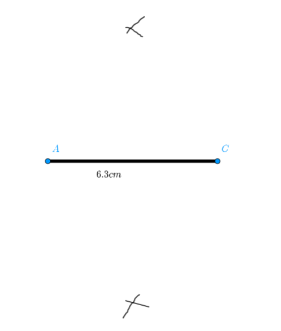
Now draw the perpendicular bisector of the line segment\[AC\].
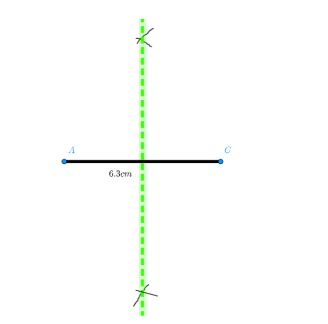
Mark the point of intersection of the perpendicular bisector as $E$.
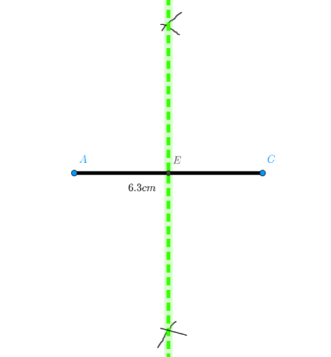
Using a ruler we will mark points $B$ and $D$ which are from a distance of $\dfrac{{5.5}}{2} = 2.75$cm from $E$ along the green dotted line (perpendicular bisector of the line segment \[AC\]) .
The above fact is used because $BD$ is a diagonal of the rhombus and the diagonals of a rhombus bisect each other.
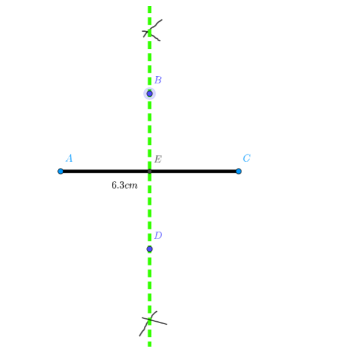
Now after this construction we can join the marked points.
Now join the lines $AB,AD,DC,CB$.
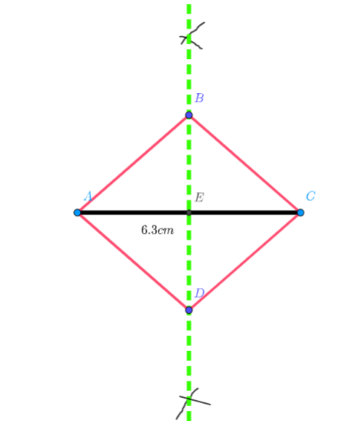
This is the required rhombus.
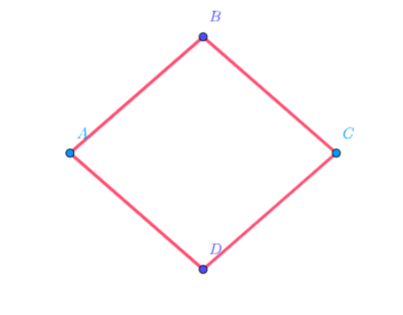
Note: Make the proper use of ruler and compass. A very small measurement may not hamper the whole construction but it may make the solution look ugly. We have used the line segment \[AC\] to draw the rhombus while the same can be drawn using $BD$ with the same process.
We can measure half of the distance of $5.5$ and mark it and then the required rhombus can be drawn.
Complete step-by-step answer:
Draw a line segment \[AC\] of length $6.3$ cm which will be our line of reference.
Using a compass we will draw a perpendicular bisector of \[AC\]:
First use the compass for marking the arc intersection drawn from points \[A\] and \[B\].
Now draw the perpendicular bisector of the line segment\[AC\].
Mark the point of intersection of the perpendicular bisector as $E$.
Using a ruler we will mark points $B$ and $D$ which are from a distance of $\dfrac{{5.5}}{2} = 2.75$cm from $E$ along the green dotted line (perpendicular bisector of the line segment \[AC\]) .
The above fact is used because $BD$ is a diagonal of the rhombus and the diagonals of a rhombus bisect each other.
Now after this construction we can join the marked points.
Now join the lines $AB,AD,DC,CB$.
This is the required rhombus.
Note: Make the proper use of ruler and compass. A very small measurement may not hamper the whole construction but it may make the solution look ugly. We have used the line segment \[AC\] to draw the rhombus while the same can be drawn using $BD$ with the same process.
Recently Updated Pages
Three beakers labelled as A B and C each containing 25 mL of water were taken A small amount of NaOH anhydrous CuSO4 and NaCl were added to the beakers A B and C respectively It was observed that there was an increase in the temperature of the solutions contained in beakers A and B whereas in case of beaker C the temperature of the solution falls Which one of the following statements isarecorrect i In beakers A and B exothermic process has occurred ii In beakers A and B endothermic process has occurred iii In beaker C exothermic process has occurred iv In beaker C endothermic process has occurred

Master Class 9 Social Science: Engaging Questions & Answers for Success
Master Class 9 Science: Engaging Questions & Answers for Success
Master Class 9 Maths: Engaging Questions & Answers for Success
Master Class 9 General Knowledge: Engaging Questions & Answers for Success
Class 9 Question and Answer - Your Ultimate Solutions Guide
Three beakers labelled as A B and C each containing 25 mL of water were taken A small amount of NaOH anhydrous CuSO4 and NaCl were added to the beakers A B and C respectively It was observed that there was an increase in the temperature of the solutions contained in beakers A and B whereas in case of beaker C the temperature of the solution falls Which one of the following statements isarecorrect i In beakers A and B exothermic process has occurred ii In beakers A and B endothermic process has occurred iii In beaker C exothermic process has occurred iv In beaker C endothermic process has occurred
Master Class 9 Social Science: Engaging Questions & Answers for Success
Master Class 9 Science: Engaging Questions & Answers for Success
Trending doubts
Find the sum of series 1 + 2 + 3 + 4 + 5 + + 100 class 9 maths CBSE
What is the Full Form of ISI and RAW
Fill the blanks with the suitable prepositions 1 The class 9 english CBSE
Difference Between Plant Cell and Animal Cell
What is pollution? How many types of pollution? Define it
Which are the Top 10 Largest States of India?