



Construct a quadrilateral \[ABCD\] with \[AB = 4.5\,cm,BC = 5.5\,cm,CD = 4\,cm,AD = 6\,cm\] and\[AC = 7\,cm\].
Answer
 Verified
487.5k+ views
Hint: Firstly we will draw a rough sketch according to the dimensions given in the statement. After drawing the rough sketch we will now construct the quadrilateral using scale, pencil and a compass with the dimensions given in the question.
Complete step by step answer:
A quadrilateral is a polygon which has \[4\] vertices and \[4\]sides enclosing \[4\]angles. The sum of its interior angles is \[{360^ \circ }\]. A quadrilateral, in general, has sides of different lengths and angles of different measures. However, squares, rectangles, etc. are special types of quadrilaterals with some of their sides and angles being equal.First draw a rough sketch.
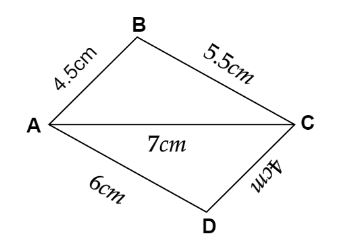
Steps of construction:
(1) Draw diagonal AC of length\[7\,cm\].
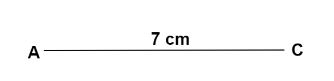
(2) Taking \[4.5\,cm\] as radius, and A as center, draw an arc on top of AC.

(3) Taking \[5.5\,cm\] as radius, and C as center, draw an arc on top of AC.
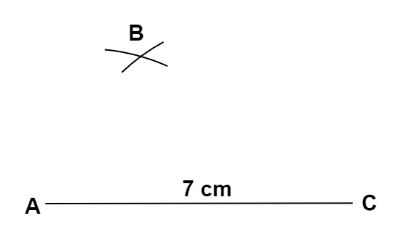
(4) Taking \[6\,cm\] as radius, and A as center, draw an arc on bottom of AC.
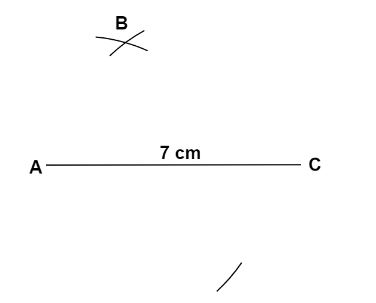
(5) Taking \[4\,cm\] as radius, and A as center, draw an arc on the bottom of AC.
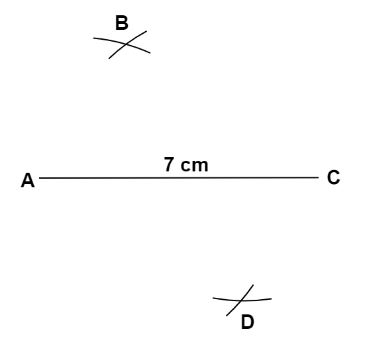
(6) Join AB, BC, AD, and CD and label them.

Therefore ABCD is the required quadrilateral.
Note: Whenever you get questions related to construction of a figure, always make a rough sketch with the given information. Once you are done with making the rough sketch start constructing the diagram using scale, pencil and a compass with the dimensions given in the question.
Complete step by step answer:
A quadrilateral is a polygon which has \[4\] vertices and \[4\]sides enclosing \[4\]angles. The sum of its interior angles is \[{360^ \circ }\]. A quadrilateral, in general, has sides of different lengths and angles of different measures. However, squares, rectangles, etc. are special types of quadrilaterals with some of their sides and angles being equal.First draw a rough sketch.
Steps of construction:
(1) Draw diagonal AC of length\[7\,cm\].
(2) Taking \[4.5\,cm\] as radius, and A as center, draw an arc on top of AC.
(3) Taking \[5.5\,cm\] as radius, and C as center, draw an arc on top of AC.
(4) Taking \[6\,cm\] as radius, and A as center, draw an arc on bottom of AC.
(5) Taking \[4\,cm\] as radius, and A as center, draw an arc on the bottom of AC.
(6) Join AB, BC, AD, and CD and label them.
Therefore ABCD is the required quadrilateral.
Note: Whenever you get questions related to construction of a figure, always make a rough sketch with the given information. Once you are done with making the rough sketch start constructing the diagram using scale, pencil and a compass with the dimensions given in the question.
Recently Updated Pages
Master Class 8 Social Science: Engaging Questions & Answers for Success

Master Class 8 English: Engaging Questions & Answers for Success
Class 8 Question and Answer - Your Ultimate Solutions Guide
Master Class 8 Maths: Engaging Questions & Answers for Success
Master Class 8 Science: Engaging Questions & Answers for Success
Master Class 9 General Knowledge: Engaging Questions & Answers for Success
Trending doubts
What is BLO What is the full form of BLO class 8 social science CBSE
Citizens of India can vote at the age of A 18 years class 8 social science CBSE
Full form of STD, ISD and PCO
Advantages and disadvantages of science
Right to vote is a AFundamental Right BFundamental class 8 social science CBSE
What are the 12 elements of nature class 8 chemistry CBSE