




Construct a parallelogram ABCD, when diagonal AC=6.4 cm, diagonal BD=8.2 cm and the angle between the diagonal is equal to ${60^0}$. What is the value of the perimeter of the parallelogram ABCD (in cm)? (Round off your answer to the nearest integer)
Answer
 Verified
620.4k+ views
Hint: Here, we will proceed by drawing the diagonals AC of length 6.4 cm and BD of length 8.2 cm with the help of scale, compass and protractor. Then, we will join the points A, B, C and D in order to get the parallelogram ABCD.
Complete step-by-step answer:
The various steps of construction required to draw parallelogram ABCD are mentioned below:
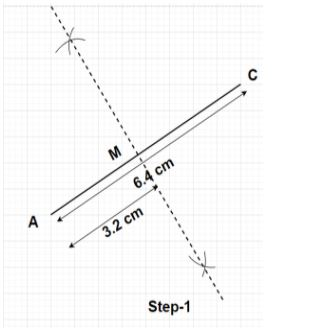
Step1- Draw a line segment of length 6.4 cm with the help of a scale. Name the end points of this line segment as A and C respectively. This line segment AC is the diagonal of the parallelogram. Now, using compass bisect the line segment AC in order to get the midpoint of this line segment AC. Mark this midpoint of line segment AC as point M where AM=MC=$\dfrac{{{\text{AC}}}}{2} = \dfrac{{{\text{6}}{\text{.4}}}}{2} = 3.2$ cm.
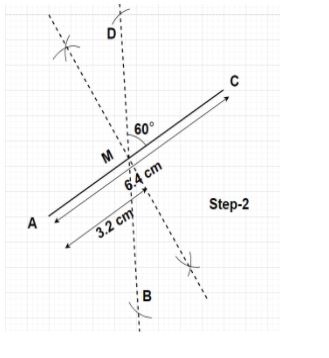
Step2- Since, the angle between the diagonals AC and BD of the parallelogram ABCD is equal to ${60^0}$. Using the protractor, from point M draw a dotted line segment inclined at ${60^0}$ with the diagonal AC. According to the property of the parallelogram, the diagonals of the parallelogram bisect each other (i.e., the diagonals of the parallelogram intersect at the midpoint). So, midpoint M of the diagonal AC is also the midpoint of the diagonal BD. Hence, BM=MD=$\dfrac{{{\text{BD}}}}{2} = \dfrac{{{\text{8}}{\text{.2}}}}{2} = 4.1$ cm. Now make two arcs on the dotted line segment which is inclined to the diagonal AC at ${60^0}$ from point M on the both sides each of length 4.1 cm. Name these points as B and D as shown in the figure.
Step3- Now, join points A and B together, B and C together, C and D together, D and A together through a straight line using a scale. This ABCD is the required parallelogram with AC of length 6.4 cm and BD of length 8.2 cm as the diagonals. Here, the side AB is parallel to side CD and the side BC is parallel to the side AD.
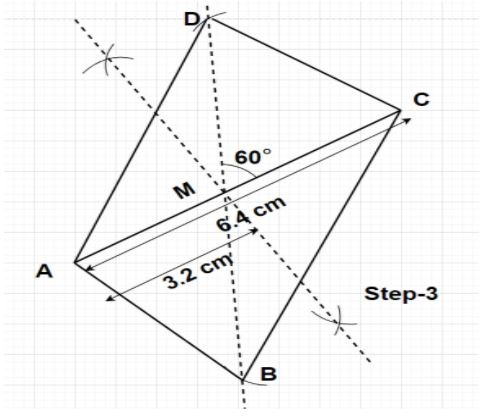
Now, if we will measure the length of the sides of this parallelogram ABCD using scale, we will find that AB=CD=3.7 cm and BC=AD=6.3 cm.
The perimeter of the constructed parallelogram is calculated by adding the length of all the sides i.e., Perimeter of parallelogram ABCD = AB+BC+CD+AD = 3.7+6.3+3.7+6.3 = 20 cm.
Therefore, the perimeter of the parallelogram ABCD is equal to 20 cm.
Note: In this particular problem, we have obtained the midpoint M of the diagonal AC by opening the ends of the compass more than half of the length of diagonal AC (i.e., the distance between the ends of the compass is more than 3.2 cm) and then by placing the fixed end at point A and then at point B respectively, these arcs will intersect at two distinct points. Join these points by a dotted line and this dotted line intersects the diagonal AC at the midpoint of AC i.e., point M.
Complete step-by-step answer:
The various steps of construction required to draw parallelogram ABCD are mentioned below:
Step1- Draw a line segment of length 6.4 cm with the help of a scale. Name the end points of this line segment as A and C respectively. This line segment AC is the diagonal of the parallelogram. Now, using compass bisect the line segment AC in order to get the midpoint of this line segment AC. Mark this midpoint of line segment AC as point M where AM=MC=$\dfrac{{{\text{AC}}}}{2} = \dfrac{{{\text{6}}{\text{.4}}}}{2} = 3.2$ cm.
Step2- Since, the angle between the diagonals AC and BD of the parallelogram ABCD is equal to ${60^0}$. Using the protractor, from point M draw a dotted line segment inclined at ${60^0}$ with the diagonal AC. According to the property of the parallelogram, the diagonals of the parallelogram bisect each other (i.e., the diagonals of the parallelogram intersect at the midpoint). So, midpoint M of the diagonal AC is also the midpoint of the diagonal BD. Hence, BM=MD=$\dfrac{{{\text{BD}}}}{2} = \dfrac{{{\text{8}}{\text{.2}}}}{2} = 4.1$ cm. Now make two arcs on the dotted line segment which is inclined to the diagonal AC at ${60^0}$ from point M on the both sides each of length 4.1 cm. Name these points as B and D as shown in the figure.
Step3- Now, join points A and B together, B and C together, C and D together, D and A together through a straight line using a scale. This ABCD is the required parallelogram with AC of length 6.4 cm and BD of length 8.2 cm as the diagonals. Here, the side AB is parallel to side CD and the side BC is parallel to the side AD.
Now, if we will measure the length of the sides of this parallelogram ABCD using scale, we will find that AB=CD=3.7 cm and BC=AD=6.3 cm.
The perimeter of the constructed parallelogram is calculated by adding the length of all the sides i.e., Perimeter of parallelogram ABCD = AB+BC+CD+AD = 3.7+6.3+3.7+6.3 = 20 cm.
Therefore, the perimeter of the parallelogram ABCD is equal to 20 cm.
Note: In this particular problem, we have obtained the midpoint M of the diagonal AC by opening the ends of the compass more than half of the length of diagonal AC (i.e., the distance between the ends of the compass is more than 3.2 cm) and then by placing the fixed end at point A and then at point B respectively, these arcs will intersect at two distinct points. Join these points by a dotted line and this dotted line intersects the diagonal AC at the midpoint of AC i.e., point M.
Recently Updated Pages
Master Class 12 Business Studies: Engaging Questions & Answers for Success

Master Class 12 Biology: Engaging Questions & Answers for Success
Master Class 12 Chemistry: Engaging Questions & Answers for Success
Class 12 Question and Answer - Your Ultimate Solutions Guide
Master Class 11 Social Science: Engaging Questions & Answers for Success
Master Class 11 English: Engaging Questions & Answers for Success
Trending doubts
Explain the Treaty of Vienna of 1815 class 10 social science CBSE
Which Indian city is known as the "City of Victory"?
Which instrument is used to measure the Blood Pressure?
Who Won 36 Oscar Awards? Record Holder Revealed
What is the median of the first 10 natural numbers class 10 maths CBSE
Why is it 530 pm in india when it is 1200 afternoon class 10 social science CBSE