




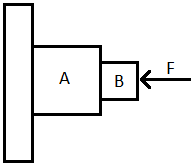
Consider the situation shown in figure. The wall is smooth but the surface of A and B in contact are rough. The friction on B due to A in equilibrium-
(a) is upward
(b) is downward
(c) is zero
(d) the system can't remain in equilibrium
A. Only a
B. Only b
C. Only d
D. c and d both
Answer
 Verified
581.1k+ views
Hint: we are given two blocks attached together which is attached to a wall. By drawing the free body diagram of the given situation we can easily find all the forces acting on the bodies and their direction. From the figure we can find the friction acting on ‘B’ due to ‘A’. thus we will get the solution.
Complete answer:
In the question we are given two blocks A and B who are attached together.
To solve the question, let us draw the free body diagram of the given case.

From the figure we can see the different forces acting on both the blocks.
The weight of the two bodies A and B, ‘\[{{m}_{A}}g\]’ and ‘${{m}_{B}}g$’ respectively will be vertically downwards.
The normal force acting on ‘B’ by ‘A’ and on ‘A’ by ‘B’ will be equal and opposite, and is represented as N.
The force acting on the block ‘A’ due the wall will also be ‘N’.
The frictional force exerted by ‘A’ on ‘B’, ${{f}_{AB}}$ will be the same as the frictional force exerted by ‘B’ on ‘A’, ‘${{f}_{BA}}$’.
We are asked about the frictional force on B due to A.
From the figure we can see that,
${{f}_{AB}}=\mu N+mg$, were ‘$\mu $’ is the coefficient of friction between the two surfaces.
Since the frictional force is not equal to zero, we know that the system will not remain in equilibrium.
So, the correct answer is “Option C”.
Note:
Here it is given that the wall is smooth and the surfaces between the blocks are rough. Since the surface of the wall is smooth, we know that there is no friction acting. Hence due to the gravitational force both the blocks will fall downward with acceleration due to gravity.
Complete answer:
In the question we are given two blocks A and B who are attached together.
To solve the question, let us draw the free body diagram of the given case.
From the figure we can see the different forces acting on both the blocks.
The weight of the two bodies A and B, ‘\[{{m}_{A}}g\]’ and ‘${{m}_{B}}g$’ respectively will be vertically downwards.
The normal force acting on ‘B’ by ‘A’ and on ‘A’ by ‘B’ will be equal and opposite, and is represented as N.
The force acting on the block ‘A’ due the wall will also be ‘N’.
The frictional force exerted by ‘A’ on ‘B’, ${{f}_{AB}}$ will be the same as the frictional force exerted by ‘B’ on ‘A’, ‘${{f}_{BA}}$’.
We are asked about the frictional force on B due to A.
From the figure we can see that,
${{f}_{AB}}=\mu N+mg$, were ‘$\mu $’ is the coefficient of friction between the two surfaces.
Since the frictional force is not equal to zero, we know that the system will not remain in equilibrium.
So, the correct answer is “Option C”.
Note:
Here it is given that the wall is smooth and the surfaces between the blocks are rough. Since the surface of the wall is smooth, we know that there is no friction acting. Hence due to the gravitational force both the blocks will fall downward with acceleration due to gravity.
Recently Updated Pages
Master Class 11 Computer Science: Engaging Questions & Answers for Success

Master Class 11 Business Studies: Engaging Questions & Answers for Success
Master Class 11 Economics: Engaging Questions & Answers for Success
Master Class 11 English: Engaging Questions & Answers for Success
Master Class 11 Maths: Engaging Questions & Answers for Success
Master Class 11 Biology: Engaging Questions & Answers for Success
Trending doubts
One Metric ton is equal to kg A 10000 B 1000 C 100 class 11 physics CBSE
There are 720 permutations of the digits 1 2 3 4 5 class 11 maths CBSE
Discuss the various forms of bacteria class 11 biology CBSE
Draw a diagram of a plant cell and label at least eight class 11 biology CBSE
State the laws of reflection of light
10 examples of friction in our daily life