




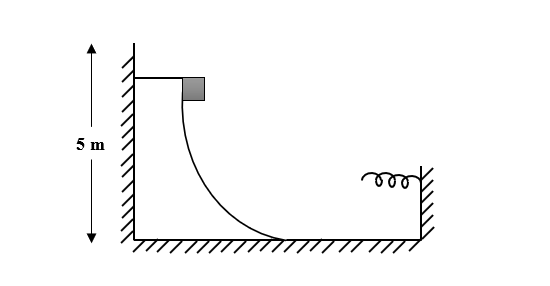
Consider the situation shown in figure. A spring of spring constant 400N/m is attached at one end to a wedge fixed rigidly with the horizontal part. A 40 g mass is released from rest while situated at a height 5 m the curved track. The maximum deformation in the spring is nearly equal to?
A. 9.8 m
B. 9.8 cm
C. 0.98 cm
D. 0.009 km
Answer
 Verified
644.1k+ views
Hint: Loss in gravitational potential energy is equal to the gain in the elastic potential. So, at maximum deformation, all the gravitational potential energy would get converted to elastic energy. Use the formula for gravitational potential energy, substitute the values and find the gravitational potential energy. Then, use the formula for elastic potential energy, substitute the values and find its value. Then equate the value of gravitational potential energy to elastic potential energy. Solve it and calculate the value of x. This value will be the maximum deformation in the spring.
Complete step by step answer:
Given: height (h)= 5 m
Mass (m)= 40 g= 0.04 kg
g= 9.8 m/s
Spring constant (k)= 400 N/m
The loss in gravitational potential energy is equal to the gain in elastic potential energy. This implies that at the maximum deformation, all the gravitational potential energy gets converted to elastic potential energy.
$\Rightarrow {E}_{gravitational}= {E}_{elastic}$ …(1)
Gravitational potential energy is given by,
${E}_{gravitational}= mgh$ …(2)
Where, m is the mass in kg
g is the gravitational field strength in ${N}/{kg}$
h is the height in meters
Substituting values in the equation. (2) we get,
${E}_{gravitational}= 0.04 \times 9.8 \times 5$
$\Rightarrow {E}_{gravitational}= 1.96 J$
Elastic potential energy is given by,
${E}_{elastic}= \dfrac {1}{2}k{x}^{2}$ …(3)
Where, k is the spring constant in ${N}/{m}$
x is the displacement in meters
Substituting values in the equation. (3) we get,
${E}_{elastic}= \dfrac {1}{2} \times 400{x}^{2}$
$\Rightarrow {E}_{elastic}= 200{x}^{2}$
Now, substituting values in the equation. (1) we get,
$1.96= 200{x}^{2}$
$\Rightarrow {x}^{2}= \dfrac {1.96}{200}$
$\Rightarrow {x}^{2}= 0.0098$
Taking out the square root on both the sides we get,
$x= 0.099 m$
$\therefore x= 9.9cm$
Thus, the maximum deformation in the spring is nearly equal to 9.8 cm.
So, the correct answer is “Option B”.
Note:
Students must make sure that they convert all the units to their S.I. units. Not converting the units to their S.I. units will give them a wrong output altogether. Gravitational potential energy is directly proportional to the height of the object. Doubling the height will result in doubling of the gravitational potential energy and tripling the height of the object will result in tripling of the gravitational potential energy.
Complete step by step answer:
Given: height (h)= 5 m
Mass (m)= 40 g= 0.04 kg
g= 9.8 m/s
Spring constant (k)= 400 N/m
The loss in gravitational potential energy is equal to the gain in elastic potential energy. This implies that at the maximum deformation, all the gravitational potential energy gets converted to elastic potential energy.
$\Rightarrow {E}_{gravitational}= {E}_{elastic}$ …(1)
Gravitational potential energy is given by,
${E}_{gravitational}= mgh$ …(2)
Where, m is the mass in kg
g is the gravitational field strength in ${N}/{kg}$
h is the height in meters
Substituting values in the equation. (2) we get,
${E}_{gravitational}= 0.04 \times 9.8 \times 5$
$\Rightarrow {E}_{gravitational}= 1.96 J$
Elastic potential energy is given by,
${E}_{elastic}= \dfrac {1}{2}k{x}^{2}$ …(3)
Where, k is the spring constant in ${N}/{m}$
x is the displacement in meters
Substituting values in the equation. (3) we get,
${E}_{elastic}= \dfrac {1}{2} \times 400{x}^{2}$
$\Rightarrow {E}_{elastic}= 200{x}^{2}$
Now, substituting values in the equation. (1) we get,
$1.96= 200{x}^{2}$
$\Rightarrow {x}^{2}= \dfrac {1.96}{200}$
$\Rightarrow {x}^{2}= 0.0098$
Taking out the square root on both the sides we get,
$x= 0.099 m$
$\therefore x= 9.9cm$
Thus, the maximum deformation in the spring is nearly equal to 9.8 cm.
So, the correct answer is “Option B”.
Note:
Students must make sure that they convert all the units to their S.I. units. Not converting the units to their S.I. units will give them a wrong output altogether. Gravitational potential energy is directly proportional to the height of the object. Doubling the height will result in doubling of the gravitational potential energy and tripling the height of the object will result in tripling of the gravitational potential energy.
Recently Updated Pages
If x a + bt + ct2 where x is in meters and t is in class 11 physics CBSE

A car covers the first half distance between two places class 11 physics CBSE
The resultant of two vectors overrightarrow P and overrightarrow class 11 physics CBSE
Find the value of cos 135 class 11 maths CBSE
A mass M is held in place by an applied force F and class 11 physics CBSE
A solution of glucose in water is labelled as 10 dfracwv class 11 chemistry CBSE
Trending doubts
One Metric ton is equal to kg A 10000 B 1000 C 100 class 11 physics CBSE
Find the value of the expression given below sin 30circ class 11 maths CBSE
Draw a diagram of nephron and explain its structur class 11 biology CBSE
10 examples of friction in our daily life
Proton was discovered by A Thomson B Rutherford C Chadwick class 11 chemistry CBSE
Bond order ofO2 O2+ O2 and O22 is in order A O2 langle class 11 chemistry CBSE