




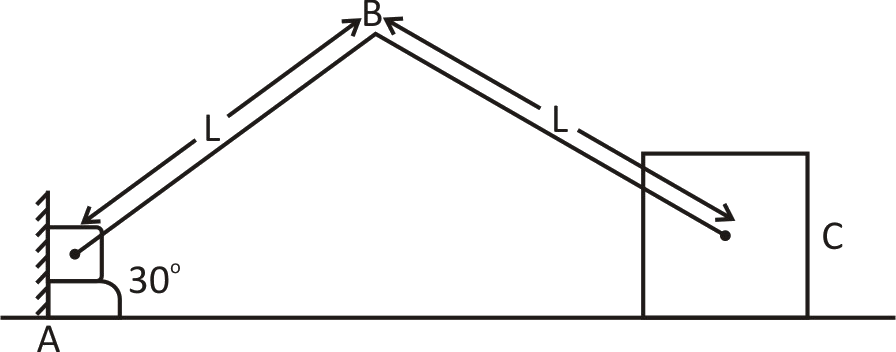
Consider the shown mechanism ABC. At a certain instant shown in diagram block C was found to be moving with speed of \[1m/s\]to the right. At this instant what is the magnitude of the vertical component of velocity B.
(A)\[\dfrac{1}{2}m/s\]
(B) \[\dfrac{{\sqrt 3 }}{2}m/s\]
(C) \[\dfrac{{\sqrt 3 }}{4}m/s\]
(D) \[2\sqrt 3 m/s\]
Answer
 Verified
572.4k+ views
Hint: In this question, block C is moving with a speed of \[1m/s\] to the right direction. By taking the angles into consideration we can find the velocity along BC we can take the vertical component of Velocity. By substituting the value of angle and velocity, we can easily determine the value of the vertical component of velocity B.
Complete step by step solution:
For finding the vertical component of velocity B, Firstly we need to find by which velocity BC is moving.
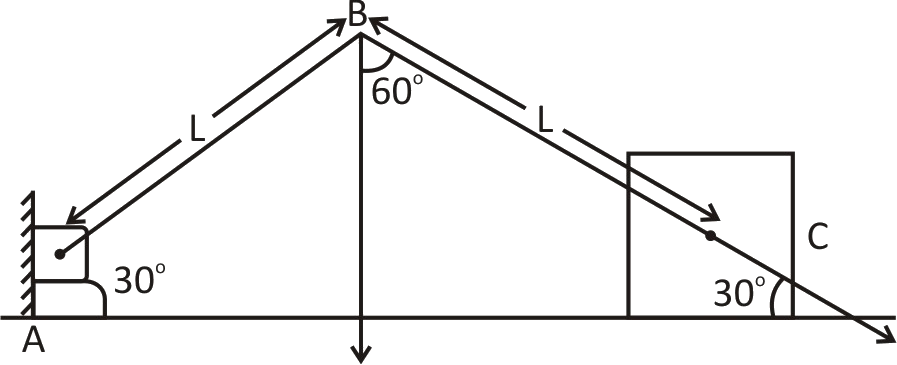
As already given in the question, that block is moving with speed of \[1m/s\] to the right.
So, velocity along BC will be-
\[{V_X}\operatorname{Cos} {30^ \circ } = 1 \times \dfrac{{\sqrt 3 }}{2} = \dfrac{{\sqrt 3 }}{2}m/\sec \]
Now, for calculating the vertical component of velocity at B. We know that vertical component will be-\[{V_y}\operatorname{Cos} \theta \]
Here θ is 60° along the vertical component of Velocity, so-
\[V\operatorname{Cos} {60^ \circ } = \dfrac{{\sqrt 3 }}{2} \times \dfrac{1}{2} = \dfrac{{\sqrt 3 }}{4}m/\sec \]
So, magnitude of vertical component of velocity B is- \[\dfrac{{\sqrt 3 }}{4}m/\sec \]
So, the correct answer is “Option C”.
Note:
By breaking the diagonal velocity into horizontal and vertical components makes it easy for us to deal with each direction separately. This method of breaking up the vectors into its horizontal and vertical components works even when the vector is other than velocity such as force and momentum.
Complete step by step solution:
For finding the vertical component of velocity B, Firstly we need to find by which velocity BC is moving.
As already given in the question, that block is moving with speed of \[1m/s\] to the right.
So, velocity along BC will be-
\[{V_X}\operatorname{Cos} {30^ \circ } = 1 \times \dfrac{{\sqrt 3 }}{2} = \dfrac{{\sqrt 3 }}{2}m/\sec \]
Now, for calculating the vertical component of velocity at B. We know that vertical component will be-\[{V_y}\operatorname{Cos} \theta \]
Here θ is 60° along the vertical component of Velocity, so-
\[V\operatorname{Cos} {60^ \circ } = \dfrac{{\sqrt 3 }}{2} \times \dfrac{1}{2} = \dfrac{{\sqrt 3 }}{4}m/\sec \]
So, magnitude of vertical component of velocity B is- \[\dfrac{{\sqrt 3 }}{4}m/\sec \]
So, the correct answer is “Option C”.
Note:
By breaking the diagonal velocity into horizontal and vertical components makes it easy for us to deal with each direction separately. This method of breaking up the vectors into its horizontal and vertical components works even when the vector is other than velocity such as force and momentum.
Recently Updated Pages
Master Class 11 Computer Science: Engaging Questions & Answers for Success

Master Class 11 Business Studies: Engaging Questions & Answers for Success
Master Class 11 Economics: Engaging Questions & Answers for Success
Master Class 11 English: Engaging Questions & Answers for Success
Master Class 11 Maths: Engaging Questions & Answers for Success
Master Class 11 Biology: Engaging Questions & Answers for Success
Trending doubts
One Metric ton is equal to kg A 10000 B 1000 C 100 class 11 physics CBSE
There are 720 permutations of the digits 1 2 3 4 5 class 11 maths CBSE
Discuss the various forms of bacteria class 11 biology CBSE
Draw a diagram of a plant cell and label at least eight class 11 biology CBSE
State the laws of reflection of light
Explain zero factorial class 11 maths CBSE