




Consider the given trigonometric expression, ${{\cos }^{-1}}x=a+{{\tan }^{-1}}\dfrac{\sqrt{1-{{x}^{b}}}}{cx}$ for $x\le 0$. Find the value of $a,b$ and $c$.
(a) $a=\pi ,b=1,c=1$
(b) $a=-\pi ,b=2,c=2$
(c) $a=-\pi ,b=1,c=2$
(d) $a=\pi ,b=2,c=1$
Answer
 Verified
574.8k+ views
Hint: Change ${{\cos }^{-1}}$ into ${{\tan }^{-1}}$ by assuming $x$ as base and 1 as perpendicular. Take both the ${{\tan }^{-1}}$ into left hand side and use the formula ${{\tan }^{-1}}x-{{\tan }^{-1}}y={{\tan }^{-1}}\left( \dfrac{x-y}{1+xy} \right)$ to convert it into single inverse function. Assume $a=\pm \pi $ according to the given options and accordingly compare L.H.S and R.H.S to determine the value of $a,b$ and $c$.
Complete step by step answer:
We have been given, ${{\cos }^{-1}}x=a+{{\tan }^{-1}}\dfrac{\sqrt{1-{{x}^{b}}}}{cx}$. We know that, $\cos \theta =\dfrac{\text{base}}{\text{Hypotenuse}}$. Therefore, ${{\cos }^{-1}}x$ will have the numerator ‘$x$’ as its base and the denominator ‘1’ as its hypotenuse.
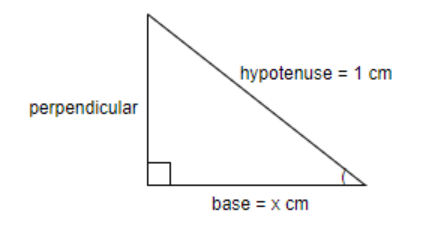
Therefore, using Pythagoras theorem: $\text {hypotenuse}^{2}=\text{perpendicular}^{2}+\text{base}^{2}$, we get,
$\begin{align}
& \text{perpendicular}^{2}=\text {hypotenuse}^{2}-\text{base}^{2} \\
& \Rightarrow \text{perpendicular}=\sqrt{\text {hypotenuse}^{2}-\text{base}^{2}} \\
& \Rightarrow \text{perpendicular}=\sqrt{1-{{x}^{2}}} \\
\end{align}$
$\therefore {{\cos }^{-1}}x={{\tan }^{-1}}\dfrac{\sqrt{1-{{x}^{2}}}}{x}$
Therefore, the equation becomes, ${{\tan }^{-1}}\dfrac{\sqrt{1-{{x}^{2}}}}{x}=a+{{\tan }^{-1}}\dfrac{\sqrt{1-{{x}^{b}}}}{cx}$. Now,
${{\tan }^{-1}}\dfrac{\sqrt{1-{{x}^{2}}}}{x}-{{\tan }^{-1}}\dfrac{\sqrt{1-{{x}^{b}}}}{cx}=a$
Applying the formula ${{\tan }^{-1}}x-{{\tan }^{-1}}y={{\tan }^{-1}}\left( \dfrac{x-y}{1+xy} \right)$ we get,
$\begin{align}
& {{\tan }^{-1}}\left( \dfrac{\dfrac{\sqrt{1-{{x}^{2}}}}{x}-\dfrac{\sqrt{1-{{x}^{b}}}}{cx}}{1+\dfrac{\sqrt{1-{{x}^{2}}}}{x}\times \dfrac{\sqrt{1-{{x}^{b}}}}{cx}} \right)=a \\
& \Rightarrow \left( \dfrac{\dfrac{\sqrt{1-{{x}^{2}}}}{x}-\dfrac{\sqrt{1-{{x}^{b}}}}{cx}}{1+\dfrac{\sqrt{1-{{x}^{2}}}}{x}\times \dfrac{\sqrt{1-{{x}^{b}}}}{cx}} \right)=\tan a \\
\end{align}$
Now, when we see the given options carefully, we observe that $a$ is either, $\pi \text{ or }-\pi $. We know that, $\tan \pi =\tan (-\pi )=0$. Therefore, $\tan a$ must be zero.
$\begin{align}
& \Rightarrow \left( \dfrac{\dfrac{\sqrt{1-{{x}^{2}}}}{x}-\dfrac{\sqrt{1-{{x}^{b}}}}{cx}}{1+\dfrac{\sqrt{1-{{x}^{2}}}}{x}\times \dfrac{\sqrt{1-{{x}^{b}}}}{cx}} \right)=0 \\
& \Rightarrow \dfrac{\sqrt{1-{{x}^{2}}}}{x}-\dfrac{\sqrt{1-{{x}^{b}}}}{cx}=0 \\
& \Rightarrow \dfrac{\sqrt{1-{{x}^{2}}}}{x}=\dfrac{\sqrt{1-{{x}^{b}}}}{cx} \\
\end{align}$
Now, on comparing the left hand side and right hand side, we get,
‘$b$’ must be 2 and ‘$c$’ must be 1.
So, the correct answer is “Option d”.
Note: In the above solution we have changed ${{\cos }^{-1}}$ into ${{\tan }^{-1}}$. We can also apply the reverse process, that is, to change ${{\tan }^{-1}}$ into ${{\cos }^{-1}}$. But, the next problem that we will encounter is that we will get an equation that will be pretty difficult to solve. Therefore, it is always convenient to convert the different inverse functions into ${{\tan }^{-1}}$.
Complete step by step answer:
We have been given, ${{\cos }^{-1}}x=a+{{\tan }^{-1}}\dfrac{\sqrt{1-{{x}^{b}}}}{cx}$. We know that, $\cos \theta =\dfrac{\text{base}}{\text{Hypotenuse}}$. Therefore, ${{\cos }^{-1}}x$ will have the numerator ‘$x$’ as its base and the denominator ‘1’ as its hypotenuse.
Therefore, using Pythagoras theorem: $\text {hypotenuse}^{2}=\text{perpendicular}^{2}+\text{base}^{2}$, we get,
$\begin{align}
& \text{perpendicular}^{2}=\text {hypotenuse}^{2}-\text{base}^{2} \\
& \Rightarrow \text{perpendicular}=\sqrt{\text {hypotenuse}^{2}-\text{base}^{2}} \\
& \Rightarrow \text{perpendicular}=\sqrt{1-{{x}^{2}}} \\
\end{align}$
$\therefore {{\cos }^{-1}}x={{\tan }^{-1}}\dfrac{\sqrt{1-{{x}^{2}}}}{x}$
Therefore, the equation becomes, ${{\tan }^{-1}}\dfrac{\sqrt{1-{{x}^{2}}}}{x}=a+{{\tan }^{-1}}\dfrac{\sqrt{1-{{x}^{b}}}}{cx}$. Now,
${{\tan }^{-1}}\dfrac{\sqrt{1-{{x}^{2}}}}{x}-{{\tan }^{-1}}\dfrac{\sqrt{1-{{x}^{b}}}}{cx}=a$
Applying the formula ${{\tan }^{-1}}x-{{\tan }^{-1}}y={{\tan }^{-1}}\left( \dfrac{x-y}{1+xy} \right)$ we get,
$\begin{align}
& {{\tan }^{-1}}\left( \dfrac{\dfrac{\sqrt{1-{{x}^{2}}}}{x}-\dfrac{\sqrt{1-{{x}^{b}}}}{cx}}{1+\dfrac{\sqrt{1-{{x}^{2}}}}{x}\times \dfrac{\sqrt{1-{{x}^{b}}}}{cx}} \right)=a \\
& \Rightarrow \left( \dfrac{\dfrac{\sqrt{1-{{x}^{2}}}}{x}-\dfrac{\sqrt{1-{{x}^{b}}}}{cx}}{1+\dfrac{\sqrt{1-{{x}^{2}}}}{x}\times \dfrac{\sqrt{1-{{x}^{b}}}}{cx}} \right)=\tan a \\
\end{align}$
Now, when we see the given options carefully, we observe that $a$ is either, $\pi \text{ or }-\pi $. We know that, $\tan \pi =\tan (-\pi )=0$. Therefore, $\tan a$ must be zero.
$\begin{align}
& \Rightarrow \left( \dfrac{\dfrac{\sqrt{1-{{x}^{2}}}}{x}-\dfrac{\sqrt{1-{{x}^{b}}}}{cx}}{1+\dfrac{\sqrt{1-{{x}^{2}}}}{x}\times \dfrac{\sqrt{1-{{x}^{b}}}}{cx}} \right)=0 \\
& \Rightarrow \dfrac{\sqrt{1-{{x}^{2}}}}{x}-\dfrac{\sqrt{1-{{x}^{b}}}}{cx}=0 \\
& \Rightarrow \dfrac{\sqrt{1-{{x}^{2}}}}{x}=\dfrac{\sqrt{1-{{x}^{b}}}}{cx} \\
\end{align}$
Now, on comparing the left hand side and right hand side, we get,
‘$b$’ must be 2 and ‘$c$’ must be 1.
So, the correct answer is “Option d”.
Note: In the above solution we have changed ${{\cos }^{-1}}$ into ${{\tan }^{-1}}$. We can also apply the reverse process, that is, to change ${{\tan }^{-1}}$ into ${{\cos }^{-1}}$. But, the next problem that we will encounter is that we will get an equation that will be pretty difficult to solve. Therefore, it is always convenient to convert the different inverse functions into ${{\tan }^{-1}}$.
Recently Updated Pages
Master Class 12 English: Engaging Questions & Answers for Success

Master Class 12 Social Science: Engaging Questions & Answers for Success
Master Class 12 Maths: Engaging Questions & Answers for Success
Master Class 12 Economics: Engaging Questions & Answers for Success
Master Class 12 Physics: Engaging Questions & Answers for Success
Master Class 12 Business Studies: Engaging Questions & Answers for Success
Trending doubts
Which are the Top 10 Largest Countries of the World?
What are the major means of transport Explain each class 12 social science CBSE
Draw a labelled sketch of the human eye class 12 physics CBSE
Differentiate between insitu conservation and exsitu class 12 biology CBSE
RNA and DNA are chiral molecules their chirality is class 12 chemistry CBSE
RNA and DNA are chiral molecules their chirality is class 12 chemistry CBSE