




Consider the following molecules /ions
$\text{ S}{{\text{O}}_{\text{2}}}\text{ }$, $\text{ C}{{\text{O}}_{\text{2}}}\text{ }$, $\text{ }{{\text{N}}_{\text{2}}}\text{O }$ , $\text{ O}{{\text{F}}_{\text{2}}}\text{ }$ , $\text{ ICl}_{2}^{-}\text{ }$,$\text{ I}_{3}^{-}\text{ }$, $\text{ N}{{\text{O}}_{\text{2}}}\text{ }$,$\text{ NO}_{2}^{-}\text{ }$,$\text{ NO}_{2}^{+}\text{ }$ , $\text{ BF}_{2}^{-}\text{ }$,$\text{ BeC}{{\text{l}}_{\text{2}}}\text{ }$, $\text{ N}_{3}^{-}\text{ }$, $\text{ HCN }$.
Among the above, the number of molecules/ions which are linear is
Answer
 Verified
608.4k+ views
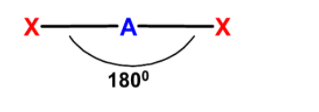
Hint: A geometry in which the central atom is bonded to two other atoms such that the bond angle between the bonds is $\text{ 18}{{\text{0}}^{\text{0}}}\text{ }$ are known as the linear molecules. In linear geometry, the central atom is $\text{ sp }$ hybridized. The two-hybrid orbitals involved in the bond formation. The structure is linear. The general structure of the linear molecule is as shown below,
Complete step by step answer:
Let's have a look at the molecules or the ions given in the problem.
A)$\text{ C}{{\text{O}}_{\text{2}}}\text{ }$ : the central carbon atom is bonded to the two oxygen bonds. Carbon has 4 valence electrons in its valence shell .This 4 electrons are involved in the bond formation with oxygen. Thus the $\text{ C}{{\text{O}}_{\text{2}}}\text{ }$ has a linear structure. The bond angle between the bonding pairs is $\text{ 18}{{\text{0}}^{\text{0}}}\text{ }$ . The bond is arranged as follows,

$\text{ }{{\text{N}}_{\text{2}}}\text{O }$ : The central atom nitrogen is asymmetrically bonded to nitrogen and oxygen atoms. The most stable resonating structure, O is more electronegative and has a negative charge and N is less electronegative. Two nitrogen atoms are joined by the triple bond. This is an asymmetric molecule and exhibits a linear structure. The linear structure of $\text{ }{{\text{N}}_{\text{2}}}\text{O }$ or nitrous oxide is as shown below,

Similarly $\text{ NO}_{2}^{+}\text{ }$ , $\text{ BeC}{{\text{l}}_{\text{2}}}\text{ }$, $\text{ N}_{3}^{-}\text{ }$ and $\text{ HCN }$ are sp hybridized molecules. They exhibit linear geometry.
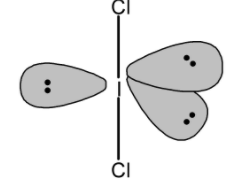
$\text{ ICl}_{2}^{-}\text{ }$ : The central atom iodine is bonded to two chlorine atoms and acquires three lone pairs of electrons. These lone pairs of electrons are situated in the equatorial plane such that each lone pair is directed towards the corner of a triangle. Thus, iodine is surrounded by 5 electrons pairs. It is $\text{ s}{{\text{p}}^{\text{3}}}\text{d }$ hybridized. Thus the molecular geometry of $\text{ ICl}_{2}^{-}\text{ }$is trigonal bipyramidal. The structure is as shown below,
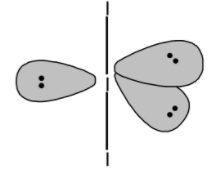
Similarly, the $\text{ I}_{3}^{-}\text{ }$ is a $\text{ s}{{\text{p}}^{\text{3}}}\text{d }$ hybridized molecule. The two iodine are bonded to the central iodine atom. The lone three pairs on the iodine atom are placed in the trigonal plane. Thus $\text{ I}_{3}^{-}\text{ }$ also has a trigonal bipyramidal geometry. However, the two bonds are in the axial plane make is a linear molecule
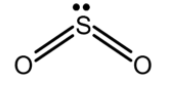
B) $\text{ S}{{\text{O}}_{\text{2}}}\text{ }$ : the central sulphur atom is bonded to the two oxygen bonds. Sulphur has 6 valence electrons in its valence shell. Out of these 6 electrons, 4 electrons are involved in the bond formation with oxygen. The two electrons remain as the lone pair on the sulphur atom. The lone pair pushes the bond pairs, thus the $\text{ S}{{\text{O}}_{\text{2}}}\text{ }$has a trigonal planar. The bond angle between the bonding pairs is $\text{ 12}{{\text{0}}^{\text{0}}}\text{ }$ .the structure of $\text{ S}{{\text{O}}_{\text{2}}}\text{ }$is as follows,
Similarly, the $\text{ NO}_{2}^{-}\text{ }$ , $\text{ N}{{\text{O}}_{\text{2}}}\text{ }$and $\text{ BF}_{2}^{-}\text{ }$are $\text{ s}{{\text{p}}^{\text{2}}}\text{ }$ hybridized molecules but this is non-linear. The lone pair on the atoms makes it trigonal geometry.
$\text{ C}{{\text{O}}_{\text{2}}}\text{ }$ : The central carbon atom is bonded to the two oxygen bonds. Carbon has 4 valence electrons in its valence shell .This 4 electrons are involved in the bond formation with oxygen. Thus the $\text{ C}{{\text{O}}_{\text{2}}}\text{ }$has a linear structure. The bond angle between the bonding pairs is $\text{ 18}{{\text{0}}^{\text{0}}}\text{ }$ . The bond is arranged as follows,

$\text{ }{{\text{N}}_{\text{2}}}\text{O }$ : The central atom nitrogen is asymmetrically bonded to nitrogen and oxygen atoms. The most stable resonating structure, O is more electronegative and has a negative charge and N is less electronegative. Two nitrogen atoms are joined by the triple bond. This is an asymmetric molecule and exhibits a linear structure. The linear structure of $\text{ }{{\text{N}}_{\text{2}}}\text{O }$or nitrous oxide is as shown below,

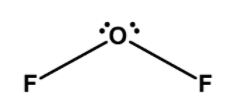
C) $\text{ O}{{\text{F}}_{\text{2}}}\text{ }$ : the central oxygen atom is bonded to the two fluorine bonds. Oxygen has 6 valence electrons in its valence shell. Out of these 6 electrons, 2 electrons are involved in the bond formation with fluorine. The four electrons remain as the lone pair on the oxygen atom. The lone pair pushes the bond pairs, thus $\text{ O}{{\text{F}}_{\text{2}}}\text{ }$ has a trigonal planar. The bond angle between the bonding pairs is $\text{ 10}{{\text{3}}^{\text{0}}}\text{ }$. The structure of $\text{ O}{{\text{F}}_{\text{2}}}\text{ }$is as follows,
Thus, there are in total eight molecules or ions which have a linear geometry.
Note: Note that, $\text{ I}_{3}^{-}\text{ }$ the three iodine atoms and three lone pairs. These lone pairs acquire the equatorial position in such a way that they have zero repulsion between them. In other words, the lone pair on the molecule do not contribute towards the significant geometry. Thus even though the molecule is $\text{ s}{{\text{p}}^{\text{3}}}\text{d }$ hybridized it will be more or a less a linear structure.
Complete step by step answer:
Let's have a look at the molecules or the ions given in the problem.
A)$\text{ C}{{\text{O}}_{\text{2}}}\text{ }$ : the central carbon atom is bonded to the two oxygen bonds. Carbon has 4 valence electrons in its valence shell .This 4 electrons are involved in the bond formation with oxygen. Thus the $\text{ C}{{\text{O}}_{\text{2}}}\text{ }$ has a linear structure. The bond angle between the bonding pairs is $\text{ 18}{{\text{0}}^{\text{0}}}\text{ }$ . The bond is arranged as follows,
$\text{ }{{\text{N}}_{\text{2}}}\text{O }$ : The central atom nitrogen is asymmetrically bonded to nitrogen and oxygen atoms. The most stable resonating structure, O is more electronegative and has a negative charge and N is less electronegative. Two nitrogen atoms are joined by the triple bond. This is an asymmetric molecule and exhibits a linear structure. The linear structure of $\text{ }{{\text{N}}_{\text{2}}}\text{O }$ or nitrous oxide is as shown below,
Similarly $\text{ NO}_{2}^{+}\text{ }$ , $\text{ BeC}{{\text{l}}_{\text{2}}}\text{ }$, $\text{ N}_{3}^{-}\text{ }$ and $\text{ HCN }$ are sp hybridized molecules. They exhibit linear geometry.
$\text{ ICl}_{2}^{-}\text{ }$ : The central atom iodine is bonded to two chlorine atoms and acquires three lone pairs of electrons. These lone pairs of electrons are situated in the equatorial plane such that each lone pair is directed towards the corner of a triangle. Thus, iodine is surrounded by 5 electrons pairs. It is $\text{ s}{{\text{p}}^{\text{3}}}\text{d }$ hybridized. Thus the molecular geometry of $\text{ ICl}_{2}^{-}\text{ }$is trigonal bipyramidal. The structure is as shown below,
Similarly, the $\text{ I}_{3}^{-}\text{ }$ is a $\text{ s}{{\text{p}}^{\text{3}}}\text{d }$ hybridized molecule. The two iodine are bonded to the central iodine atom. The lone three pairs on the iodine atom are placed in the trigonal plane. Thus $\text{ I}_{3}^{-}\text{ }$ also has a trigonal bipyramidal geometry. However, the two bonds are in the axial plane make is a linear molecule
B) $\text{ S}{{\text{O}}_{\text{2}}}\text{ }$ : the central sulphur atom is bonded to the two oxygen bonds. Sulphur has 6 valence electrons in its valence shell. Out of these 6 electrons, 4 electrons are involved in the bond formation with oxygen. The two electrons remain as the lone pair on the sulphur atom. The lone pair pushes the bond pairs, thus the $\text{ S}{{\text{O}}_{\text{2}}}\text{ }$has a trigonal planar. The bond angle between the bonding pairs is $\text{ 12}{{\text{0}}^{\text{0}}}\text{ }$ .the structure of $\text{ S}{{\text{O}}_{\text{2}}}\text{ }$is as follows,
Similarly, the $\text{ NO}_{2}^{-}\text{ }$ , $\text{ N}{{\text{O}}_{\text{2}}}\text{ }$and $\text{ BF}_{2}^{-}\text{ }$are $\text{ s}{{\text{p}}^{\text{2}}}\text{ }$ hybridized molecules but this is non-linear. The lone pair on the atoms makes it trigonal geometry.
$\text{ C}{{\text{O}}_{\text{2}}}\text{ }$ : The central carbon atom is bonded to the two oxygen bonds. Carbon has 4 valence electrons in its valence shell .This 4 electrons are involved in the bond formation with oxygen. Thus the $\text{ C}{{\text{O}}_{\text{2}}}\text{ }$has a linear structure. The bond angle between the bonding pairs is $\text{ 18}{{\text{0}}^{\text{0}}}\text{ }$ . The bond is arranged as follows,
$\text{ }{{\text{N}}_{\text{2}}}\text{O }$ : The central atom nitrogen is asymmetrically bonded to nitrogen and oxygen atoms. The most stable resonating structure, O is more electronegative and has a negative charge and N is less electronegative. Two nitrogen atoms are joined by the triple bond. This is an asymmetric molecule and exhibits a linear structure. The linear structure of $\text{ }{{\text{N}}_{\text{2}}}\text{O }$or nitrous oxide is as shown below,
C) $\text{ O}{{\text{F}}_{\text{2}}}\text{ }$ : the central oxygen atom is bonded to the two fluorine bonds. Oxygen has 6 valence electrons in its valence shell. Out of these 6 electrons, 2 electrons are involved in the bond formation with fluorine. The four electrons remain as the lone pair on the oxygen atom. The lone pair pushes the bond pairs, thus $\text{ O}{{\text{F}}_{\text{2}}}\text{ }$ has a trigonal planar. The bond angle between the bonding pairs is $\text{ 10}{{\text{3}}^{\text{0}}}\text{ }$. The structure of $\text{ O}{{\text{F}}_{\text{2}}}\text{ }$is as follows,
Thus, there are in total eight molecules or ions which have a linear geometry.
Note: Note that, $\text{ I}_{3}^{-}\text{ }$ the three iodine atoms and three lone pairs. These lone pairs acquire the equatorial position in such a way that they have zero repulsion between them. In other words, the lone pair on the molecule do not contribute towards the significant geometry. Thus even though the molecule is $\text{ s}{{\text{p}}^{\text{3}}}\text{d }$ hybridized it will be more or a less a linear structure.
Recently Updated Pages
Master Class 12 Economics: Engaging Questions & Answers for Success

Master Class 12 English: Engaging Questions & Answers for Success
Master Class 12 Social Science: Engaging Questions & Answers for Success
Master Class 12 Maths: Engaging Questions & Answers for Success
Master Class 12 Physics: Engaging Questions & Answers for Success
Master Class 9 General Knowledge: Engaging Questions & Answers for Success
Trending doubts
One Metric ton is equal to kg A 10000 B 1000 C 100 class 11 physics CBSE
Difference Between Prokaryotic Cells and Eukaryotic Cells
Two of the body parts which do not appear in MRI are class 11 biology CBSE
1 ton equals to A 100 kg B 1000 kg C 10 kg D 10000 class 11 physics CBSE
Draw a diagram of nephron and explain its structur class 11 biology CBSE
10 examples of friction in our daily life