




Consider the ellipse $\dfrac{{{x}^{2}}}{f({{k}^{2}}+2k+5)}+\dfrac{{{y}^{2}}}{f(k+11)}=1$ , where $f(x)$is a positive decreasing function, then value of $k$ for which major axis coincides with the $x$ axis is :
(a) $k\in (-7,-5)$
(b) $k\in (-5,-3)$
(c) $k\in (-3,2)$
(d) None of these
Answer
 Verified
623.1k+ views
Hint: In an ellipse the lengths of the major and minor axis are different. The length of the major axis = $2a$ and the length of the minor axis = $2b$, if $a > b$and the length of the major axis = $2b$ and the length of the minor axis = $2a$, if $b > a$.
The general equation of an ellipse is $\dfrac{{{x}^{2}}}{{{a}^{2}}}+\dfrac{{{y}^{2}}}{{{b}^{2}}}=1$. Compare the equation given above with this general equation, and then apply some knowledge of increasing and decreasing functions after satisfying the condition given in the question.
Complete step-by-step solution -
For an ellipse having the general formula :
$\dfrac{{{x}^{2}}}{{{a}^{2}}}+\dfrac{{{y}^{2}}}{{{b}^{2}}}=1$, the vertex of the ellipse is $(0,0)$.
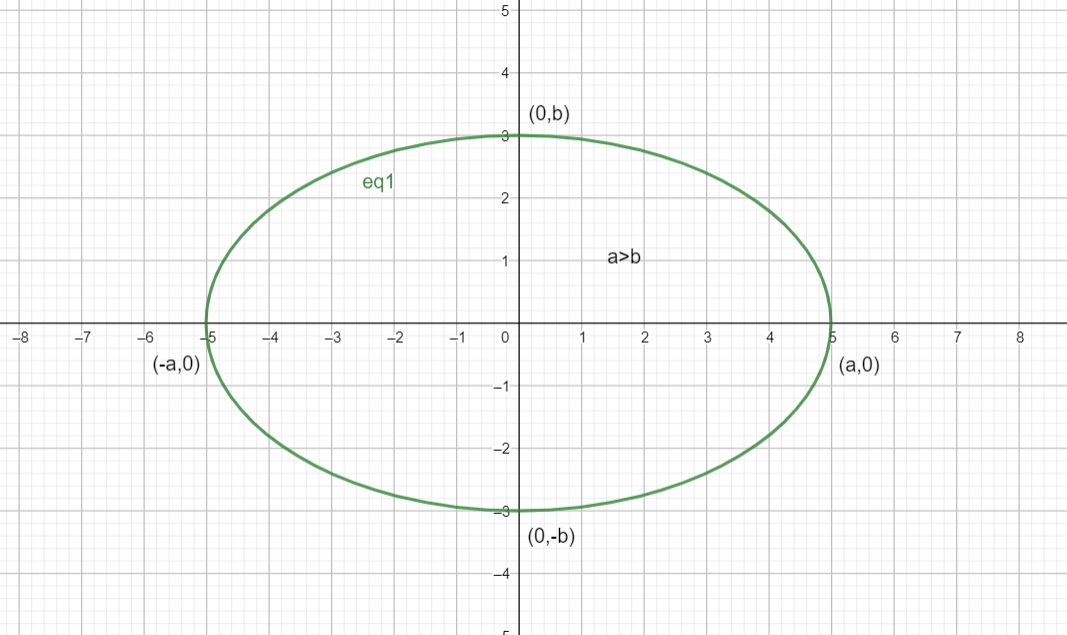
If $a > b$: the major axis of the ellipse lies on the $x$ axis.
Here is a diagram of what such an ellipse would look like :
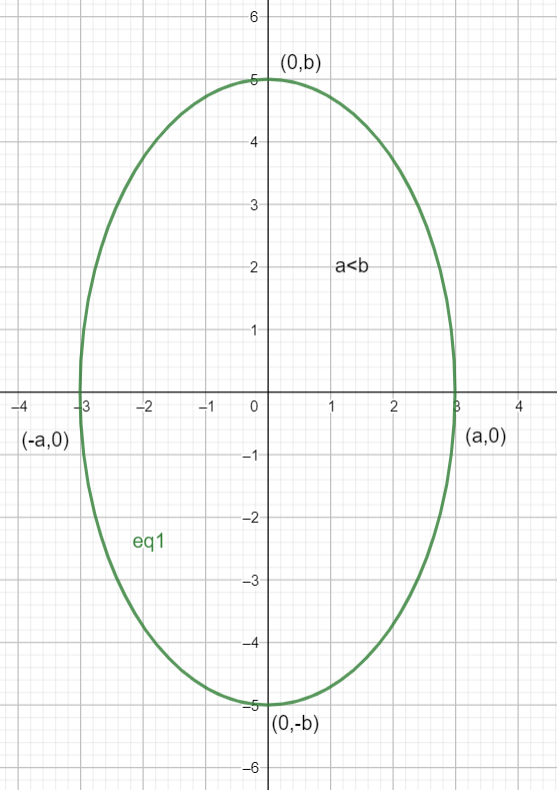
If $b > a$: the major axis of the ellipse lies on the $y$ axis.
Here is a diagram of what such an ellipse would look like :
Comparing the equation given in the question, to the general formula of an ellipse, we get that :
${{a}^{2}}=f({{k}^{2}}+2k+5)$ and ${{b}^{2}}=f(k+11)$
It is told that the major axis of this ellipse should coincide with the $x$ axis.
This means that the $x$ axis has the major axis of the ellipse, and for that to be possible, we need that $b < a$.
Therefore, for this ellipse we need that :
$\begin{align}
& a > b \\
& \Rightarrow \sqrt{f({{k}^{2}}+2k+5)} > \sqrt{f(k+11)} \\
\end{align}$
Squaring both sides, we get :
$f({{k}^{2}}+2k+5) > f(k+11)$
Now, we’re given that $f(x)$ is a positive decreasing function. The fact that it is a decreasing function means that it gives a lower value of $f(x)$ at a higher value of $x$. Written mathematically, it means that :
If $\begin{align}
& f({{x}_{1}}) > f({{x}_{2}}) \\
& \Rightarrow {{x}_{1}} < {{x}_{2}} \\
\end{align}$
Applying this result to the inequality we got from the ellipse, we can say that
$\begin{align}
f({{k}^{2}}+2k+5) > f(k+11) \\
\Rightarrow {{k}^{2}}+2k+5 < k+11 \\
\Rightarrow {{k}^{2}}+k-6 < 0 \\
\Rightarrow {{k}^{2}}+3k-2k-6 < 0 \\
\Rightarrow k(k+3)-2(k+3) < 0 \\
\Rightarrow (k-2)(k+3) < 0 \\
\end{align}$
Now, we know that the sign of a product of two numbers will be negative when the signs of the individual numbers to be multiplied are opposite. Therefore, the last step will be satisfied when
(k-2) is positive and (k+3) is negative $\Rightarrow k-2 > 0\text{ and }k+3 < 0\Rightarrow k > 2\text{ and }k < -3$ which is never possible....................................(i)
Or
(k-2) is negative and (k+3) is positive $\Rightarrow k-2 < 0\text{ and }k+3 > 0\Rightarrow k < 2\text{ and }k > -3$ which means that k should lie in the interval $k\in (-3,2)$
Thus, for the given condition, the interval which $k$ belongs to should be (-3,2) which matches option (c). Therefore, option (c) is the correct answer.
Note: Some knowledge of increasing and decreasing functions is used in this question. So, you should revise the theory of that topic a bit, before attempting this question. In general, for an increasing function,
If $\begin{align}
& f({{x}_{1}}) > f({{x}_{2}}) \\
& \Rightarrow {{x}_{1}} > {{x}_{2}} \\
\end{align}$
And for a decreasing function, if $\begin{align}
& f({{x}_{1}}) > f({{x}_{2}}) \\
& \Rightarrow {{x}_{1}} < {{x}_{2}} \\
\end{align}$.
The general equation of an ellipse is $\dfrac{{{x}^{2}}}{{{a}^{2}}}+\dfrac{{{y}^{2}}}{{{b}^{2}}}=1$. Compare the equation given above with this general equation, and then apply some knowledge of increasing and decreasing functions after satisfying the condition given in the question.
Complete step-by-step solution -
For an ellipse having the general formula :
$\dfrac{{{x}^{2}}}{{{a}^{2}}}+\dfrac{{{y}^{2}}}{{{b}^{2}}}=1$, the vertex of the ellipse is $(0,0)$.
If $a > b$: the major axis of the ellipse lies on the $x$ axis.
Here is a diagram of what such an ellipse would look like :
If $b > a$: the major axis of the ellipse lies on the $y$ axis.
Here is a diagram of what such an ellipse would look like :
Comparing the equation given in the question, to the general formula of an ellipse, we get that :
${{a}^{2}}=f({{k}^{2}}+2k+5)$ and ${{b}^{2}}=f(k+11)$
It is told that the major axis of this ellipse should coincide with the $x$ axis.
This means that the $x$ axis has the major axis of the ellipse, and for that to be possible, we need that $b < a$.
Therefore, for this ellipse we need that :
$\begin{align}
& a > b \\
& \Rightarrow \sqrt{f({{k}^{2}}+2k+5)} > \sqrt{f(k+11)} \\
\end{align}$
Squaring both sides, we get :
$f({{k}^{2}}+2k+5) > f(k+11)$
Now, we’re given that $f(x)$ is a positive decreasing function. The fact that it is a decreasing function means that it gives a lower value of $f(x)$ at a higher value of $x$. Written mathematically, it means that :
If $\begin{align}
& f({{x}_{1}}) > f({{x}_{2}}) \\
& \Rightarrow {{x}_{1}} < {{x}_{2}} \\
\end{align}$
Applying this result to the inequality we got from the ellipse, we can say that
$\begin{align}
f({{k}^{2}}+2k+5) > f(k+11) \\
\Rightarrow {{k}^{2}}+2k+5 < k+11 \\
\Rightarrow {{k}^{2}}+k-6 < 0 \\
\Rightarrow {{k}^{2}}+3k-2k-6 < 0 \\
\Rightarrow k(k+3)-2(k+3) < 0 \\
\Rightarrow (k-2)(k+3) < 0 \\
\end{align}$
Now, we know that the sign of a product of two numbers will be negative when the signs of the individual numbers to be multiplied are opposite. Therefore, the last step will be satisfied when
(k-2) is positive and (k+3) is negative $\Rightarrow k-2 > 0\text{ and }k+3 < 0\Rightarrow k > 2\text{ and }k < -3$ which is never possible....................................(i)
Or
(k-2) is negative and (k+3) is positive $\Rightarrow k-2 < 0\text{ and }k+3 > 0\Rightarrow k < 2\text{ and }k > -3$ which means that k should lie in the interval $k\in (-3,2)$
Thus, for the given condition, the interval which $k$ belongs to should be (-3,2) which matches option (c). Therefore, option (c) is the correct answer.
Note: Some knowledge of increasing and decreasing functions is used in this question. So, you should revise the theory of that topic a bit, before attempting this question. In general, for an increasing function,
If $\begin{align}
& f({{x}_{1}}) > f({{x}_{2}}) \\
& \Rightarrow {{x}_{1}} > {{x}_{2}} \\
\end{align}$
And for a decreasing function, if $\begin{align}
& f({{x}_{1}}) > f({{x}_{2}}) \\
& \Rightarrow {{x}_{1}} < {{x}_{2}} \\
\end{align}$.
Recently Updated Pages
Master Class 11 Social Science: Engaging Questions & Answers for Success

Master Class 11 English: Engaging Questions & Answers for Success
Master Class 11 Maths: Engaging Questions & Answers for Success
Master Class 11 Chemistry: Engaging Questions & Answers for Success
Master Class 11 Biology: Engaging Questions & Answers for Success
Master Class 11 Physics: Engaging Questions & Answers for Success
Trending doubts
Differentiate between an exothermic and an endothermic class 11 chemistry CBSE
One Metric ton is equal to kg A 10000 B 1000 C 100 class 11 physics CBSE
Difference Between Prokaryotic Cells and Eukaryotic Cells
There are 720 permutations of the digits 1 2 3 4 5 class 11 maths CBSE
Draw a diagram of a plant cell and label at least eight class 11 biology CBSE
Which chemical is known as king of chemicals A H 2 class 11 chemistry CBSE