




Consider the circuit shown in the figure below:
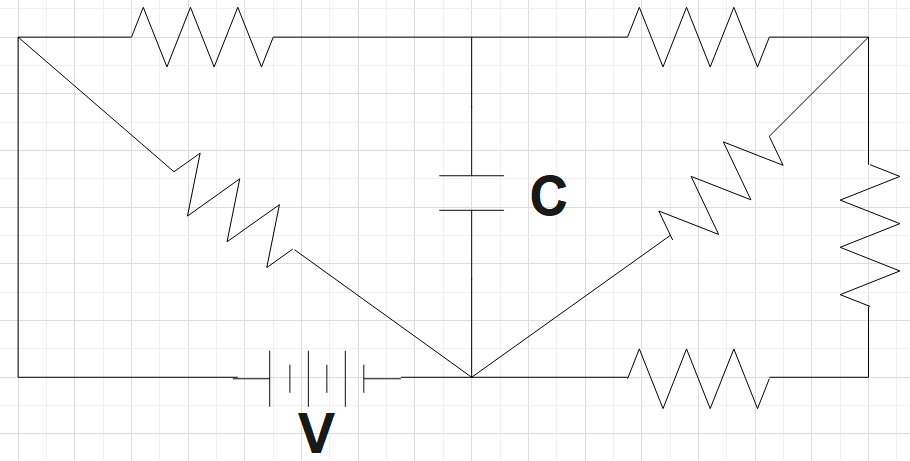
All the resistors are identical. The charge stored in the capacitor once it is fully charged is
A. 0
B. $\dfrac{5}{13}CV$
C. $\dfrac{2}{3}CV$
D.$\dfrac{5}{8}CV$
Answer
 Verified
602.1k+ views
Hint: As a very first step, one could find the equivalent resistance of the given circuit by considering the series and parallel combination into account. Thereby you could find the equivalent current in the circuit. Then you could find the voltage drop across the capacitor and hence the charge stored.
Complete answer:
In the question, we are given a circuit in which a number of resistors are connected in various combinations and we have a capacitor and also a battery. Let us now recall the fact that when the capacitor gets charged fully, the voltage across the capacitor is considered equivalent to voltage of the cell. Also, note that all the connected resistors are identical.
We could conclude that the current through the capacitor zero for the fully charged capacitor. On finding the equivalent resistance of the circuit we see the value to be,
${{R}_{eq}}=\dfrac{8R}{11}$
Now, for the current that is flowing through the first loop, we have the ohms law given by,
$I=\dfrac{V}{R}$
Now we could simply substitute the equivalent resistance into this expression to get,
${{I}_{eq}}=\dfrac{11V}{8R}$
What we have to understand here is that the current is being distributed between the $\dfrac{8R}{3}$and $R$resistances that are connected in parallel. So, the current through the $\dfrac{8R}{3}$ resistance would be $\dfrac{3V}{8R}$
Now the voltage drop could be given by,
$V-\dfrac{3V}{8R}R=\dfrac{5V}{8}$
Now the charge stored in the capacitor would be,
Q=CV
Substituting the voltage drop found above here, we get,
$Q=\dfrac{5CV}{8}$
So, we found the correct answer to be D.
Note:
You may have noted that we have directly substituted the equivalent resistance of the given combination as this is a pretty basic stuff. For the resistors connected in series equivalent resistance is given by the sum and for the resistors connected in parallel, it would be,
${{R}_{EQ}}=\dfrac{{{R}_{1}}{{R}_{2}}}{{{R}_{1}}+{{R}_{2}}}$
Using these two basic steps, we could easily find the answer.
Complete answer:
In the question, we are given a circuit in which a number of resistors are connected in various combinations and we have a capacitor and also a battery. Let us now recall the fact that when the capacitor gets charged fully, the voltage across the capacitor is considered equivalent to voltage of the cell. Also, note that all the connected resistors are identical.
We could conclude that the current through the capacitor zero for the fully charged capacitor. On finding the equivalent resistance of the circuit we see the value to be,
${{R}_{eq}}=\dfrac{8R}{11}$
Now, for the current that is flowing through the first loop, we have the ohms law given by,
$I=\dfrac{V}{R}$
Now we could simply substitute the equivalent resistance into this expression to get,
${{I}_{eq}}=\dfrac{11V}{8R}$
What we have to understand here is that the current is being distributed between the $\dfrac{8R}{3}$and $R$resistances that are connected in parallel. So, the current through the $\dfrac{8R}{3}$ resistance would be $\dfrac{3V}{8R}$
Now the voltage drop could be given by,
$V-\dfrac{3V}{8R}R=\dfrac{5V}{8}$
Now the charge stored in the capacitor would be,
Q=CV
Substituting the voltage drop found above here, we get,
$Q=\dfrac{5CV}{8}$
So, we found the correct answer to be D.
Note:
You may have noted that we have directly substituted the equivalent resistance of the given combination as this is a pretty basic stuff. For the resistors connected in series equivalent resistance is given by the sum and for the resistors connected in parallel, it would be,
${{R}_{EQ}}=\dfrac{{{R}_{1}}{{R}_{2}}}{{{R}_{1}}+{{R}_{2}}}$
Using these two basic steps, we could easily find the answer.
Recently Updated Pages
Which will be the least stable resonating structure class 11 chemistry CBSE

How many 5 digit telephone numbers can be construc-class-11-maths-CBSE
How do you find the angle of the resultant vector class 11 physics CBSE
Draw labelled diagram of the following i Gram seed class 11 biology CBSE
1 Quintal is equal to a 110 kg b 10 kg c 100kg d 1000 class 11 physics CBSE
What is the need and importance of classification class 11 biology CBSE
Trending doubts
Find the value of the expression given below sin 30circ class 11 maths CBSE
One Metric ton is equal to kg A 10000 B 1000 C 100 class 11 physics CBSE
10 examples of friction in our daily life
Draw a diagram of a plant cell and label at least eight class 11 biology CBSE
Difference between physical and chemical change class 11 chemistry CBSE
Proton was discovered by A Thomson B Rutherford C Chadwick class 11 chemistry CBSE