




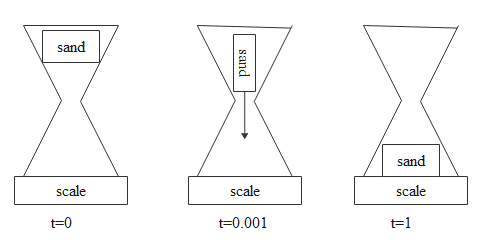
Consider an hourglass on a scale pictured below at the times t=0,0.001 and at 1hr. what happens to the scale’s measure of weight of the hour glass plus sand combination as the sand falls?
A. The weight is constant
B. The weight decreases and then increases
C. The weight increases
D. The weight increases and then decreases.
Answer
 Verified
605.4k+ views
Hint: This question can be answered by using newton’s second law. According to Newton's second law for a particular system, rate of change of momentum will be equal to the external force acting on the system. Here external force will be due to the motion of this sand in the hour glass.
Formula used:
${F_{ext}} = \dfrac{{d{p_{system}}}}{{dt}}$
Complete step by step answer:
In the first case the sand is at rest initially. We have the formula
${F_{ext}} = \dfrac{{d{p_{system}}}}{{dt}}$ where ‘p’ is the momentum of the sand here
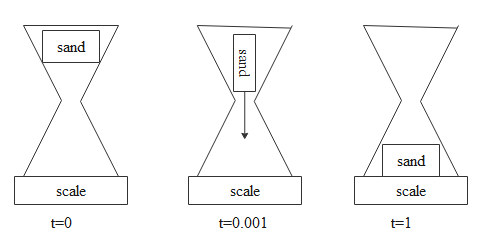
In the initial case it doesn’t have any momentum as sand is at rest momentum is zero so there will be no external force due to that sand. Hence initially it doesn’t experience any force so initial weight will be zero.
Then in the second case sand starts moving which means it gains some momentum and momentum keeps on increasing as it moves and then external force also keeps on increasing so the weight increases.
Then in the third case the sand falls on the floor as it's an hourglass that is within one hour and falls on the floor. So then sand will be at rest. If sand is at rest then there will be no momentum for the sand then weight will again become zero.
So the answer would be first weight will increase and then it will decrease.
Hence answer would be option D.
Note:
Since it is an hourglass it is clear that exactly after one hour the entire sand must be falling down within one hour of the time span. So the rate of change of momentum is what that determines the weight and if momentum is constant then there will be no force too.
Formula used:
${F_{ext}} = \dfrac{{d{p_{system}}}}{{dt}}$
Complete step by step answer:
In the first case the sand is at rest initially. We have the formula
${F_{ext}} = \dfrac{{d{p_{system}}}}{{dt}}$ where ‘p’ is the momentum of the sand here
In the initial case it doesn’t have any momentum as sand is at rest momentum is zero so there will be no external force due to that sand. Hence initially it doesn’t experience any force so initial weight will be zero.
Then in the second case sand starts moving which means it gains some momentum and momentum keeps on increasing as it moves and then external force also keeps on increasing so the weight increases.
Then in the third case the sand falls on the floor as it's an hourglass that is within one hour and falls on the floor. So then sand will be at rest. If sand is at rest then there will be no momentum for the sand then weight will again become zero.
So the answer would be first weight will increase and then it will decrease.
Hence answer would be option D.
Note:
Since it is an hourglass it is clear that exactly after one hour the entire sand must be falling down within one hour of the time span. So the rate of change of momentum is what that determines the weight and if momentum is constant then there will be no force too.
Recently Updated Pages
Three beakers labelled as A B and C each containing 25 mL of water were taken A small amount of NaOH anhydrous CuSO4 and NaCl were added to the beakers A B and C respectively It was observed that there was an increase in the temperature of the solutions contained in beakers A and B whereas in case of beaker C the temperature of the solution falls Which one of the following statements isarecorrect i In beakers A and B exothermic process has occurred ii In beakers A and B endothermic process has occurred iii In beaker C exothermic process has occurred iv In beaker C endothermic process has occurred

Master Class 11 Social Science: Engaging Questions & Answers for Success
Master Class 11 Physics: Engaging Questions & Answers for Success
Master Class 11 Maths: Engaging Questions & Answers for Success
Master Class 11 Economics: Engaging Questions & Answers for Success
Master Class 11 Computer Science: Engaging Questions & Answers for Success
Three beakers labelled as A B and C each containing 25 mL of water were taken A small amount of NaOH anhydrous CuSO4 and NaCl were added to the beakers A B and C respectively It was observed that there was an increase in the temperature of the solutions contained in beakers A and B whereas in case of beaker C the temperature of the solution falls Which one of the following statements isarecorrect i In beakers A and B exothermic process has occurred ii In beakers A and B endothermic process has occurred iii In beaker C exothermic process has occurred iv In beaker C endothermic process has occurred
Master Class 11 Social Science: Engaging Questions & Answers for Success
Master Class 11 Physics: Engaging Questions & Answers for Success
Trending doubts
One Metric ton is equal to kg A 10000 B 1000 C 100 class 11 physics CBSE
There are 720 permutations of the digits 1 2 3 4 5 class 11 maths CBSE
State and prove Bernoullis theorem class 11 physics CBSE
Draw a diagram of a plant cell and label at least eight class 11 biology CBSE
Difference Between Prokaryotic Cells and Eukaryotic Cells
1 Quintal is equal to a 110 kg b 10 kg c 100kg d 1000 class 11 physics CBSE