




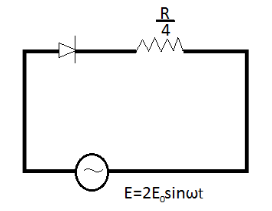
Consider an electric circuit with a diode. What will be the average power dissipated in the resistor? (Assume diode is ideal)
$ \left( A \right)\dfrac{{32{E_0}^2}}{R} \\
\left( B \right)\dfrac{{16{E_0}^2}}{R} \\
\left( C \right)\dfrac{{4{E_0}^2}}{R} \\
\left( D \right)\dfrac{{{E_0}^2}}{{2R}} \\ $
Answer
 Verified
589.2k+ views
Hint :In order to solve this question, we are going to first consider the two cases for the circuit, one with a diode and the other without a diode, after that, we need to calculate the power of the case without the diode, and then, from the formula , we calculate the power for the circuit with a diode.
The power dissipated by the diode can be calculated as:
$ {P_D} = \dfrac{1}{2}{P_0} $
Where $ {P_D} $ is the power dissipated with a diode while $ {P_0} $ is the power dissipated without a diode
Power of circuit without diode
$ {P_0} = \dfrac{1}{2} \times \dfrac{{voltag{e^2}}}{{resistance}} $ .
Complete Step By Step Answer:
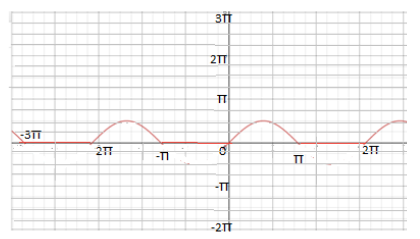
Let us start by taking two cases of the circuit, first with a diode which is given in the above circuit and second without a diode.
With a diode:
Without a diode:
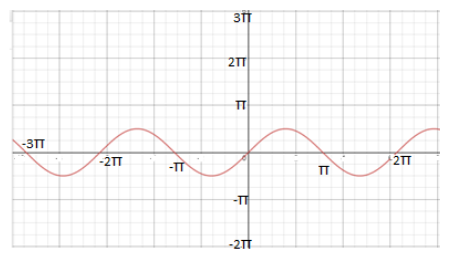
The power dissipated by the diode can be calculated as:
$ {P_D} = \dfrac{1}{2}{P_0} $
Where $ {P_D} $ is the power dissipated with a diode while $ {P_0} $ is the power dissipated without a diode
Now, without the diode, the power is given by:
$ {P_0} = \dfrac{1}{2} \times \dfrac{{{{\left( {2\dfrac{{{E_0}}}{{\sqrt 2 }}} \right)}^2}}}{{\dfrac{R}{4}}} $
Putting this in the above equation to calculate the power without a diode, we get
$ {P_D} = \dfrac{1}{2} \times \dfrac{{{{\left( {2\dfrac{{{E_0}}}{{\sqrt 2 }}} \right)}^2}}}{{\dfrac{R}{4}}} = \dfrac{{4{E_0}^2}}{R} $
Hence, option $ \left( C \right)\dfrac{{4{E_0}^2}}{R} $ is the correct answer.
Note :
The key function of an ideal diode is to control the direction of current-flow. Current passing through a diode can only go in one direction, called the forward direction. Current trying to flow the reverse direction is blocked. By applying a diode in the circuit, the power becomes half of that of the power without diode.
The power dissipated by the diode can be calculated as:
$ {P_D} = \dfrac{1}{2}{P_0} $
Where $ {P_D} $ is the power dissipated with a diode while $ {P_0} $ is the power dissipated without a diode
Power of circuit without diode
$ {P_0} = \dfrac{1}{2} \times \dfrac{{voltag{e^2}}}{{resistance}} $ .
Complete Step By Step Answer:
Let us start by taking two cases of the circuit, first with a diode which is given in the above circuit and second without a diode.
With a diode:
Without a diode:
The power dissipated by the diode can be calculated as:
$ {P_D} = \dfrac{1}{2}{P_0} $
Where $ {P_D} $ is the power dissipated with a diode while $ {P_0} $ is the power dissipated without a diode
Now, without the diode, the power is given by:
$ {P_0} = \dfrac{1}{2} \times \dfrac{{{{\left( {2\dfrac{{{E_0}}}{{\sqrt 2 }}} \right)}^2}}}{{\dfrac{R}{4}}} $
Putting this in the above equation to calculate the power without a diode, we get
$ {P_D} = \dfrac{1}{2} \times \dfrac{{{{\left( {2\dfrac{{{E_0}}}{{\sqrt 2 }}} \right)}^2}}}{{\dfrac{R}{4}}} = \dfrac{{4{E_0}^2}}{R} $
Hence, option $ \left( C \right)\dfrac{{4{E_0}^2}}{R} $ is the correct answer.
Note :
The key function of an ideal diode is to control the direction of current-flow. Current passing through a diode can only go in one direction, called the forward direction. Current trying to flow the reverse direction is blocked. By applying a diode in the circuit, the power becomes half of that of the power without diode.
Recently Updated Pages
Basicity of sulphurous acid and sulphuric acid are

Master Class 12 Economics: Engaging Questions & Answers for Success
Master Class 12 Biology: Engaging Questions & Answers for Success
Master Class 11 English: Engaging Questions & Answers for Success
Master Class 11 Physics: Engaging Questions & Answers for Success
Master Class 11 Computer Science: Engaging Questions & Answers for Success
Trending doubts
Draw a labelled sketch of the human eye class 12 physics CBSE
The chemical formula of tear gas is A CO Cl 2 B C 10 class 12 chemistry CBSE
Draw ray diagrams each showing i myopic eye and ii class 12 physics CBSE
Which are the Top 10 Largest Countries of the World?
Differentiate between homogeneous and heterogeneous class 12 chemistry CBSE
Which is the correct genotypic ratio of mendel dihybrid class 12 biology CBSE