




Consider a triangular plot $ABC$ with sides $AB = 7m, BC = 5m$ and $CA = 6m$. A vertical lamp post at the midpoint $O$ of $AC$ substance an angle $30^\circ $ at $B.$ The height an ml of the lamp post is:
(A) $7\sqrt 3 $
(B) $\dfrac{2}{3}\sqrt {21} $
(C) $\dfrac{3}{2}\sqrt {21} $
(D) $2\sqrt {21} $
Answer
 Verified
624.9k+ views
Hint: Use the trigonometric ratio of function:
(1) $\sin \theta = \dfrac{{{\text{Opposite side}}}}{{{\text{Hypotenuse}}}}$
(2) $\cos \theta = \dfrac{{{\text{Adjacent side}}}}{{{\text{Hypotenuse}}}}$
(3) $\tan \theta = \dfrac{{{\text{Opposite side}}}}{{{\text{Adjacent side}}}}$
Draw a triangle as per given information, name the points, make the distance as it gets easy to solve the problem.
Complete Step by Step Solution:
Given,
$AB = 7m$
$BC = 5m.$
$CA = 6m.$
To find: the height of the lamp-post.
Draw a triangle as per given information about the problem.
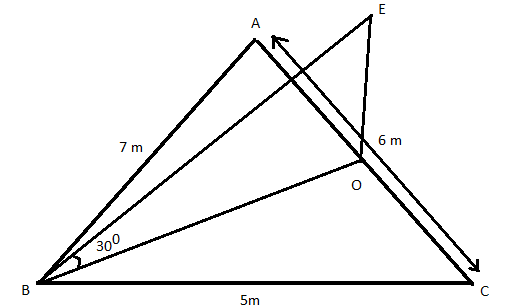
As per given information you have to draw a midpoint at side $AC$ and draw a line through $B$ at on $30^\circ $ angle. Means joint $(BO)$ and for finding the height of the lamp-post. Draw a line at $90^\circ $ straight. Mark that point as $'E'$ and joint $'BE'$
Here, you have to find $DE$ that is the height of the lamp-post.
So,
$BO = h\cot 30^\circ $
$BO = h\sqrt 3 $ (value of $\cot 30^\circ = \sqrt 3 )$
$A{B^2} + B{C^2} = 2\left( {B{O^2} + A{D^2}} \right)$
Put the value of the above sides.
${\left( 7 \right)^2} + {\left( 5 \right)^5} = 2\left[ {{{\left( {h\sqrt 3 } \right)}^2} + {3^2}} \right]$
$49 + 25 = 2\left( {3{h^2} + 9} \right)$
Here, ${\left( {h\sqrt 3 } \right)^2} = {h^2}\left( {\sqrt 3 \times \sqrt 3 } \right) = {h^2}3 = 3{h^2}$
$90^\circ = 2\left( {3{h^2} + 9} \right)$
above $'2'$ of right side will transfer to the left side and get division with $'74'$
Therefore,
$\dfrac{{74}}{2} = \left( {3{h^2} + 9} \right)$
$37 + 3{h^2} + 9$
Here, move constant terms to the one side and variable to another side.
$37 - 9 = 3{h^2}$
$28 = 3{h^2}$
Which can also be written as,
$3{h^2} = 28$
Here, transfer $'3'$ to the right side and convert into division.
${h^2} = \dfrac{{28}}{3}$
Here, the square of $'n'$ will transfer to the right side and get converted into square root.
$h = \sqrt {\dfrac{{28}}{3}} $
$ = \dfrac{{2\sqrt 7 }}{{\sqrt 3 }} \times \dfrac{{\sqrt 3 }}{{\sqrt 3 }}$
$h = \dfrac{{2\sqrt {21} }}{3}m$
Hence, the correct answer is option (B).
Additional information:
In mathematics the trigonometric function also called circular function, angle function or geometric function are real functions which relate an angle of a right angled triangle to a ratio of two side lengths. They are widely used in all sciences that are related to geometry, such as navigation, solid mechanics, celestial mechanics and many others. They are among the simplest periodic functions and as such are also widely used for studying periodic phenomena. Basis of trigonometry. If two right angles have equal acute angles they are similar so their lengths are proportional. Proportionality constants are written within $\sin \theta ,\cos \theta ,\tan \theta $ where $'\theta '$ is the common measure of five acute angles.
Note: Use the trigonometric identities, and function.
As you transfer one term to different sides therefore its sign will also change.
$' + '$ Addition will get converted into $' - '$ subtraction.
$' - '$ Subtraction will get converted into $' + '$ Addition.
$' \times '$ Multiplication will get converted into $' \div '$ division.
$' \div '$ division will get converted into $' \times '$ multiplication.
(1) $\sin \theta = \dfrac{{{\text{Opposite side}}}}{{{\text{Hypotenuse}}}}$
(2) $\cos \theta = \dfrac{{{\text{Adjacent side}}}}{{{\text{Hypotenuse}}}}$
(3) $\tan \theta = \dfrac{{{\text{Opposite side}}}}{{{\text{Adjacent side}}}}$
Draw a triangle as per given information, name the points, make the distance as it gets easy to solve the problem.
Complete Step by Step Solution:
Given,
$AB = 7m$
$BC = 5m.$
$CA = 6m.$
To find: the height of the lamp-post.
Draw a triangle as per given information about the problem.
As per given information you have to draw a midpoint at side $AC$ and draw a line through $B$ at on $30^\circ $ angle. Means joint $(BO)$ and for finding the height of the lamp-post. Draw a line at $90^\circ $ straight. Mark that point as $'E'$ and joint $'BE'$
Here, you have to find $DE$ that is the height of the lamp-post.
So,
$BO = h\cot 30^\circ $
$BO = h\sqrt 3 $ (value of $\cot 30^\circ = \sqrt 3 )$
$A{B^2} + B{C^2} = 2\left( {B{O^2} + A{D^2}} \right)$
Put the value of the above sides.
${\left( 7 \right)^2} + {\left( 5 \right)^5} = 2\left[ {{{\left( {h\sqrt 3 } \right)}^2} + {3^2}} \right]$
$49 + 25 = 2\left( {3{h^2} + 9} \right)$
Here, ${\left( {h\sqrt 3 } \right)^2} = {h^2}\left( {\sqrt 3 \times \sqrt 3 } \right) = {h^2}3 = 3{h^2}$
$90^\circ = 2\left( {3{h^2} + 9} \right)$
above $'2'$ of right side will transfer to the left side and get division with $'74'$
Therefore,
$\dfrac{{74}}{2} = \left( {3{h^2} + 9} \right)$
$37 + 3{h^2} + 9$
Here, move constant terms to the one side and variable to another side.
$37 - 9 = 3{h^2}$
$28 = 3{h^2}$
Which can also be written as,
$3{h^2} = 28$
Here, transfer $'3'$ to the right side and convert into division.
${h^2} = \dfrac{{28}}{3}$
Here, the square of $'n'$ will transfer to the right side and get converted into square root.
$h = \sqrt {\dfrac{{28}}{3}} $
$ = \dfrac{{2\sqrt 7 }}{{\sqrt 3 }} \times \dfrac{{\sqrt 3 }}{{\sqrt 3 }}$
$h = \dfrac{{2\sqrt {21} }}{3}m$
Hence, the correct answer is option (B).
Additional information:
In mathematics the trigonometric function also called circular function, angle function or geometric function are real functions which relate an angle of a right angled triangle to a ratio of two side lengths. They are widely used in all sciences that are related to geometry, such as navigation, solid mechanics, celestial mechanics and many others. They are among the simplest periodic functions and as such are also widely used for studying periodic phenomena. Basis of trigonometry. If two right angles have equal acute angles they are similar so their lengths are proportional. Proportionality constants are written within $\sin \theta ,\cos \theta ,\tan \theta $ where $'\theta '$ is the common measure of five acute angles.
Note: Use the trigonometric identities, and function.
As you transfer one term to different sides therefore its sign will also change.
$' + '$ Addition will get converted into $' - '$ subtraction.
$' - '$ Subtraction will get converted into $' + '$ Addition.
$' \times '$ Multiplication will get converted into $' \div '$ division.
$' \div '$ division will get converted into $' \times '$ multiplication.
Recently Updated Pages
Which will be the least stable resonating structure class 11 chemistry CBSE

How many 5 digit telephone numbers can be construc-class-11-maths-CBSE
How do you find the angle of the resultant vector class 11 physics CBSE
Draw labelled diagram of the following i Gram seed class 11 biology CBSE
1 Quintal is equal to a 110 kg b 10 kg c 100kg d 1000 class 11 physics CBSE
What is the need and importance of classification class 11 biology CBSE
Trending doubts
Find the value of the expression given below sin 30circ class 11 maths CBSE
One Metric ton is equal to kg A 10000 B 1000 C 100 class 11 physics CBSE
10 examples of friction in our daily life
Draw a diagram of a plant cell and label at least eight class 11 biology CBSE
Difference between physical and chemical change class 11 chemistry CBSE
Proton was discovered by A Thomson B Rutherford C Chadwick class 11 chemistry CBSE