




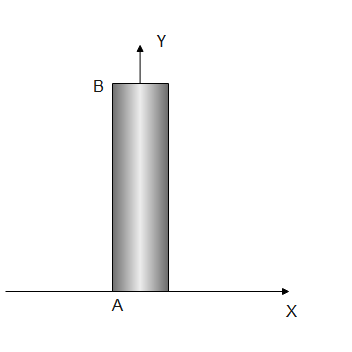
Consider a thin stick of length L. standing on one of its ends on a frictionless surface. It is slightly pushed at the other end of the rod. Then path of center of mass of the rod is
A. $\mathrm{x}=0$
B. $x^{2}+y^{2}=\dfrac{L^{2}}{4}$
C. $\mathrm{y}=0$
D. $\dfrac{\mathrm{x}^{2}}{\mathrm{L}^{2} /4}+\dfrac{\mathrm{y}^{2}}{\mathrm{L}^{2}}=1$
Answer
 Verified
606.9k+ views
Hint: The center of mass of a spatial mass distribution is the particular point where the weighted relative location of the mass distributed amounts to zero. This is the point at which a force without an angular acceleration may be applied to induce a linear acceleration. The center of mass can be determined by taking the masses that you are trying to locate and multiplying the center of mass between them by their locations. You then add these together and divide them by the sum of all the masses of individuals.
Formula used:
$(\mathrm{x}-\mathrm{a})^{2}+(\mathrm{y}-\mathrm{b})^{2}=\mathrm{r}^{2}$
Complete step by step solution:
Since the stick is very small, the rod length is L From the figure, the stick is positioned at the center of the axis with one end $(\mathrm{x}=0, \mathrm{y}=0)$
Center of mass of the stick is at $\dfrac{\mathrm{L}}{2}$ distance from the edge. Center of mass of stick, follow circular path.
With radius $\mathrm{r}=\dfrac{\mathrm{L}}{2}$ center $(\mathrm{a}=0, \mathrm{b}=0)$
Apply the equation of the circle.
$\Rightarrow {{(\text{x}-\text{a})}^{2}}+{{(\text{y}-\text{b})}^{2}}={{\text{r}}^{2}}$
$\Rightarrow {{(\text{x}-0)}^{2}}+{{(\text{y}-0)}^{2}}={{\left( \dfrac{\text{L}}{2} \right)}^{2}}$
$\Rightarrow {{\text{x}}^{2}}+{{\text{y}}^{2}}=\dfrac{{{\text{L}}^{2}}}{4}$
\[\therefore \] Then path of center of mass of the rod is ${{\text{x}}^{2}}+{{\text{y}}^{2}}=\dfrac{{{\text{L}}^{2}}}{4}$
So, the correct answer is “Option B”.
Additional Information: It is the same as the center of mass in uniform gravity. It lies at the center of the specific body for regularly shaped bodies. Therefore, the center of gravity for a cylinder is at the midpoint of the cylinder 's axis. The mass center is a point of equilibrium for an object or a group of objects. For any single, two-, or three-dimensional object, the center of mass can be found, and so the units are meters (m) in each dimension.
Note: The center of mass can be determined by taking the masses that you are trying to locate and multiplying the center of mass between them by their locations. You then add these together and divide them by the sum of all the masses of individuals. At the center of the rod is the center of the mass of a uniform rod. So, for example, a uniform rod's center of mass
Formula used:
$(\mathrm{x}-\mathrm{a})^{2}+(\mathrm{y}-\mathrm{b})^{2}=\mathrm{r}^{2}$
Complete step by step solution:
Since the stick is very small, the rod length is L From the figure, the stick is positioned at the center of the axis with one end $(\mathrm{x}=0, \mathrm{y}=0)$
Center of mass of the stick is at $\dfrac{\mathrm{L}}{2}$ distance from the edge. Center of mass of stick, follow circular path.
With radius $\mathrm{r}=\dfrac{\mathrm{L}}{2}$ center $(\mathrm{a}=0, \mathrm{b}=0)$
Apply the equation of the circle.
$\Rightarrow {{(\text{x}-\text{a})}^{2}}+{{(\text{y}-\text{b})}^{2}}={{\text{r}}^{2}}$
$\Rightarrow {{(\text{x}-0)}^{2}}+{{(\text{y}-0)}^{2}}={{\left( \dfrac{\text{L}}{2} \right)}^{2}}$
$\Rightarrow {{\text{x}}^{2}}+{{\text{y}}^{2}}=\dfrac{{{\text{L}}^{2}}}{4}$
\[\therefore \] Then path of center of mass of the rod is ${{\text{x}}^{2}}+{{\text{y}}^{2}}=\dfrac{{{\text{L}}^{2}}}{4}$
So, the correct answer is “Option B”.
Additional Information: It is the same as the center of mass in uniform gravity. It lies at the center of the specific body for regularly shaped bodies. Therefore, the center of gravity for a cylinder is at the midpoint of the cylinder 's axis. The mass center is a point of equilibrium for an object or a group of objects. For any single, two-, or three-dimensional object, the center of mass can be found, and so the units are meters (m) in each dimension.
Note: The center of mass can be determined by taking the masses that you are trying to locate and multiplying the center of mass between them by their locations. You then add these together and divide them by the sum of all the masses of individuals. At the center of the rod is the center of the mass of a uniform rod. So, for example, a uniform rod's center of mass
Recently Updated Pages
Master Class 11 Social Science: Engaging Questions & Answers for Success

Master Class 11 English: Engaging Questions & Answers for Success
Master Class 11 Maths: Engaging Questions & Answers for Success
Master Class 11 Chemistry: Engaging Questions & Answers for Success
Master Class 11 Biology: Engaging Questions & Answers for Success
Class 11 Question and Answer - Your Ultimate Solutions Guide
Trending doubts
One Metric ton is equal to kg A 10000 B 1000 C 100 class 11 physics CBSE
Difference Between Prokaryotic Cells and Eukaryotic Cells
Find the value of the expression given below sin 30circ class 11 maths CBSE
1 ton equals to A 100 kg B 1000 kg C 10 kg D 10000 class 11 physics CBSE
Two of the body parts which do not appear in MRI are class 11 biology CBSE
Draw a diagram of nephron and explain its structur class 11 biology CBSE