




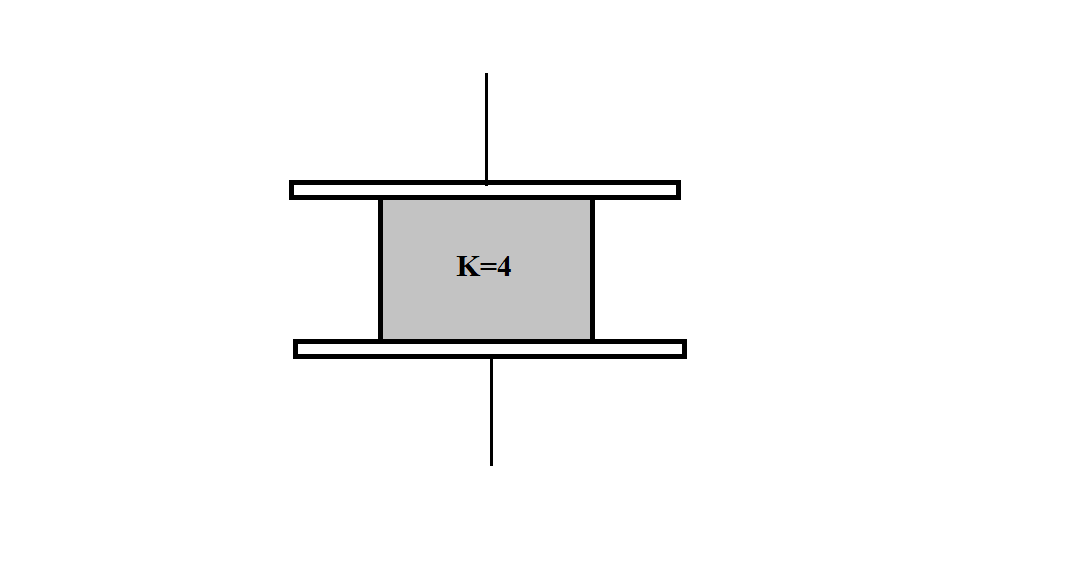
Consider a parallel plate capacitor of capacity $ 10\mu F $ with air filled in the gap between the plates. Now, one-half of the space between the plates is filled with a dielectric constant $ 4 $ as shown in the figure. The capacity of capacitor changes to:
A. $ 25\mu F $
B. $ 20\mu F $
C. $ 40\mu F $
D. $ 5\mu F $
Answer
 Verified
674.1k+ views
Hint: Dielectrics in capacitors are used to keep the conducting plates from coming in contact resulting in smaller plate separations and higher capacitance. Dielectrics increase the effective capacitance by reducing the electric field strength. We can find the final capacitance of the combination by considering it as a parallel combination of two capacitors having different values of capacitance.
Formulae used:
$ C=\dfrac{{{\varepsilon }_{o}}A}{d} $
$ K=\dfrac{\varepsilon }{{{\varepsilon }_{o}}} $
Complete step-by-step answer:
When a dielectric is inserted into a charged capacitor, the dielectric gets polarized by the electric field present between capacitor plates. The electric field from the dielectric will partially cancel the electric field in the capacitor plates. Adding a dielectric into a capacitor allows the capacitor to store more charge for a specified value of voltage.
The dielectric constant $ K $ of a material is the ratio of its permittivity $ \varepsilon $ to the permittivity of vacuum $ {{\varepsilon }_{o}} $ . Therefore, $K=\dfrac{\varepsilon }{{{\varepsilon }_{o}}}$. The dielectric constant of a material is also known as the relative permittivity of the material. Also, dielectric constant, being a ratio of two similar quantities, is a dimensionless quantity.
For the above set of preparation, let’s take the area of capacitor plates as $ A $ and the length of capacitor, distance between two plates, as $ d $ . As the dielectric is inserted between the capacitor plates, covering one half of the original space between plates, we can consider this configuration as a parallel combination of two capacitors. The one is with area $ \dfrac{A}{2} $ and having dielectric between its plates and the other one with area $ \dfrac{A}{2} $ and without the dielectric being inserted between its plates.
For capacitors in parallel combination, the resultant capacitance is the sum of individual capacitances
$ C={{C}_{1}}+{{C}_{2}} $
Capacitance of half area of original capacitor without dielectric, being air in between the plates, $ {{C}_{1}}=\dfrac{{{\varepsilon }_{o}}A}{2d} $
The capacitance of a capacitor having dielectric of dielectric constant $ K $ in between its plates is given as $ {{C}_{K}}=KC $ where $ C $ is the capacitance of capacitor with air in between its plates
Capacitance of half area of capacitor having dielectric between its plates, $ {{C}_{2}}=\dfrac{4{{\varepsilon }_{o}}A}{2d} $
The effective capacitance of the combination is $ C={{C}_{1}}+{{C}_{2}} $
$ \begin{align}
& C=\dfrac{{{\varepsilon }_{o}}A}{2d}+\dfrac{4{{\varepsilon }_{o}}A}{2d} \\
& C=\dfrac{5{{\varepsilon }_{o}}A}{2d} \\
\end{align} $
Initial capacitance of capacitor is given as $ 10\mu F $ , that is, $ \dfrac{{{\varepsilon }_{o}}A}{d}=10 $
$ \begin{align}
& C=\dfrac{5}{2}\times 10=25 \\
& C=25\mu F \\
\end{align} $
Resultant capacitance of the combination is $ 25\mu F $
Hence, the correct option is A.
Note: Students should remember the formula for resultant capacitance in series and parallel combination. The formula in case of capacitors is opposite to that of resistors.
Formulae used:
$ C=\dfrac{{{\varepsilon }_{o}}A}{d} $
$ K=\dfrac{\varepsilon }{{{\varepsilon }_{o}}} $
Complete step-by-step answer:
When a dielectric is inserted into a charged capacitor, the dielectric gets polarized by the electric field present between capacitor plates. The electric field from the dielectric will partially cancel the electric field in the capacitor plates. Adding a dielectric into a capacitor allows the capacitor to store more charge for a specified value of voltage.
The dielectric constant $ K $ of a material is the ratio of its permittivity $ \varepsilon $ to the permittivity of vacuum $ {{\varepsilon }_{o}} $ . Therefore, $K=\dfrac{\varepsilon }{{{\varepsilon }_{o}}}$. The dielectric constant of a material is also known as the relative permittivity of the material. Also, dielectric constant, being a ratio of two similar quantities, is a dimensionless quantity.
For the above set of preparation, let’s take the area of capacitor plates as $ A $ and the length of capacitor, distance between two plates, as $ d $ . As the dielectric is inserted between the capacitor plates, covering one half of the original space between plates, we can consider this configuration as a parallel combination of two capacitors. The one is with area $ \dfrac{A}{2} $ and having dielectric between its plates and the other one with area $ \dfrac{A}{2} $ and without the dielectric being inserted between its plates.
For capacitors in parallel combination, the resultant capacitance is the sum of individual capacitances
$ C={{C}_{1}}+{{C}_{2}} $
Capacitance of half area of original capacitor without dielectric, being air in between the plates, $ {{C}_{1}}=\dfrac{{{\varepsilon }_{o}}A}{2d} $
The capacitance of a capacitor having dielectric of dielectric constant $ K $ in between its plates is given as $ {{C}_{K}}=KC $ where $ C $ is the capacitance of capacitor with air in between its plates
Capacitance of half area of capacitor having dielectric between its plates, $ {{C}_{2}}=\dfrac{4{{\varepsilon }_{o}}A}{2d} $
The effective capacitance of the combination is $ C={{C}_{1}}+{{C}_{2}} $
$ \begin{align}
& C=\dfrac{{{\varepsilon }_{o}}A}{2d}+\dfrac{4{{\varepsilon }_{o}}A}{2d} \\
& C=\dfrac{5{{\varepsilon }_{o}}A}{2d} \\
\end{align} $
Initial capacitance of capacitor is given as $ 10\mu F $ , that is, $ \dfrac{{{\varepsilon }_{o}}A}{d}=10 $
$ \begin{align}
& C=\dfrac{5}{2}\times 10=25 \\
& C=25\mu F \\
\end{align} $
Resultant capacitance of the combination is $ 25\mu F $
Hence, the correct option is A.
Note: Students should remember the formula for resultant capacitance in series and parallel combination. The formula in case of capacitors is opposite to that of resistors.
Recently Updated Pages
Master Class 12 Physics: Engaging Questions & Answers for Success

Master Class 12 Social Science: Engaging Questions & Answers for Success
Master Class 12 English: Engaging Questions & Answers for Success
Master Class 12 Maths: Engaging Questions & Answers for Success
Master Class 12 Business Studies: Engaging Questions & Answers for Success
Master Class 12 Chemistry: Engaging Questions & Answers for Success
Trending doubts
Draw a labelled sketch of the human eye class 12 physics CBSE
Which are the Top 10 Largest Countries of the World?
Draw ray diagrams each showing i myopic eye and ii class 12 physics CBSE
One megawatt is equal to how many units of electri class 12 physics CBSE
Which is the correct genotypic ratio of mendel dihybrid class 12 biology CBSE
Give 10 examples of unisexual and bisexual flowers