




What is the concentration or enrichment of ore? Explain the method of enrichment of ore containing sulphide with diagram?
Answer
 Verified
663.9k+ views
Hint:
We know that minerals are present in ores. The solid materials from which a pure metal can be obtained is called ore. The minerals in the ore are present with unwanted minerals called impurities.
Complete step by step solution:
As we know that minerals are present in ores. To extract minerals we have to dig the ore of that mineral. Minerals are present with some unwanted materials called impurities. To remove these unwanted substances the ores are concentrated on the basic of the type of impurities and their percentage proportion. There are different procedures for the concentration of ores such as hydraulic washing, magnetic separation, froth floatation process, leaching etc.
- Froth flotation method is used for enrichment of ore containing sulphide.
- The term flotation refers to separating mineral particles according to the difference in their physical and chemical properties.
- This method is particularly used for sulphide minerals as sulphide minerals have high float ability.
- In this method of froth flotation water and fine powder of the ore are filled in a big vessel. After this substances like pine, or turpentine oil is poured into it. By doing so the sulphides of metal get wet and stick to it, while clay and particles of sand do not get wet.
- After this air is passed with pressure through a tube.
- Froth is produced along with the light particles of the sulphide ore and comes to the surface of the liquid mixture. Heavy particles become wet and settle down at the bottom.
- Now the sulphide ore is removed with sieves ( a utensil used for straining solid from liquid ) in other vessel and washed with water.
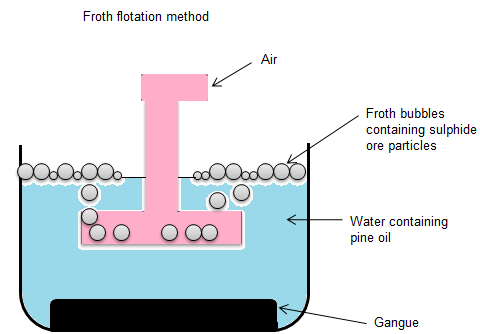
Gangue also means impurities.
Note:
Remember that the process of froth flotation is mainly used for sulphide ores of copper, lead and zinc. Apart from these it can also be used for the concentration of Cinnabar ( HgS ) the ore of mercury.
We know that minerals are present in ores. The solid materials from which a pure metal can be obtained is called ore. The minerals in the ore are present with unwanted minerals called impurities.
Complete step by step solution:
As we know that minerals are present in ores. To extract minerals we have to dig the ore of that mineral. Minerals are present with some unwanted materials called impurities. To remove these unwanted substances the ores are concentrated on the basic of the type of impurities and their percentage proportion. There are different procedures for the concentration of ores such as hydraulic washing, magnetic separation, froth floatation process, leaching etc.
- Froth flotation method is used for enrichment of ore containing sulphide.
- The term flotation refers to separating mineral particles according to the difference in their physical and chemical properties.
- This method is particularly used for sulphide minerals as sulphide minerals have high float ability.
- In this method of froth flotation water and fine powder of the ore are filled in a big vessel. After this substances like pine, or turpentine oil is poured into it. By doing so the sulphides of metal get wet and stick to it, while clay and particles of sand do not get wet.
- After this air is passed with pressure through a tube.
- Froth is produced along with the light particles of the sulphide ore and comes to the surface of the liquid mixture. Heavy particles become wet and settle down at the bottom.
- Now the sulphide ore is removed with sieves ( a utensil used for straining solid from liquid ) in other vessel and washed with water.
Gangue also means impurities.
Note:
Remember that the process of froth flotation is mainly used for sulphide ores of copper, lead and zinc. Apart from these it can also be used for the concentration of Cinnabar ( HgS ) the ore of mercury.
Recently Updated Pages
Write structures of the following compounds i 2 Chloro3methylpentane class 11 chemistry CBSE

What is BLO What is the full form of BLO class 8 social science CBSE
Explain the Treaty of Vienna of 1815 class 10 social science CBSE
A Paragraph on Pollution in about 100-150 Words
XIX+XXX A 49 B 51 C 55 D 44 class 5 maths CBSE
If x a + bt + ct2 where x is in meters and t is in class 11 physics CBSE
Trending doubts
One Metric ton is equal to kg A 10000 B 1000 C 100 class 11 physics CBSE
Find the value of the expression given below sin 30circ class 11 maths CBSE
What do you mean by retardation What is its SI uni class 11 physics CBSE
Draw a diagram of nephron and explain its structur class 11 biology CBSE
10 examples of friction in our daily life
Difference between physical and chemical change class 11 chemistry CBSE