




Compute the Curves surface area, Surface area and volume for a cylinder with the following dimensions.
a. diameter 2.4cm, height 6.2cm.
b. radius 3cm, height 3.6cm.
Answer
 Verified
582.3k+ views
Hint: In this problem, we have to find the curved surface area, surface area and the volume of a cylinder whose dimensions are given. We should know the formulas to find the values. We know that the volume of a cylinder is \[\pi {{r}^{2}}h\], surface area of the cylinder is \[2\pi \left( r+h \right)\] and the curved surface area is \[2\pi rh\].
Complete step by step solution:
We know that the given dimensions are,
a. diameter 2.4cm, height 6.2cm.
we also know that the formula for the volume of the cylinder is
Volume of the cylinder = \[\pi {{r}^{2}}h\]
We know that radius is half of the diameter, so
\[r=\dfrac{2.4}{2}=1.2\]cm and we have h = 6.2cm.
We can substitute the above values in volume formula, we get
\[\begin{align}
& \Rightarrow \dfrac{22}{7}{{\left( 1.2 \right)}^{2}}\left( 6.2 \right) \\
& \Rightarrow 28.05c{{m}^{3}} \\
\end{align}\]
We know that the formula for curved surface area is,
Curved surface area of cylinder = \[2\pi rh\].
\[\begin{align}
& \Rightarrow 2\times \dfrac{22}{7}\left( 1.2 \right)\left( 6.2 \right) \\
& \Rightarrow 3975c{{m}^{2}} \\
\end{align}\]
We know that the formula for surface area is,
Surface area of cylinder = \[2\pi \left( r+h \right)\].
\[\begin{align}
& \Rightarrow 2\times \dfrac{22}{7}\left( 1.2+6.2 \right) \\
& \Rightarrow 46.51c{{m}^{2}} \\
\end{align}\]
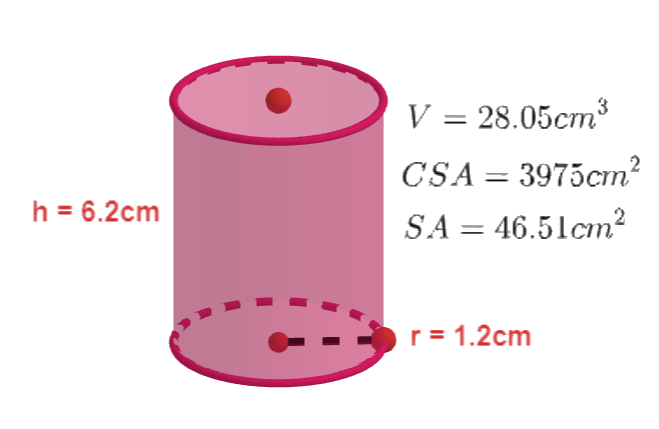
Therefore, the volume of cylinder is \[28.05c{{m}^{3}}\], curved surface area of cylinder is \[3975c{{m}^{2}}\] and surface area is \[46.51c{{m}^{2}}\].
b. radius 3cm, height 3.6cm.
we also know that the formula for the volume of the cylinder is
Volume of the cylinder = \[\pi {{r}^{2}}h\]
We know that radius is half of the diameter, so
r = 3cm and we have h = 3.6cm.
We can substitute the above values in volume formula, we get
\[\begin{align}
& \Rightarrow \dfrac{22}{7}{{\left( 3 \right)}^{2}}\left( 3.6 \right) \\
& \Rightarrow 101.82c{{m}^{3}} \\
\end{align}\]
We know that the formula for curved surface area is,
Curved surface area of cylinder = \[2\pi rh\].
\[\begin{align}
& \Rightarrow 2\times \dfrac{22}{7}\left( 3 \right)\left( 3.6 \right) \\
& \Rightarrow 67.88c{{m}^{2}} \\
\end{align}\]
We know that the formula for surface area is,
Surface area of cylinder = \[2\pi \left( r+h \right)\].
\[\begin{align}
& \Rightarrow 2\times \dfrac{22}{7}\left( 3+3.6 \right) \\
& \Rightarrow 41.48c{{m}^{2}} \\
\end{align}\]
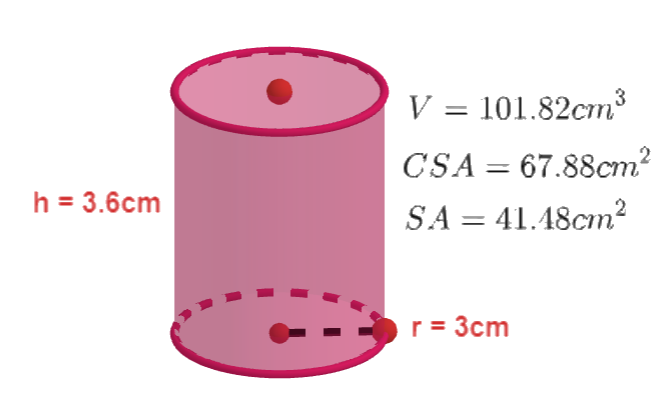
Therefore, the volume of cylinder is \[101.82c{{m}^{3}}\], curved surface area of cylinder is \[67.88c{{m}^{2}}\] and surface area is \[41.48c{{m}^{2}}\].
Note: Students make mistakes while writing the correct formula for the volume, curved surface area and the surface area. We should also remember that radius is half the diameter, so we can divide the given diameter by 2 to get the value of the radius.
Complete step by step solution:
We know that the given dimensions are,
a. diameter 2.4cm, height 6.2cm.
we also know that the formula for the volume of the cylinder is
Volume of the cylinder = \[\pi {{r}^{2}}h\]
We know that radius is half of the diameter, so
\[r=\dfrac{2.4}{2}=1.2\]cm and we have h = 6.2cm.
We can substitute the above values in volume formula, we get
\[\begin{align}
& \Rightarrow \dfrac{22}{7}{{\left( 1.2 \right)}^{2}}\left( 6.2 \right) \\
& \Rightarrow 28.05c{{m}^{3}} \\
\end{align}\]
We know that the formula for curved surface area is,
Curved surface area of cylinder = \[2\pi rh\].
\[\begin{align}
& \Rightarrow 2\times \dfrac{22}{7}\left( 1.2 \right)\left( 6.2 \right) \\
& \Rightarrow 3975c{{m}^{2}} \\
\end{align}\]
We know that the formula for surface area is,
Surface area of cylinder = \[2\pi \left( r+h \right)\].
\[\begin{align}
& \Rightarrow 2\times \dfrac{22}{7}\left( 1.2+6.2 \right) \\
& \Rightarrow 46.51c{{m}^{2}} \\
\end{align}\]
Therefore, the volume of cylinder is \[28.05c{{m}^{3}}\], curved surface area of cylinder is \[3975c{{m}^{2}}\] and surface area is \[46.51c{{m}^{2}}\].
b. radius 3cm, height 3.6cm.
we also know that the formula for the volume of the cylinder is
Volume of the cylinder = \[\pi {{r}^{2}}h\]
We know that radius is half of the diameter, so
r = 3cm and we have h = 3.6cm.
We can substitute the above values in volume formula, we get
\[\begin{align}
& \Rightarrow \dfrac{22}{7}{{\left( 3 \right)}^{2}}\left( 3.6 \right) \\
& \Rightarrow 101.82c{{m}^{3}} \\
\end{align}\]
We know that the formula for curved surface area is,
Curved surface area of cylinder = \[2\pi rh\].
\[\begin{align}
& \Rightarrow 2\times \dfrac{22}{7}\left( 3 \right)\left( 3.6 \right) \\
& \Rightarrow 67.88c{{m}^{2}} \\
\end{align}\]
We know that the formula for surface area is,
Surface area of cylinder = \[2\pi \left( r+h \right)\].
\[\begin{align}
& \Rightarrow 2\times \dfrac{22}{7}\left( 3+3.6 \right) \\
& \Rightarrow 41.48c{{m}^{2}} \\
\end{align}\]
Therefore, the volume of cylinder is \[101.82c{{m}^{3}}\], curved surface area of cylinder is \[67.88c{{m}^{2}}\] and surface area is \[41.48c{{m}^{2}}\].
Note: Students make mistakes while writing the correct formula for the volume, curved surface area and the surface area. We should also remember that radius is half the diameter, so we can divide the given diameter by 2 to get the value of the radius.
Recently Updated Pages
Master Class 11 English: Engaging Questions & Answers for Success

Master Class 11 Social Science: Engaging Questions & Answers for Success
Master Class 11 Maths: Engaging Questions & Answers for Success
Master Class 11 Biology: Engaging Questions & Answers for Success
Master Class 11 Physics: Engaging Questions & Answers for Success
Master Class 11 Chemistry: Engaging Questions & Answers for Success
Trending doubts
Explain the Treaty of Vienna of 1815 class 10 social science CBSE
What is the full form of POSCO class 10 social science CBSE
What planets have no moons Which one has only one moon class 10 physics CBSE
Define Potential, Developed, Stock and Reserved resources
In cricket, which Indian bowler is known as the "Yorker King"?
The diagonals of a rhombus are 10cm and 24cm Find the class 10 maths CBSE