




Complete the Venn diagram
\[\begin{array}{l}E = \left\{ {21,22,23,24,25,26,27,28,29,30} \right\}\\A = \left\{ {x:x\,{\rm{is}}\,{\rm{a}}\,{\rm{multiple}}\,{\rm{of}}\,3} \right\}\\B = \left\{ {x:x\,{\rm{is}}\,{\rm{prime}}} \right\}\\C = \left\{ {x:x\,{\rm{ < 25}}} \right\}\end{array}\]
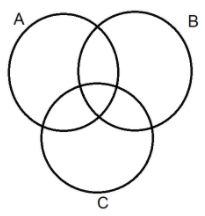
Answer
 Verified
610.8k+ views
Hint:
Here we will first find the elements of the sets given with the conditions. Then we will find the common terms between the every two groups. We will then find the common terms from all the three groups. Then we will complete the Venn diagram using the obtained elements or terms.
Complete step by step solution:
The given set of data is \[E = \left\{ {21,22,23,24,25,26,27,28,29,30} \right\}\]
Firstly we will find the elements of each group.
Condition of the group A is \[A = \left\{ {x:x\,{\rm{is}}\,{\rm{a}}\,{\rm{multiple}}\,{\rm{of}}\,3} \right\}\]. Therefore the elements in the group A is
\[A = \left\{ {21,24,27,30} \right\}\]
Condition of the group B is \[B = \left\{ {x:x\,{\rm{is}}\,{\rm{prime}}} \right\}\]. Therefore the elements in the group B is
\[B = \left\{ {23,29} \right\}\]
Condition of the group C is \[C = \left\{ {x:x\,{\rm{ < 25}}} \right\}\]. Therefore the elements in the group C is
\[C = \left\{ {21,22,23,24} \right\}\]
Now we will find the common term between the group A and B, we get
\[A \cup B = 0\]
Now we will find the common term between the group B and C, we get
\[B \cup C = \left\{ {23} \right\}\]
Now we will find the common term between the group A and C, we get
\[A \cup C = \left\{ {21,24} \right\}\]
Now we will find the common terms in all the three groups A, Band C. Therefore, we get
\[A \cup B \cup C = 0\]
Now we will fill these values in the Venn diagram. Therefore we get
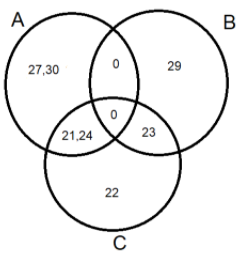
Hence, the Venn diagram is completed.
Note:
Here we should know that Venn diagram is the diagram which shows all the possible relations between different sets of data. Venn diagrams are also known as the primary diagram or logic diagram or set diagram. It is important to note that the intersection area by all the three circles is the area for the elements common in all the three groups. The areas intersected by two circles are the area for the elements which are common in those two groups. We should also remember that in the common region the data may not repeat.
Here we will first find the elements of the sets given with the conditions. Then we will find the common terms between the every two groups. We will then find the common terms from all the three groups. Then we will complete the Venn diagram using the obtained elements or terms.
Complete step by step solution:
The given set of data is \[E = \left\{ {21,22,23,24,25,26,27,28,29,30} \right\}\]
Firstly we will find the elements of each group.
Condition of the group A is \[A = \left\{ {x:x\,{\rm{is}}\,{\rm{a}}\,{\rm{multiple}}\,{\rm{of}}\,3} \right\}\]. Therefore the elements in the group A is
\[A = \left\{ {21,24,27,30} \right\}\]
Condition of the group B is \[B = \left\{ {x:x\,{\rm{is}}\,{\rm{prime}}} \right\}\]. Therefore the elements in the group B is
\[B = \left\{ {23,29} \right\}\]
Condition of the group C is \[C = \left\{ {x:x\,{\rm{ < 25}}} \right\}\]. Therefore the elements in the group C is
\[C = \left\{ {21,22,23,24} \right\}\]
Now we will find the common term between the group A and B, we get
\[A \cup B = 0\]
Now we will find the common term between the group B and C, we get
\[B \cup C = \left\{ {23} \right\}\]
Now we will find the common term between the group A and C, we get
\[A \cup C = \left\{ {21,24} \right\}\]
Now we will find the common terms in all the three groups A, Band C. Therefore, we get
\[A \cup B \cup C = 0\]
Now we will fill these values in the Venn diagram. Therefore we get
Hence, the Venn diagram is completed.
Note:
Here we should know that Venn diagram is the diagram which shows all the possible relations between different sets of data. Venn diagrams are also known as the primary diagram or logic diagram or set diagram. It is important to note that the intersection area by all the three circles is the area for the elements common in all the three groups. The areas intersected by two circles are the area for the elements which are common in those two groups. We should also remember that in the common region the data may not repeat.
Recently Updated Pages
Master Class 11 English: Engaging Questions & Answers for Success

Master Class 11 Social Science: Engaging Questions & Answers for Success
Master Class 11 Maths: Engaging Questions & Answers for Success
Master Class 11 Biology: Engaging Questions & Answers for Success
Master Class 11 Physics: Engaging Questions & Answers for Success
Master Class 11 Chemistry: Engaging Questions & Answers for Success
Trending doubts
One Metric ton is equal to kg A 10000 B 1000 C 100 class 11 physics CBSE
Difference Between Prokaryotic Cells and Eukaryotic Cells
Find the value of the expression given below sin 30circ class 11 maths CBSE
Difference between physical and chemical change class 11 chemistry CBSE
Two of the body parts which do not appear in MRI are class 11 biology CBSE
Draw a diagram of a plant cell and label at least eight class 11 biology CBSE