



Complete the following table by writing (YES) if the property holds for the particular Quadrilateral and (NO) if property does not hold.

Answer
 Verified
644.4k+ views
Hint: Here we need to discuss the given property that two pairs of opposite sides are parallel, with respect to the various geometrical figures.
Complete step by step solution: The first figure to be taken into consideration is a Trapezium:
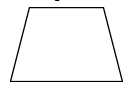
Clearly, a trapezium has only one pair of opposite sides parallel to each other. That means, as per the property mentioned in the table, the answer is NO- since, in a trapezium only one and not two pairs of opposite sides are parallel.
Next we need to consider a Parallelogram which looks like the following:
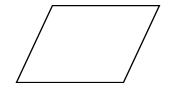
A typical parallelogram is a quadrilateral in which two pairs of opposite sides are parallel, that is primarily the reason why we call this typical quadrilateral a parallelogram. Hence the answer with respect to the table is YES-a parallelogram has two pairs of opposite sides which are parallel.
Next we need to consider a Rhombus which looks like the following:
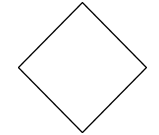
A Rhombus is a quadrilateral which has all four sides equal and two opposite pairs of parallel sides. Hence, with respect to the property mentioned in the table given in the question, the answer is YES- a Rhombus has two pairs of opposite parallel sides.
Next we need to consider a Rectangle which looks like the following:
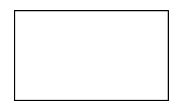
A Rectangle is a special parallelogram whose vertices have an angle of ${90^ \circ }$. So it is a quadrilateral which will have two opposite pairs of parallel sides. Hence, the answer with respect to the table in the question is YES- Rectangle has two pairs of parallel opposite sides.
Next we need to consider a Square which looks like the following:
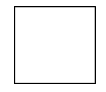
A Square is a special parallelogram whose all sides and diagonals are equal and the vertex angles are ${90^ \circ }$. A square has two pairs opposite parallel sides.
The table will finally look like:

Note: All the figures asked are four sided quadrilaterals and parallelograms; however, we need to be careful in establishing the special cases to check for the property mentioned in the question. Square and Rectangle are special cases of parallelogram with the vertex angles of${90^ \circ }$.
Square and Rhombus both are parallelograms, whose all sides are equal, the only difference between the two being while Square has its vertex angles as ${90^ \circ }$, the rhombus does not have its vertex angles as ${90^ \circ }$. A trapezium is not a complete parallelogram, since it has only one pair of opposite sides parallel.
Complete step by step solution: The first figure to be taken into consideration is a Trapezium:
Clearly, a trapezium has only one pair of opposite sides parallel to each other. That means, as per the property mentioned in the table, the answer is NO- since, in a trapezium only one and not two pairs of opposite sides are parallel.
Next we need to consider a Parallelogram which looks like the following:
A typical parallelogram is a quadrilateral in which two pairs of opposite sides are parallel, that is primarily the reason why we call this typical quadrilateral a parallelogram. Hence the answer with respect to the table is YES-a parallelogram has two pairs of opposite sides which are parallel.
Next we need to consider a Rhombus which looks like the following:
A Rhombus is a quadrilateral which has all four sides equal and two opposite pairs of parallel sides. Hence, with respect to the property mentioned in the table given in the question, the answer is YES- a Rhombus has two pairs of opposite parallel sides.
Next we need to consider a Rectangle which looks like the following:
A Rectangle is a special parallelogram whose vertices have an angle of ${90^ \circ }$. So it is a quadrilateral which will have two opposite pairs of parallel sides. Hence, the answer with respect to the table in the question is YES- Rectangle has two pairs of parallel opposite sides.
Next we need to consider a Square which looks like the following:
A Square is a special parallelogram whose all sides and diagonals are equal and the vertex angles are ${90^ \circ }$. A square has two pairs opposite parallel sides.
The table will finally look like:
Note: All the figures asked are four sided quadrilaterals and parallelograms; however, we need to be careful in establishing the special cases to check for the property mentioned in the question. Square and Rectangle are special cases of parallelogram with the vertex angles of${90^ \circ }$.
Square and Rhombus both are parallelograms, whose all sides are equal, the only difference between the two being while Square has its vertex angles as ${90^ \circ }$, the rhombus does not have its vertex angles as ${90^ \circ }$. A trapezium is not a complete parallelogram, since it has only one pair of opposite sides parallel.
Recently Updated Pages
Master Class 12 Economics: Engaging Questions & Answers for Success

Master Class 12 Biology: Engaging Questions & Answers for Success
Master Class 11 English: Engaging Questions & Answers for Success
Master Class 11 Physics: Engaging Questions & Answers for Success
Master Class 11 Computer Science: Engaging Questions & Answers for Success
Master Class 11 Chemistry: Engaging Questions & Answers for Success
Trending doubts
Difference Between Plant Cell and Animal Cell
Fill the blanks with the suitable prepositions 1 The class 9 english CBSE
What is pollution? How many types of pollution? Define it
What is the full form of pH?
Name 10 Living and Non living things class 9 biology CBSE
How do you solve for x in the equation xy x + y class 9 maths CBSE