




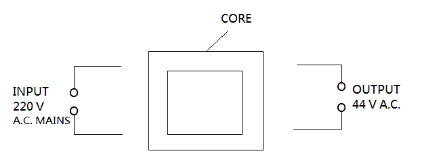
Complete the diagram of the transformer and connection by labelling all parts joined by you.
Answer
 Verified
611.7k+ views
Hint: In the given diagram, one end is at higher potential difference while the other end is at lower difference. The given diagram is of a transformer. A transformer is a device which is capable of transferring electric current from one circuit to another circuit.
Complete answer:
As the given diagram is of transformer, we will complete the diagram accordingly. In a transformer, the coil is of iron. The core is made up of thin laminated sheets of iron.The complete and labelled diagram is given below:
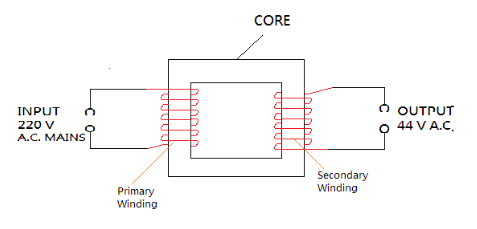
There are two types of winding in the transformer. The winding on the left side (input side) is known as primary winding. The winding on the right side is the output side. The winding on the output side is known as secondary winding.
Based on the number of turns there are two types of transformers.
1) Step up transformer
2) Step down transformer
1) Step-up transformer: When the voltage at output is more than the input voltage, it is known as a step-up transformer. In step-up transformers, the number of turns in secondary winding is more than in primary winding.
2) Step-down transformer: When the voltage at output is less than the input voltage, it is known as a step-down transformer. In step-down transformers, the number of turns in secondary winding is less than number of turns in primary winding.
Note: When the output voltage is less than input voltage, the given transformer is a step-down transformer. Number of turns is important in transformers. In some transformers, the primary and secondary winding is shared through the same coil. In that case the diagram will be different.
Complete answer:
As the given diagram is of transformer, we will complete the diagram accordingly. In a transformer, the coil is of iron. The core is made up of thin laminated sheets of iron.The complete and labelled diagram is given below:
There are two types of winding in the transformer. The winding on the left side (input side) is known as primary winding. The winding on the right side is the output side. The winding on the output side is known as secondary winding.
Based on the number of turns there are two types of transformers.
1) Step up transformer
2) Step down transformer
1) Step-up transformer: When the voltage at output is more than the input voltage, it is known as a step-up transformer. In step-up transformers, the number of turns in secondary winding is more than in primary winding.
2) Step-down transformer: When the voltage at output is less than the input voltage, it is known as a step-down transformer. In step-down transformers, the number of turns in secondary winding is less than number of turns in primary winding.
Note: When the output voltage is less than input voltage, the given transformer is a step-down transformer. Number of turns is important in transformers. In some transformers, the primary and secondary winding is shared through the same coil. In that case the diagram will be different.
Recently Updated Pages
Master Class 12 Business Studies: Engaging Questions & Answers for Success

Master Class 12 Chemistry: Engaging Questions & Answers for Success
Master Class 12 Biology: Engaging Questions & Answers for Success
Class 12 Question and Answer - Your Ultimate Solutions Guide
Master Class 11 English: Engaging Questions & Answers for Success
Master Class 11 Social Science: Engaging Questions & Answers for Success
Trending doubts
Which are the Top 10 Largest Countries of the World?
Draw a labelled sketch of the human eye class 12 physics CBSE
The end of compass needle which points towards north class 12 physics CBSE
Differentiate between homogeneous and heterogeneous class 12 chemistry CBSE
Why is the cell called the structural and functional class 12 biology CBSE
When was the first election held in India a 194748 class 12 sst CBSE