




Compensation point is the value of the factor where there is-
a. Neither photosynthesis or respiration.
b. Little photosynthesis
c. Photosynthesis is equal to the rate of respiration
d. Beginning of photosynthesis.
Answer
 Verified
650.4k+ views
Hint: The compensation point in the plant is the light intensity on the light curve for which the rate of photosynthesis is equal to the rate of respiration in the plant cell.
Complete answer:
> Option A, Neither photosynthesis or respiration
This option is incorrect as the compensation point is light intensity with the equal value of photosynthesis and respiration.
> Option B, Little photosynthesis
Option b is not the right answer to the question as the right value of the compensation point is the balance between the both photosynthesis and respiration.
> Option C, Photosynthesis is equal to the rate of respiration
Compensation point:
The compensation point is the value of light intensity on the light curve where the rate of photosynthesis exactly matches the rate of respiration. At this point, the uptake $CO_2$ of through photosynthetic pathways is exactly the same value to the respiratory release of carbon dioxide, and the uptake of $O_2$ by respiration is balanced to the photosynthetic release of oxygen.
Timing:
This point is reached during early mornings as well as late evenings. Respiration is relatively constant whereas photosynthesis depends on the amount of sunlight the plant is receiving.
Rate:
At the compensation point, the rate of photosynthesis should be balanced to the rate of respiration resulting in plant is neither consuming nor building biomass.
> Option D, Beginning of photosynthesis.
This is not right as the compensation point is made up of the balanced amount of both the process photosynthesis as well as respiration.
Hence, The correct answer is option (C).
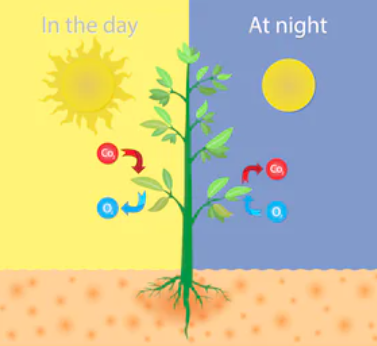
Note: Compensation point varies in different species of plants. It even varies in response to changes in temperature and other environmental factors. Compensation points can usually be seen at dusk and dawn on a cloudy day.
Complete answer:
> Option A, Neither photosynthesis or respiration
This option is incorrect as the compensation point is light intensity with the equal value of photosynthesis and respiration.
> Option B, Little photosynthesis
Option b is not the right answer to the question as the right value of the compensation point is the balance between the both photosynthesis and respiration.
> Option C, Photosynthesis is equal to the rate of respiration
Compensation point:
The compensation point is the value of light intensity on the light curve where the rate of photosynthesis exactly matches the rate of respiration. At this point, the uptake $CO_2$ of through photosynthetic pathways is exactly the same value to the respiratory release of carbon dioxide, and the uptake of $O_2$ by respiration is balanced to the photosynthetic release of oxygen.
Timing:
This point is reached during early mornings as well as late evenings. Respiration is relatively constant whereas photosynthesis depends on the amount of sunlight the plant is receiving.
Rate:
At the compensation point, the rate of photosynthesis should be balanced to the rate of respiration resulting in plant is neither consuming nor building biomass.
> Option D, Beginning of photosynthesis.
This is not right as the compensation point is made up of the balanced amount of both the process photosynthesis as well as respiration.
Hence, The correct answer is option (C).
Note: Compensation point varies in different species of plants. It even varies in response to changes in temperature and other environmental factors. Compensation points can usually be seen at dusk and dawn on a cloudy day.
Recently Updated Pages
Which will be the least stable resonating structure class 11 chemistry CBSE

How many 5 digit telephone numbers can be construc-class-11-maths-CBSE
How do you find the angle of the resultant vector class 11 physics CBSE
Draw labelled diagram of the following i Gram seed class 11 biology CBSE
1 Quintal is equal to a 110 kg b 10 kg c 100kg d 1000 class 11 physics CBSE
What is the need and importance of classification class 11 biology CBSE
Trending doubts
One Metric ton is equal to kg A 10000 B 1000 C 100 class 11 physics CBSE
Find the value of the expression given below sin 30circ class 11 maths CBSE
Draw a diagram of nephron and explain its structur class 11 biology CBSE
10 examples of friction in our daily life
Proton was discovered by A Thomson B Rutherford C Chadwick class 11 chemistry CBSE
The teeth used for biting and cutting food are called class 11 biology CBSE