



What color is the interior of a solar cooker?
A. White
B. Black
C. Purple
D. Yellow
Answer
 Verified
585.6k+ views
Hint: You can start by describing the function of a solar cooker with the help of a diagram of a simple solar cooker. Then move on to explain which color reflects all the light (white color) and which color absorbs all the light (black color). Then mention which color is used in the interior of a solar cooker.
Complete answer:
To solve this problem, it would be good if we understand the functioning of a solar cooker.
A solar cooker is an equipment that uses energy from the sun to cook food kept inside it.
The components of a basic solar cooker are shown in the following diagram
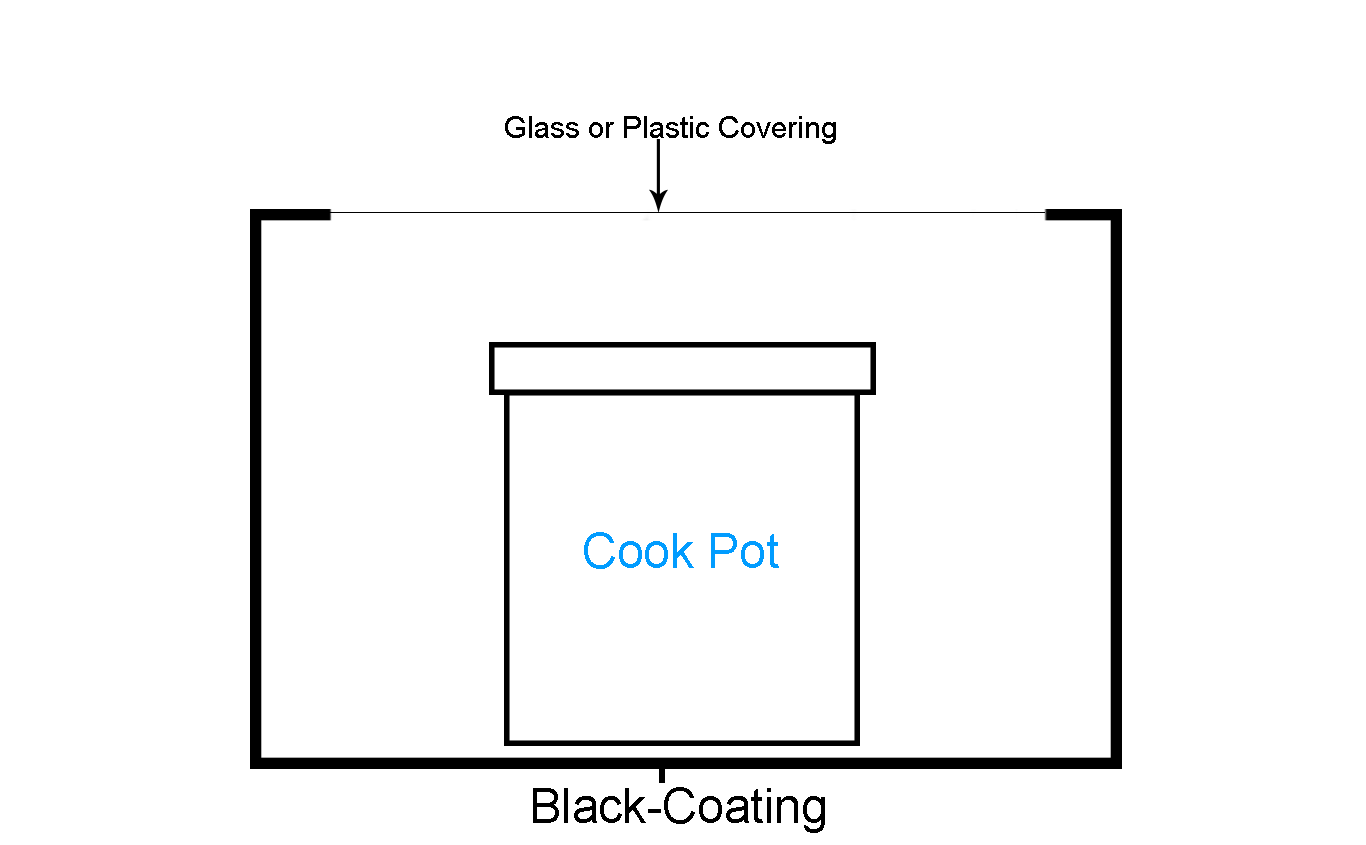
The solar cooker here is the form of a cube (it can be of any shape). The top face of the cube is covered by a glass or plastic sheet, this allows light rays from the sun to enter the solar cooker. All the other walls of the cube are black this will be explained later on. Then on the inside, we place a cooking pot that has the food that is to be cooked.
We all know that different color objects absorb different amounts of light energy. White-colored objects do not absorb any light and reflect all the light that falls on it. Black colored objects absorb all the light and do not reflect any light that falls on it. Any other color (like say blue) absorbs some amount of light and reflects the rest.
This is why the interior of a solar cooker is always black in, as any light energy that enters through the glass or plastic covering is trapped in the solar cooker and this increases the temperature inside the solar temperature, which in turn raises the temperature of the cooking pot and this cooks the food.
So, the correct answer is “Option B”.
Note:
In the solution above, we discussed that white color does not absorb light and reflects all the light. We also discussed that black color absorbs all light and reflects nothing. But, in reality, black does reflect some amount of light and white does absorb some amount of light. So what it means is no black or white-colored object you see in your surrounding is not truly black and white respectively.
Complete answer:
To solve this problem, it would be good if we understand the functioning of a solar cooker.
A solar cooker is an equipment that uses energy from the sun to cook food kept inside it.
The components of a basic solar cooker are shown in the following diagram
The solar cooker here is the form of a cube (it can be of any shape). The top face of the cube is covered by a glass or plastic sheet, this allows light rays from the sun to enter the solar cooker. All the other walls of the cube are black this will be explained later on. Then on the inside, we place a cooking pot that has the food that is to be cooked.
We all know that different color objects absorb different amounts of light energy. White-colored objects do not absorb any light and reflect all the light that falls on it. Black colored objects absorb all the light and do not reflect any light that falls on it. Any other color (like say blue) absorbs some amount of light and reflects the rest.
This is why the interior of a solar cooker is always black in, as any light energy that enters through the glass or plastic covering is trapped in the solar cooker and this increases the temperature inside the solar temperature, which in turn raises the temperature of the cooking pot and this cooks the food.
So, the correct answer is “Option B”.
Note:
In the solution above, we discussed that white color does not absorb light and reflects all the light. We also discussed that black color absorbs all light and reflects nothing. But, in reality, black does reflect some amount of light and white does absorb some amount of light. So what it means is no black or white-colored object you see in your surrounding is not truly black and white respectively.

Recently Updated Pages
Master Class 8 Social Science: Engaging Questions & Answers for Success

Master Class 8 English: Engaging Questions & Answers for Success
Class 8 Question and Answer - Your Ultimate Solutions Guide
Master Class 8 Maths: Engaging Questions & Answers for Success
Master Class 8 Science: Engaging Questions & Answers for Success
Master Class 7 English: Engaging Questions & Answers for Success
Trending doubts
Difference Between Plant Cell and Animal Cell
Fill the blanks with the suitable prepositions 1 The class 9 english CBSE
Who is eligible for RTE class 9 social science CBSE
Which places in India experience sunrise first and class 9 social science CBSE
What is pollution? How many types of pollution? Define it
Name 10 Living and Non living things class 9 biology CBSE