




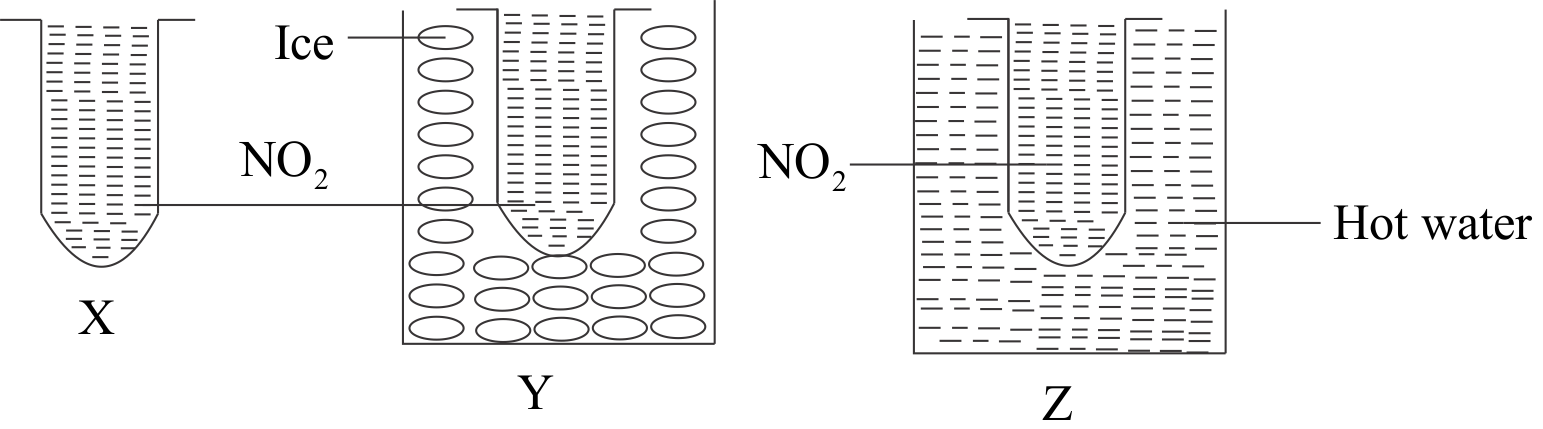
What color change will you observe in the test tubes and why? If in an experiment, $N{O_2}$ is prepared and kept in 3 text tubes X,Y and Z. $N{O_2}$ gas is brown in color which dimerizes into ${N_2}{O_4}$ which is colorless. X is kept at room temperature, Y in ice and Z in hot water. If $2N{O_{2(g)}} \rightleftharpoons {N_2}{O_{4(g)}},\Delta H = - 57.2kJmo{l^{ - 1}}$
A.In test tube X, brown color intensifies since the backward reaction is favoured at low temperature.
B.In test tube Y, brown color intensifies since backward reaction takes place at room temperature.
C.In test tube Z, brown color intensifies since high temperature favours the backward reaction.
D.Brown color in the test tubes X, Y and Z remains the same since there is no effect of change in the temperature on the reaction.
Answer
 Verified
611.7k+ views
Hint: Le Chatelier's Principle helps to predict what effect a change in temperature, concentration or pressure will have on the position of the equilibrium in a chemical reaction.
Complete answer:
Since this is an exothermic process, heat is released, and at low temperatures forward reaction is favoured.
In test tubes, X and Y forward reaction is favoured and ${N_2}{O_4}$ is formed which is colorless. In the test tube, brown color intensifies, as it is kept in hot water since high temperature favours the backward reaction.
Hence, the correct answer is (C).
Note:
-If the temperature of a reaction mixture is changed, the equilibrium will shift to minimize that change.
-If the temperature is increased, the equilibrium will shift to favour the reaction which will reduce the temperature. The endothermic reaction is favoured.
-If the temperature is decreased, the equilibrium will shift to favour the reaction which will increase the temperature. The exothermic reaction is favoured.
Complete answer:
Since this is an exothermic process, heat is released, and at low temperatures forward reaction is favoured.
In test tubes, X and Y forward reaction is favoured and ${N_2}{O_4}$ is formed which is colorless. In the test tube, brown color intensifies, as it is kept in hot water since high temperature favours the backward reaction.
Hence, the correct answer is (C).
Note:
-If the temperature of a reaction mixture is changed, the equilibrium will shift to minimize that change.
-If the temperature is increased, the equilibrium will shift to favour the reaction which will reduce the temperature. The endothermic reaction is favoured.
-If the temperature is decreased, the equilibrium will shift to favour the reaction which will increase the temperature. The exothermic reaction is favoured.
Recently Updated Pages
Master Class 11 English: Engaging Questions & Answers for Success

Master Class 11 Social Science: Engaging Questions & Answers for Success
Master Class 11 Maths: Engaging Questions & Answers for Success
Master Class 11 Biology: Engaging Questions & Answers for Success
Master Class 11 Physics: Engaging Questions & Answers for Success
Master Class 11 Chemistry: Engaging Questions & Answers for Success
Trending doubts
One Metric ton is equal to kg A 10000 B 1000 C 100 class 11 physics CBSE
Difference Between Prokaryotic Cells and Eukaryotic Cells
Find the value of the expression given below sin 30circ class 11 maths CBSE
1 ton equals to A 100 kg B 1000 kg C 10 kg D 10000 class 11 physics CBSE
Two of the body parts which do not appear in MRI are class 11 biology CBSE
What are hard magnetic materials class 11 physics CBSE