




Colloblast (adhesive) cells are the characteristic of
A. Hydra
B. Comb jelly
C. Obelia
D. All of the above
Answer
 Verified
654.6k+ views
Hint: Colloblast cells are the characteristic feature of the largest animals that are able to swim in water with the help of cilia and also produce bioluminescence that means they illuminate light.
Complete answer:
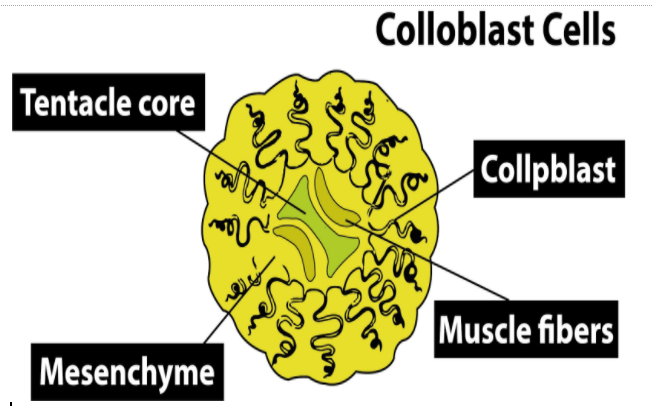
Colloblasts are the type of cells that are found in ctenophores, these cells are found in their tentacles which help them to capture their pretty. Ctenophores are commonly called comb jelly.
Additional Information:
-Ctenophores are the group of marine invertebrates that belong to the phylum Ctenophora.
-Their characteristic feature is the presence of cilia which helps them in movement.
-They have an egg-shaped body that is covered with tentacles. These tentacles are attached with little tentacles.
-On the little tentacles, a cover of sticky cells called colloblast cells is present which captures prey.
-They mainly function as predators of small as well as large animals.
-The body of ctenophores is made up of soft jelly which is covered by a two-layered thick outer wall and an inner wall that lines the body cavity.
-Inside the epidermis of the colloblast cells, a spiral filament id deeply embedded which has an axial filament and granular dome.
-These granules, when attached to prey, will burst and secrete adhesive substances onto the prey and prevent them from escaping.
So, the correct answer is ‘Comb jelly’.
Note: The colloblast cells were first discovered in 1844. Ctenophora was first discovered in 1671 by a doctor named Martens. It was later placed under the group zoophyte by Linnaeus. The order Ctenophora was first created in 1829 under Coelenterata by Eschscholtz. It has a characteristic feature of light emission called bioluminescence, which was first noticed by Charles Darwin.
Complete answer:
Colloblasts are the type of cells that are found in ctenophores, these cells are found in their tentacles which help them to capture their pretty. Ctenophores are commonly called comb jelly.
Additional Information:
-Ctenophores are the group of marine invertebrates that belong to the phylum Ctenophora.
-Their characteristic feature is the presence of cilia which helps them in movement.
-They have an egg-shaped body that is covered with tentacles. These tentacles are attached with little tentacles.
-On the little tentacles, a cover of sticky cells called colloblast cells is present which captures prey.
-They mainly function as predators of small as well as large animals.
-The body of ctenophores is made up of soft jelly which is covered by a two-layered thick outer wall and an inner wall that lines the body cavity.
-Inside the epidermis of the colloblast cells, a spiral filament id deeply embedded which has an axial filament and granular dome.
-These granules, when attached to prey, will burst and secrete adhesive substances onto the prey and prevent them from escaping.
So, the correct answer is ‘Comb jelly’.
Note: The colloblast cells were first discovered in 1844. Ctenophora was first discovered in 1671 by a doctor named Martens. It was later placed under the group zoophyte by Linnaeus. The order Ctenophora was first created in 1829 under Coelenterata by Eschscholtz. It has a characteristic feature of light emission called bioluminescence, which was first noticed by Charles Darwin.
Recently Updated Pages
Which will be the least stable resonating structure class 11 chemistry CBSE

How many 5 digit telephone numbers can be construc-class-11-maths-CBSE
How do you find the angle of the resultant vector class 11 physics CBSE
Draw labelled diagram of the following i Gram seed class 11 biology CBSE
What is the need and importance of classification class 11 biology CBSE
The way in which the sparrows expressed their sorrow class 11 english CBSE
Trending doubts
One Metric ton is equal to kg A 10000 B 1000 C 100 class 11 physics CBSE
Find the value of the expression given below sin 30circ class 11 maths CBSE
1 Quintal is equal to a 110 kg b 10 kg c 100kg d 1000 class 11 physics CBSE
Draw a diagram of nephron and explain its structur class 11 biology CBSE
10 examples of friction in our daily life
Proton was discovered by A Thomson B Rutherford C Chadwick class 11 chemistry CBSE