




What is collenchyma? Explain its structure and function in the plant body of a herbaceous angiosperm?
Answer
 Verified
577.5k+ views
Hint: Parenchyma, collenchyma, and sclerenchyma are the three types of simple permanent tissues present in plants. Collenchyma and sclerenchyma are the tissues that provide support and strength to the plant parts. Collenchyma is the first supporting tissue that develops in young stem and leaves of flowering plants and is derived from the parenchyma.
Complete answer:
Plants have two main types of tissues: meristematic tissues and permanent tissues. Meristematic tissues can divide to produce new cells. The permanent tissues are the ones that lose the ability to divide during their differentiation.
Collenchyma is one of the simple permanent tissues present in plants. Being the simple tissue, it is made up of a single type of cell. The cells of the collenchymatous tissue are elongated and retain protoplast at maturity. The cells have a thin primary cell wall, remain elastic, and can be stretched. The cell wall is made up of cellulose and also has pectins and is thickened unevenly at the corners of the cells. The thickening imparts mechanical strength to this tissue.
Collenchyma is mostly found at the periphery of the stem and leaves of herbaceous angiosperms. The function of collenchymatous tissues in these plants is to provide the mechanical support and tensile strength to their non woody stem and leaves. Collenchymatous tissues are stretched during the elongation of cells to facilitate growth. Due to the presence of collenchyma, the leaves and stem of herbs can bend by wind but do not break.
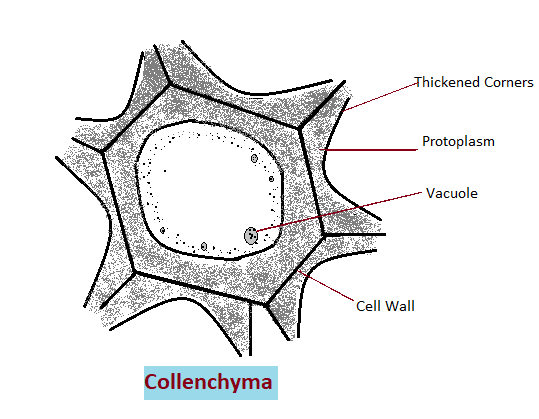
Note: Collenchyma is a flexible tissue that provides support to the soft and nonwoody parts of the plants. It mostly occurs in the form of long strands near the surface of the stem and along the length of the leaf veins. Collenchyma serves the role analogous to the skeletal system in humans.
Complete answer:
Plants have two main types of tissues: meristematic tissues and permanent tissues. Meristematic tissues can divide to produce new cells. The permanent tissues are the ones that lose the ability to divide during their differentiation.
Collenchyma is one of the simple permanent tissues present in plants. Being the simple tissue, it is made up of a single type of cell. The cells of the collenchymatous tissue are elongated and retain protoplast at maturity. The cells have a thin primary cell wall, remain elastic, and can be stretched. The cell wall is made up of cellulose and also has pectins and is thickened unevenly at the corners of the cells. The thickening imparts mechanical strength to this tissue.
Collenchyma is mostly found at the periphery of the stem and leaves of herbaceous angiosperms. The function of collenchymatous tissues in these plants is to provide the mechanical support and tensile strength to their non woody stem and leaves. Collenchymatous tissues are stretched during the elongation of cells to facilitate growth. Due to the presence of collenchyma, the leaves and stem of herbs can bend by wind but do not break.
Note: Collenchyma is a flexible tissue that provides support to the soft and nonwoody parts of the plants. It mostly occurs in the form of long strands near the surface of the stem and along the length of the leaf veins. Collenchyma serves the role analogous to the skeletal system in humans.
Recently Updated Pages
Master Class 11 English: Engaging Questions & Answers for Success

Master Class 11 Social Science: Engaging Questions & Answers for Success
Master Class 11 Maths: Engaging Questions & Answers for Success
Master Class 11 Biology: Engaging Questions & Answers for Success
Master Class 11 Physics: Engaging Questions & Answers for Success
Master Class 11 Chemistry: Engaging Questions & Answers for Success
Trending doubts
One Metric ton is equal to kg A 10000 B 1000 C 100 class 11 physics CBSE
Difference Between Prokaryotic Cells and Eukaryotic Cells
Find the value of the expression given below sin 30circ class 11 maths CBSE
Difference between physical and chemical change class 11 chemistry CBSE
Two of the body parts which do not appear in MRI are class 11 biology CBSE
Draw a diagram of a plant cell and label at least eight class 11 biology CBSE