




What is the collective name for layers of soil.
(a)A-horizon
(b)B-horizon
(c)C -horizon
(d)Soil profile
Answer
 Verified
657.6k+ views
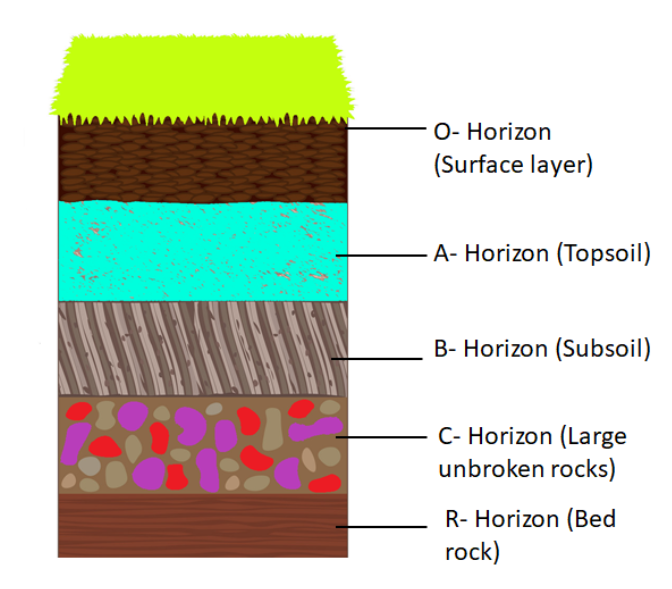
Hint: Soil has many layers that are arranged during the formation of soil. These layers of soil can easily be identified by their color and size of particles of the soil. The main layers of the soil are A-horizon, B-horizon, C-horizon, R-horizon, and O-horizon.
Complete answer:
The soil profile is the collective name for layers of soil. The layers are known as called horizons and their physical, chemical and biological characteristics differ from the layers above and beneath. The layers of soil are the soil profile. Additional information:
A-horizon or Topsoil- or humus layer is rich in organic material. This layer consists of decomposed material and organic matter, the reason why the topsoil has a dark brown color. The topsoil is soft, porous to hold enough air and water because of the hummus. This is the layer where the seeds germinate, roots grow and other living organisms like earthworms, centipedes, bacteria, and fungi are found in this layer of soil.
B- horizon or Subsoil- this lies below the topsoil and is comparatively harder and compact than topsoil. There is less humus in this layer so it is lighter in color and is less organic but is rich in minerals brought down from the topsoil. It contains metal salts mainly iron oxide in a large proportion. Farmers often mix topsoil and subsoil when plowing their fields.
C-horizon or parent rock- lies just below the subsoil. It is made up of stones, rocks and contains no organic matter. The C-horizon layer acts as a transition zone between the earth’s bedrock and B-horizon.
So, the correct answer is ‘Soil profile’.
Note: The soil has taken nearly thousands of years to just form 1cm. Big rocks break down into smaller rocks mainly by two types of weathering- physical weathering and chemical weathering. Several other forces (agents) like wind, water, the sun’s heat, and plants and animals work to break down the parent rock into tiny particles of soil. These pieces get further broken down to form sand, silt, and then finally into finer particles and the process continues.
Complete answer:
The soil profile is the collective name for layers of soil. The layers are known as called horizons and their physical, chemical and biological characteristics differ from the layers above and beneath. The layers of soil are the soil profile. Additional information:
A-horizon or Topsoil- or humus layer is rich in organic material. This layer consists of decomposed material and organic matter, the reason why the topsoil has a dark brown color. The topsoil is soft, porous to hold enough air and water because of the hummus. This is the layer where the seeds germinate, roots grow and other living organisms like earthworms, centipedes, bacteria, and fungi are found in this layer of soil.
B- horizon or Subsoil- this lies below the topsoil and is comparatively harder and compact than topsoil. There is less humus in this layer so it is lighter in color and is less organic but is rich in minerals brought down from the topsoil. It contains metal salts mainly iron oxide in a large proportion. Farmers often mix topsoil and subsoil when plowing their fields.
C-horizon or parent rock- lies just below the subsoil. It is made up of stones, rocks and contains no organic matter. The C-horizon layer acts as a transition zone between the earth’s bedrock and B-horizon.
So, the correct answer is ‘Soil profile’.
Note: The soil has taken nearly thousands of years to just form 1cm. Big rocks break down into smaller rocks mainly by two types of weathering- physical weathering and chemical weathering. Several other forces (agents) like wind, water, the sun’s heat, and plants and animals work to break down the parent rock into tiny particles of soil. These pieces get further broken down to form sand, silt, and then finally into finer particles and the process continues.
Recently Updated Pages
Write structures of the following compounds i 2 Chloro3methylpentane class 11 chemistry CBSE

What is BLO What is the full form of BLO class 8 social science CBSE
Explain the Treaty of Vienna of 1815 class 10 social science CBSE
A Paragraph on Pollution in about 100-150 Words
XIX+XXX A 49 B 51 C 55 D 44 class 5 maths CBSE
If x a + bt + ct2 where x is in meters and t is in class 11 physics CBSE
Trending doubts
One Metric ton is equal to kg A 10000 B 1000 C 100 class 11 physics CBSE
Draw a diagram of nephron and explain its structur class 11 biology CBSE
10 examples of friction in our daily life
Proton was discovered by A Thomson B Rutherford C Chadwick class 11 chemistry CBSE
Bond order ofO2 O2+ O2 and O22 is in order A O2 langle class 11 chemistry CBSE
Draw a labelled diagram of the neuron and describe class 11 biology CBSE