




$CO$ is acidic in nature when it reacts with $NaOH$ . State true or false.
(A) True
(B) False
(C) Neither true nor false
(D) None of the above
Answer
 Verified
575.1k+ views
Hint:We know that oxides are those compounds in which one or more oxygen atoms combines with another element. Carbon has two oxides that are carbon-di-oxide and carbon monoxide. Carbon monoxide is a gas that is colorless, odorless, and tasteless. Carbon mono-oxide and sodium hydroxide will react to form sodium formate.
Complete step-by-step answer:We know that oxides are those compounds in which one or more oxygen atoms combines with another element. Carbon has two oxides that are carbon-di-oxide and carbon monoxide. Carbon-monoxide has one carbon atom and one oxygen atom. They have a triple bond between them. Carbon monoxide is a gas that is colorless, odorless, and tasteless. When exposed to a concentration above $35ppm$, it can be toxic to humans and animals. Carbon mono-oxide combines with hemoglobin to form carboxy-hemoglobin. Because of the formation of carboxy-hemoglobin, hemoglobin is unable to deliver oxygen to the cells in the body. Carbon monoxide has the following structure
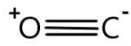
Carbon monoxide is a neutral oxide because it shows neither basic nor acidic properties. Therefore when it reacts with a strong base like $NaOH$ it requires a high temperature and pressure. Carbon mono-oxide and sodium hydroxide will not react at standard temperature and pressure. For reaction to occur. The temperature should be between ${120^0}C - {200^0}C$ and pressure should be between $6 - 10$ $bar$. The following reaction will occur:
$NaOH(s) + CO$ $\xrightarrow{{{{200}^o }C}}HCOONa$
The product formed is sodium formate. It is also known as formic acid or sodium salt. Sodium formate is used in fabric dyeing and printing processes. The salt that is sodium formate is basic and contains a weak base.
Therefore the correct answer is $B$.
Note:It is important to note that in carbon mono-oxide structure carbon has a slight negative charge and oxygen has a slight positive charge. This is because the total number of valence electrons in this compound is $10$. Carbon shares two electrons whereas oxygen shares four electrons. Let’s draw the lewis structure of carbon mono-oxide
Formal Charge on $C$ atom $ = $ $V.E - N - \dfrac{1}{2}B.E.$
$V.E. = $ Number of Valence electrons
$N = $ Number of non-bonded electrons
$B.E. = $ Number of bonded electrons
$\eqalign{
&\Rightarrow 4 - 2 - \dfrac{6}{2} \cr
&\Rightarrow 4 - 2 - 3 \cr} $
Formal Charge on $C$ atom $ = - 1$
To neutralize it, carbon monoxide undergoes resonance.
Complete step-by-step answer:We know that oxides are those compounds in which one or more oxygen atoms combines with another element. Carbon has two oxides that are carbon-di-oxide and carbon monoxide. Carbon-monoxide has one carbon atom and one oxygen atom. They have a triple bond between them. Carbon monoxide is a gas that is colorless, odorless, and tasteless. When exposed to a concentration above $35ppm$, it can be toxic to humans and animals. Carbon mono-oxide combines with hemoglobin to form carboxy-hemoglobin. Because of the formation of carboxy-hemoglobin, hemoglobin is unable to deliver oxygen to the cells in the body. Carbon monoxide has the following structure
Carbon monoxide is a neutral oxide because it shows neither basic nor acidic properties. Therefore when it reacts with a strong base like $NaOH$ it requires a high temperature and pressure. Carbon mono-oxide and sodium hydroxide will not react at standard temperature and pressure. For reaction to occur. The temperature should be between ${120^0}C - {200^0}C$ and pressure should be between $6 - 10$ $bar$. The following reaction will occur:
$NaOH(s) + CO$ $\xrightarrow{{{{200}^o }C}}HCOONa$
The product formed is sodium formate. It is also known as formic acid or sodium salt. Sodium formate is used in fabric dyeing and printing processes. The salt that is sodium formate is basic and contains a weak base.
Therefore the correct answer is $B$.
Note:It is important to note that in carbon mono-oxide structure carbon has a slight negative charge and oxygen has a slight positive charge. This is because the total number of valence electrons in this compound is $10$. Carbon shares two electrons whereas oxygen shares four electrons. Let’s draw the lewis structure of carbon mono-oxide
Formal Charge on $C$ atom $ = $ $V.E - N - \dfrac{1}{2}B.E.$
$V.E. = $ Number of Valence electrons
$N = $ Number of non-bonded electrons
$B.E. = $ Number of bonded electrons
$\eqalign{
&\Rightarrow 4 - 2 - \dfrac{6}{2} \cr
&\Rightarrow 4 - 2 - 3 \cr} $
Formal Charge on $C$ atom $ = - 1$
To neutralize it, carbon monoxide undergoes resonance.
Recently Updated Pages
Master Class 12 Social Science: Engaging Questions & Answers for Success

Master Class 12 Physics: Engaging Questions & Answers for Success
Master Class 12 Maths: Engaging Questions & Answers for Success
Master Class 12 Economics: Engaging Questions & Answers for Success
Master Class 12 Chemistry: Engaging Questions & Answers for Success
Master Class 12 Business Studies: Engaging Questions & Answers for Success
Trending doubts
Which are the Top 10 Largest Countries of the World?
Draw a labelled sketch of the human eye class 12 physics CBSE
Explain the structure of megasporangium class 12 biology CBSE
What are the major means of transport Explain each class 12 social science CBSE
How many chromosomes are found in human ovum a 46 b class 12 biology CBSE
The diagram of the section of a maize grain is given class 12 biology CBSE