



Classify the following number as rational or irrational.
30.2323422345…
Answer
 Verified
647.4k+ views
Hint: To check whether the decimal number is rational or irritation first, we have to check whether it is terminating or not. And if it is non-terminating then check whether its digits are repeating or not. And if digits are not repeating then it will be irrational.
Complete step-by-step answer:
Now as we know that according to the definition of rational number any number is known as rational number if it is expressed as quotient or fraction \[\dfrac{p}{q}\] of two integers where p is the numerator and q is the denominator. Since p and q are integers. So, q can also be equal to 1. So, every integer is a rational number.
Like \[2,{\text{ }} - 5,{\text{ }}0,{\text{ }}\dfrac{{ - 6}}{5},{\text{ }} - \dfrac{{71}}{9}\] are some of the rational numbers.
And according to the definition of irrational number any number is known as irrational if it is not rational or in other words we can say that the number cannot expressed as quotient or fraction \[\dfrac{p}{q}\] of two integers where p is the numerator and q is the denominator and both are integers.
Like \[\pi ,{\text{ }}0.0001010011010....\] are some of the irrational numbers.
So, the hierarchy or rational and irrational numbers can be drawn as,
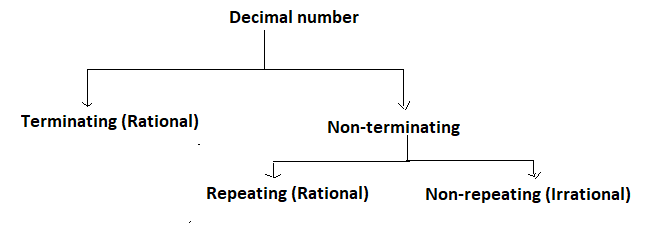
Now we are given the number 30.2323422345…
As we can see that the above number is decimal because the point is placed after 30.
And the number is non-terminating because at last of the number we are given with dots which means that digits continues.
But the given number is non-repeating because none of the pairs of numbers are repeating continuously after decimal.
Hence, the given number is an irrational number.
Note: Whenever we come up with this type of problem where we are asked to check whether the number is rational or not then first, we have to write the definition of rational and irrational numbers. And then check whether the decimal number is terminating or not. If the number is terminating, then it will be rational otherwise we check whether the given number is repeating or not. If the given number is repeated, then it will be a rational number, otherwise it will be an irrational number. This will be the easiest and efficient way to find the solution of the problem.
Complete step-by-step answer:
Now as we know that according to the definition of rational number any number is known as rational number if it is expressed as quotient or fraction \[\dfrac{p}{q}\] of two integers where p is the numerator and q is the denominator. Since p and q are integers. So, q can also be equal to 1. So, every integer is a rational number.
Like \[2,{\text{ }} - 5,{\text{ }}0,{\text{ }}\dfrac{{ - 6}}{5},{\text{ }} - \dfrac{{71}}{9}\] are some of the rational numbers.
And according to the definition of irrational number any number is known as irrational if it is not rational or in other words we can say that the number cannot expressed as quotient or fraction \[\dfrac{p}{q}\] of two integers where p is the numerator and q is the denominator and both are integers.
Like \[\pi ,{\text{ }}0.0001010011010....\] are some of the irrational numbers.
So, the hierarchy or rational and irrational numbers can be drawn as,
Now we are given the number 30.2323422345…
As we can see that the above number is decimal because the point is placed after 30.
And the number is non-terminating because at last of the number we are given with dots which means that digits continues.
But the given number is non-repeating because none of the pairs of numbers are repeating continuously after decimal.
Hence, the given number is an irrational number.
Note: Whenever we come up with this type of problem where we are asked to check whether the number is rational or not then first, we have to write the definition of rational and irrational numbers. And then check whether the decimal number is terminating or not. If the number is terminating, then it will be rational otherwise we check whether the given number is repeating or not. If the given number is repeated, then it will be a rational number, otherwise it will be an irrational number. This will be the easiest and efficient way to find the solution of the problem.
Recently Updated Pages
Master Class 9 General Knowledge: Engaging Questions & Answers for Success

Master Class 9 Maths: Engaging Questions & Answers for Success
Master Class 9 Science: Engaging Questions & Answers for Success
Master Class 9 English: Engaging Questions & Answers for Success
Master Class 9 Social Science: Engaging Questions & Answers for Success
Class 9 Question and Answer - Your Ultimate Solutions Guide
Trending doubts
Find the sum of series 1 + 2 + 3 + 4 + 5 + + 100 class 9 maths CBSE
What is the Full Form of ICSE / ISC ?
What is the Full Form of ICSE, CBSE and SSC
Given that HCF 306 657 9 find the LCM 306 657 class 9 maths CBSE
On an outline map of India show its neighbouring c class 9 social science CBSE
What comes after 10 crore in Indian system class 9 maths CBSE