




Cite an experiment to show that sound needs a material medium for its propagation.
Answer
 Verified
625.2k+ views
- Hint: We will use Bell jar experiment to show that sound needs a material medium for its propagation. The medium can be solid, liquid, or gas. Sound waves cannot travel through vacuum.
Complete step-by-step solution -
Sound travels in mechanical waves. A mechanical wave is a disturbance that propagates and transports energy from one point to another through a medium. In sound, the disturbance is caused by a vibrating object. And the medium can be any series of interconnected and interactive particles. This implies that sound can travel through solids, liquids and gases. Sound needs a material medium for its propagation. In case of air as a medium, sound waves travel as longitudinal waves with compressions and rarefactions. Sound cannot progress through vacuum because vacuum does not contain any molecules which can vibrate and carry the sound waves.
For demonstrating that sound needs a material medium for its propagation, we will consider the Bell jar experiment.
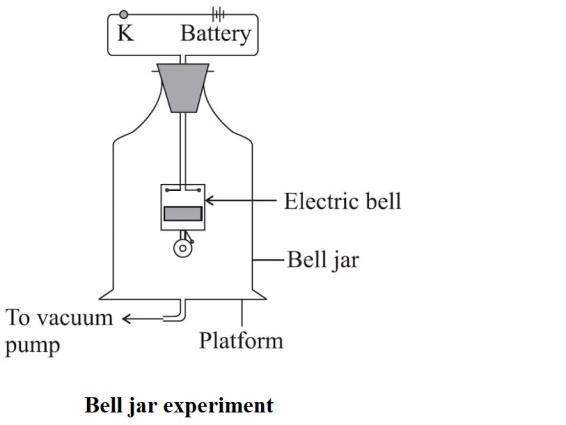
Bell jar experiment signifies that sound needs a medium for its propagation. Take an electric bell and a sealed, or air tight, glass bell jar being connected to a vacuum pump, in order to create vacuum inside the jar. Suspend the bell inside the jar. When you press the switch of the bell, you will be clearly able to hear the bell ring. Now with the help of a vacuum pump connected to the jar, pump out the air from the glass air with the help of a vacuum pump. The sound of the bell this time will be fainter and after some time, you will hear no sound. This is because almost all the air has been pumped out. It shows that sound needs a material medium to travel.
Note: Students should note that sound needs a material medium where molecules can vibrate and carry sound waves one from one point to another. In the above experiment, the medium was air and we proved that sound cannot travel through vacuum.
Complete step-by-step solution -
Sound travels in mechanical waves. A mechanical wave is a disturbance that propagates and transports energy from one point to another through a medium. In sound, the disturbance is caused by a vibrating object. And the medium can be any series of interconnected and interactive particles. This implies that sound can travel through solids, liquids and gases. Sound needs a material medium for its propagation. In case of air as a medium, sound waves travel as longitudinal waves with compressions and rarefactions. Sound cannot progress through vacuum because vacuum does not contain any molecules which can vibrate and carry the sound waves.
For demonstrating that sound needs a material medium for its propagation, we will consider the Bell jar experiment.
Bell jar experiment signifies that sound needs a medium for its propagation. Take an electric bell and a sealed, or air tight, glass bell jar being connected to a vacuum pump, in order to create vacuum inside the jar. Suspend the bell inside the jar. When you press the switch of the bell, you will be clearly able to hear the bell ring. Now with the help of a vacuum pump connected to the jar, pump out the air from the glass air with the help of a vacuum pump. The sound of the bell this time will be fainter and after some time, you will hear no sound. This is because almost all the air has been pumped out. It shows that sound needs a material medium to travel.
Note: Students should note that sound needs a material medium where molecules can vibrate and carry sound waves one from one point to another. In the above experiment, the medium was air and we proved that sound cannot travel through vacuum.
Recently Updated Pages
Master Class 11 Social Science: Engaging Questions & Answers for Success

Master Class 11 English: Engaging Questions & Answers for Success
Master Class 11 Maths: Engaging Questions & Answers for Success
Master Class 11 Chemistry: Engaging Questions & Answers for Success
Master Class 11 Biology: Engaging Questions & Answers for Success
Master Class 11 Physics: Engaging Questions & Answers for Success
Trending doubts
One Metric ton is equal to kg A 10000 B 1000 C 100 class 11 physics CBSE
Difference Between Prokaryotic Cells and Eukaryotic Cells
Draw a diagram of a plant cell and label at least eight class 11 biology CBSE
Two of the body parts which do not appear in MRI are class 11 biology CBSE
Which gas is abundant in air class 11 chemistry CBSE
10 examples of friction in our daily life