




What is the circumference of a circle with a radius of 4 inches?
Answer
 Verified
567.9k+ views
Hint: For solving this question you should know about the relation of radius, circumference and diameter of a circle with one another or each other. And this relation is generally used for calculating the circumference or radius by each other. We know that the radius is half the diameter or we can say that the diameter is double its radius. And the circumference of a circle is equal to the product of diameter with $\pi $.
Complete step-by-step solution:
In this question it is asked to determine the circumference of a circle whose radius is given by 4 inches. If we look at the diagram then,
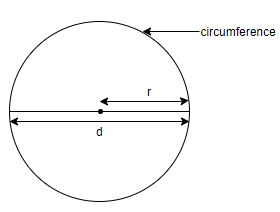
We can see in this that the radius is denoted by $r$. Diameter is denoted by $d$ and the outer side of the circle is known as the circumference where the circle ends up. As we know that the radius is always half of the diameter for a circle and we can say that the diameter of a circle is double of the radius. It means $r=\dfrac{d}{2}$ or $d=2r$.
The circumference of a circle is the product of the angle of a circle that is $2\pi $ and radius $r$. So, the circumference of a circle is equal to $2\pi r$.
According to our question, we have to find the circumference of the circle.
The radius of the circle = 4 inch = 10.16cm.
Since the circumference of the circle is $2\pi r$, so,
\[\begin{align}
& \Rightarrow C=2\pi r=2\times \pi \times 4 \\
& \Rightarrow C=8\pi inches \\
& \Rightarrow C=25.13inches \\
\end{align}\]
Therefore, the circumference of a circle is equal to $8\pi $ or 25.13inches.
Note: During solving this type of questions you should be careful of taking values of radius. The maximum time question asks for the area of the circle or the circumference of the circle and gives the value of the diameter and we have to convert it into radius. And the area of the circle is the total area which is covered by the circumference till the centre of the circle.
Complete step-by-step solution:
In this question it is asked to determine the circumference of a circle whose radius is given by 4 inches. If we look at the diagram then,
We can see in this that the radius is denoted by $r$. Diameter is denoted by $d$ and the outer side of the circle is known as the circumference where the circle ends up. As we know that the radius is always half of the diameter for a circle and we can say that the diameter of a circle is double of the radius. It means $r=\dfrac{d}{2}$ or $d=2r$.
The circumference of a circle is the product of the angle of a circle that is $2\pi $ and radius $r$. So, the circumference of a circle is equal to $2\pi r$.
According to our question, we have to find the circumference of the circle.
The radius of the circle = 4 inch = 10.16cm.
Since the circumference of the circle is $2\pi r$, so,
\[\begin{align}
& \Rightarrow C=2\pi r=2\times \pi \times 4 \\
& \Rightarrow C=8\pi inches \\
& \Rightarrow C=25.13inches \\
\end{align}\]
Therefore, the circumference of a circle is equal to $8\pi $ or 25.13inches.
Note: During solving this type of questions you should be careful of taking values of radius. The maximum time question asks for the area of the circle or the circumference of the circle and gives the value of the diameter and we have to convert it into radius. And the area of the circle is the total area which is covered by the circumference till the centre of the circle.
Recently Updated Pages
Master Class 11 English: Engaging Questions & Answers for Success

Master Class 11 Social Science: Engaging Questions & Answers for Success
Master Class 11 Maths: Engaging Questions & Answers for Success
Master Class 11 Biology: Engaging Questions & Answers for Success
Master Class 11 Physics: Engaging Questions & Answers for Success
Master Class 11 Chemistry: Engaging Questions & Answers for Success
Trending doubts
One Metric ton is equal to kg A 10000 B 1000 C 100 class 11 physics CBSE
Difference Between Prokaryotic Cells and Eukaryotic Cells
Find the value of the expression given below sin 30circ class 11 maths CBSE
Two of the body parts which do not appear in MRI are class 11 biology CBSE
Draw a diagram of a plant cell and label at least eight class 11 biology CBSE
10 examples of friction in our daily life