




What is the circum – center of the triangle with coordinates J(1, 3), K(3, -1), M(5, 3)?
Answer
 Verified
550.2k+ views
Hint: Draw a diagram of a triangle JKM inscribed in a circle and assume the center of the circle as O(x, y). Join OJ, OK and OM and assume their length as \[{{r}_{1}},{{r}_{2}}\] and ${{r}_{3}}$ respectively. Use the distance formula given as $d=\sqrt{{{\left( {{x}_{2}}-{{x}_{1}} \right)}^{2}}+{{\left( {{y}_{2}}-{{y}_{1}} \right)}^{2}}}$, where d is the distance between the two points $\left( {{x}_{1}},{{y}_{1}} \right)$ and $\left( {{x}_{2}},{{y}_{2}} \right)$, to calculate the value of \[{{r}_{1}},{{r}_{2}}\] and ${{r}_{3}}$. Now, substitute ${{r}_{1}}={{r}_{3}}$ and find the value of x coordinate. Further, substitute ${{r}_{2}}={{r}_{3}}$ and put the value of x obtained above in the relation to get the value of y coordinate.
Complete step by step solution:
Here we have been provided with a triangle with coordinates J(1, 3), K(3, -1), M(5, 3) and we have to determine the coordinate of the circum – center of this triangle. Let us draw a triangle inscribed in a circle.
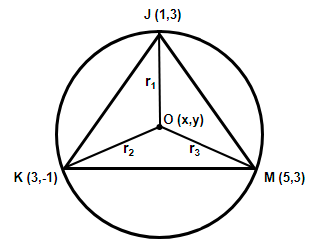
In the above figure we have assumed the center of the circle as O (0, 0). We have joined the points to form the line segments OJ, OK and OM and assumed them as \[{{r}_{1}},{{r}_{2}}\] and ${{r}_{3}}$. Using the distance formula given as $d=\sqrt{{{\left( {{x}_{2}}-{{x}_{1}} \right)}^{2}}+{{\left( {{y}_{2}}-{{y}_{1}} \right)}^{2}}}$, where d is the distance between the two points $\left( {{x}_{1}},{{y}_{1}} \right)$ and $\left( {{x}_{2}},{{y}_{2}} \right)$, we get,
(1) \[{{r}_{1}}=\sqrt{{{\left( x-1 \right)}^{2}}+{{\left( y-3 \right)}^{2}}}\]
(2) \[{{r}_{2}}=\sqrt{{{\left( x-3 \right)}^{2}}+{{\left( y+1 \right)}^{2}}}\]
(3) \[{{r}_{3}}=\sqrt{{{\left( x-5 \right)}^{2}}+{{\left( y-3 \right)}^{2}}}\]
Now, we can see that \[{{r}_{1}},{{r}_{2}}\] and ${{r}_{3}}$ so they must be equal in length, therefore we have the condition \[{{r}_{1}}={{r}_{2}}={{r}_{3}}\]. Equating ${{r}_{1}}={{r}_{3}}$ we get,
\[\Rightarrow \sqrt{{{\left( x-1 \right)}^{2}}+{{\left( y-3 \right)}^{2}}}=\sqrt{{{\left( x-5 \right)}^{2}}+{{\left( y-3 \right)}^{2}}}\]
On squaring both the sides we get,
\[\Rightarrow {{\left( x-1 \right)}^{2}}+{{\left( y-3 \right)}^{2}}={{\left( x-5 \right)}^{2}}+{{\left( y-3 \right)}^{2}}\]
Cancelling the like terms from both the sides we get,
\[\begin{align}
& \Rightarrow {{\left( x-1 \right)}^{2}}={{\left( x-5 \right)}^{2}} \\
& \Rightarrow {{\left( x-1 \right)}^{2}}-{{\left( x-5 \right)}^{2}}=0 \\
\end{align}\]
Using the algebraic identity ${{a}^{2}}-{{b}^{2}}=\left( a-b \right)\,\left( a+b \right)$ we get,
\[\begin{align}
& \Rightarrow \left( x-1-x+5 \right)\left( x-1+x-5 \right)=0 \\
& \Rightarrow 4\left( 2x-6 \right)=0 \\
& \therefore x=3.......\left( i \right) \\
\end{align}\]
Now, equating ${{r}_{2}}={{r}_{3}}$ we get,
\[\Rightarrow \sqrt{{{\left( x-3 \right)}^{2}}+{{\left( y+1 \right)}^{2}}}=\sqrt{{{\left( x-5 \right)}^{2}}+{{\left( y-3 \right)}^{2}}}\]
On squaring both the sides we get,
\[\Rightarrow {{\left( x-3 \right)}^{2}}+{{\left( y+1 \right)}^{2}}={{\left( x-5 \right)}^{2}}+{{\left( y-3 \right)}^{2}}\]
Substituting the value of x from equation (i) in the above relation we get,
\[\begin{align}
& \Rightarrow {{\left( 3-3 \right)}^{2}}+{{\left( y+1 \right)}^{2}}={{\left( 3-5 \right)}^{2}}+{{\left( y-3 \right)}^{2}} \\
& \Rightarrow {{\left( y+1 \right)}^{2}}=4+{{\left( y-3 \right)}^{2}} \\
& \Rightarrow {{\left( y+1 \right)}^{2}}-{{\left( y-3 \right)}^{2}}=4 \\
\end{align}\]
Again using the algebraic identity ${{a}^{2}}-{{b}^{2}}=\left( a-b \right)\,\left( a+b \right)$ we get,
\[\begin{align}
& \Rightarrow \left( y+1-y+3 \right)\left( y+1+y-3 \right)=4 \\
& \Rightarrow 4\left( 2y-2 \right)=4 \\
& \therefore y=\dfrac{3}{2} \\
\end{align}\]
Hence, the coordinate of the circum – center of the triangle is $O\left( 3,\dfrac{3}{2} \right)$.
Note: Once the coordinate of the circum – center is found you can easily determine the circum – radius of the circle and its equation. Here you can substitute any of the three radii with each other to get the answer. We have substituted ${{r}_{1}}={{r}_{3}}$ at the first step because we see that the term \[{{\left( y-3 \right)}^{2}}\] will get cancelled on both the sides so we can directly find the value of x without any difficult calculations. Therefore, you need to observe these small things to save time.
Complete step by step solution:
Here we have been provided with a triangle with coordinates J(1, 3), K(3, -1), M(5, 3) and we have to determine the coordinate of the circum – center of this triangle. Let us draw a triangle inscribed in a circle.
In the above figure we have assumed the center of the circle as O (0, 0). We have joined the points to form the line segments OJ, OK and OM and assumed them as \[{{r}_{1}},{{r}_{2}}\] and ${{r}_{3}}$. Using the distance formula given as $d=\sqrt{{{\left( {{x}_{2}}-{{x}_{1}} \right)}^{2}}+{{\left( {{y}_{2}}-{{y}_{1}} \right)}^{2}}}$, where d is the distance between the two points $\left( {{x}_{1}},{{y}_{1}} \right)$ and $\left( {{x}_{2}},{{y}_{2}} \right)$, we get,
(1) \[{{r}_{1}}=\sqrt{{{\left( x-1 \right)}^{2}}+{{\left( y-3 \right)}^{2}}}\]
(2) \[{{r}_{2}}=\sqrt{{{\left( x-3 \right)}^{2}}+{{\left( y+1 \right)}^{2}}}\]
(3) \[{{r}_{3}}=\sqrt{{{\left( x-5 \right)}^{2}}+{{\left( y-3 \right)}^{2}}}\]
Now, we can see that \[{{r}_{1}},{{r}_{2}}\] and ${{r}_{3}}$ so they must be equal in length, therefore we have the condition \[{{r}_{1}}={{r}_{2}}={{r}_{3}}\]. Equating ${{r}_{1}}={{r}_{3}}$ we get,
\[\Rightarrow \sqrt{{{\left( x-1 \right)}^{2}}+{{\left( y-3 \right)}^{2}}}=\sqrt{{{\left( x-5 \right)}^{2}}+{{\left( y-3 \right)}^{2}}}\]
On squaring both the sides we get,
\[\Rightarrow {{\left( x-1 \right)}^{2}}+{{\left( y-3 \right)}^{2}}={{\left( x-5 \right)}^{2}}+{{\left( y-3 \right)}^{2}}\]
Cancelling the like terms from both the sides we get,
\[\begin{align}
& \Rightarrow {{\left( x-1 \right)}^{2}}={{\left( x-5 \right)}^{2}} \\
& \Rightarrow {{\left( x-1 \right)}^{2}}-{{\left( x-5 \right)}^{2}}=0 \\
\end{align}\]
Using the algebraic identity ${{a}^{2}}-{{b}^{2}}=\left( a-b \right)\,\left( a+b \right)$ we get,
\[\begin{align}
& \Rightarrow \left( x-1-x+5 \right)\left( x-1+x-5 \right)=0 \\
& \Rightarrow 4\left( 2x-6 \right)=0 \\
& \therefore x=3.......\left( i \right) \\
\end{align}\]
Now, equating ${{r}_{2}}={{r}_{3}}$ we get,
\[\Rightarrow \sqrt{{{\left( x-3 \right)}^{2}}+{{\left( y+1 \right)}^{2}}}=\sqrt{{{\left( x-5 \right)}^{2}}+{{\left( y-3 \right)}^{2}}}\]
On squaring both the sides we get,
\[\Rightarrow {{\left( x-3 \right)}^{2}}+{{\left( y+1 \right)}^{2}}={{\left( x-5 \right)}^{2}}+{{\left( y-3 \right)}^{2}}\]
Substituting the value of x from equation (i) in the above relation we get,
\[\begin{align}
& \Rightarrow {{\left( 3-3 \right)}^{2}}+{{\left( y+1 \right)}^{2}}={{\left( 3-5 \right)}^{2}}+{{\left( y-3 \right)}^{2}} \\
& \Rightarrow {{\left( y+1 \right)}^{2}}=4+{{\left( y-3 \right)}^{2}} \\
& \Rightarrow {{\left( y+1 \right)}^{2}}-{{\left( y-3 \right)}^{2}}=4 \\
\end{align}\]
Again using the algebraic identity ${{a}^{2}}-{{b}^{2}}=\left( a-b \right)\,\left( a+b \right)$ we get,
\[\begin{align}
& \Rightarrow \left( y+1-y+3 \right)\left( y+1+y-3 \right)=4 \\
& \Rightarrow 4\left( 2y-2 \right)=4 \\
& \therefore y=\dfrac{3}{2} \\
\end{align}\]
Hence, the coordinate of the circum – center of the triangle is $O\left( 3,\dfrac{3}{2} \right)$.
Note: Once the coordinate of the circum – center is found you can easily determine the circum – radius of the circle and its equation. Here you can substitute any of the three radii with each other to get the answer. We have substituted ${{r}_{1}}={{r}_{3}}$ at the first step because we see that the term \[{{\left( y-3 \right)}^{2}}\] will get cancelled on both the sides so we can directly find the value of x without any difficult calculations. Therefore, you need to observe these small things to save time.
Recently Updated Pages
Master Class 11 Social Science: Engaging Questions & Answers for Success

Master Class 11 Physics: Engaging Questions & Answers for Success
Master Class 11 Maths: Engaging Questions & Answers for Success
Master Class 11 Economics: Engaging Questions & Answers for Success
Master Class 11 Computer Science: Engaging Questions & Answers for Success
Master Class 11 Chemistry: Engaging Questions & Answers for Success
Trending doubts
One Metric ton is equal to kg A 10000 B 1000 C 100 class 11 physics CBSE
There are 720 permutations of the digits 1 2 3 4 5 class 11 maths CBSE
1 Quintal is equal to a 110 kg b 10 kg c 100kg d 1000 class 11 physics CBSE
State and prove Bernoullis theorem class 11 physics CBSE
Difference Between Prokaryotic Cells and Eukaryotic Cells
Which among the following are examples of coming together class 11 social science CBSE