




Chromatin is made up of
A. DNA and Proteins.
B. DNA and Histones.
C. DNA, RNA, Proteins.
D. RNA, histones, and oil bodies.
Answer
 Verified
616.5k+ views
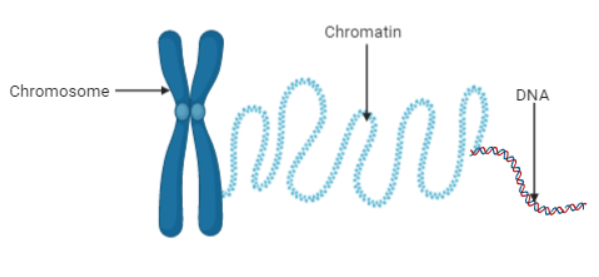
Hint: Chromatin is a nucleoprotein and is a hereditary material that is formed together by both DNA and histone protein complex and some non-histone proteins are also present. In eukaryotes, the DNA is present in condensed form as chromatin in the nucleus.
Complete step by step answer: The chromatin is created of DNA, RNA, and proteins. The composition of DNA in chromatin is \[30\text{ }\text{ }40%\], of RNA is \[1%\] and of proteins is 50 to\[60%\]. These components are found in different organisms or withinside the different tissues of the identical species. DNA wraps around a simple histone protein; this structure is understood as a nucleosome. They appear to like being beads on string-like structures. Therefore, the preferred content material of chromatin is histone proteins. Histones are tiny, positive charged proteins. Now the non- histone protein is also present in the chromatin body, the proteins that remain when the histones are classified as non-histone proteins. Hence, we tend to conclude chromatin alone cannot be shaped simply macromolecule, as a result of DNA desires a protein structure to wrap around.
Hence, the correct answer is option B which is DNA & Histones.
Additional information: The main functions of Chromatin are as follows-
-They help to prevent the DNA from getting damaged.
-They support the DNA molecules so that cell division occurs properly.
-They condense DNA properly so that it fits into the cell.
-They are responsible for controlling gene expression as well as DNA replication.
Note: Chromosomes and chromatin are different. Chromosomes are condensed forms of chromatin fibers whereas chromatin is a nucleoprotein consisting of DNA and protein complex. Chromosomes are compact and thick whereas chromatin is thin and long. Chromosomes can be seen during cell division whereas chromatin can be seen during the cell cycle.
Complete step by step answer: The chromatin is created of DNA, RNA, and proteins. The composition of DNA in chromatin is \[30\text{ }\text{ }40%\], of RNA is \[1%\] and of proteins is 50 to\[60%\]. These components are found in different organisms or withinside the different tissues of the identical species. DNA wraps around a simple histone protein; this structure is understood as a nucleosome. They appear to like being beads on string-like structures. Therefore, the preferred content material of chromatin is histone proteins. Histones are tiny, positive charged proteins. Now the non- histone protein is also present in the chromatin body, the proteins that remain when the histones are classified as non-histone proteins. Hence, we tend to conclude chromatin alone cannot be shaped simply macromolecule, as a result of DNA desires a protein structure to wrap around.
Hence, the correct answer is option B which is DNA & Histones.
Additional information: The main functions of Chromatin are as follows-
-They help to prevent the DNA from getting damaged.
-They support the DNA molecules so that cell division occurs properly.
-They condense DNA properly so that it fits into the cell.
-They are responsible for controlling gene expression as well as DNA replication.
Note: Chromosomes and chromatin are different. Chromosomes are condensed forms of chromatin fibers whereas chromatin is a nucleoprotein consisting of DNA and protein complex. Chromosomes are compact and thick whereas chromatin is thin and long. Chromosomes can be seen during cell division whereas chromatin can be seen during the cell cycle.
Recently Updated Pages
Master Class 11 English: Engaging Questions & Answers for Success

Master Class 11 Social Science: Engaging Questions & Answers for Success
Master Class 11 Maths: Engaging Questions & Answers for Success
Master Class 11 Biology: Engaging Questions & Answers for Success
Master Class 11 Physics: Engaging Questions & Answers for Success
Master Class 11 Chemistry: Engaging Questions & Answers for Success
Trending doubts
One Metric ton is equal to kg A 10000 B 1000 C 100 class 11 physics CBSE
Difference Between Prokaryotic Cells and Eukaryotic Cells
Two of the body parts which do not appear in MRI are class 11 biology CBSE
Find the value of the expression given below sin 30circ class 11 maths CBSE
Draw a diagram of a plant cell and label at least eight class 11 biology CBSE
10 examples of friction in our daily life