




Choroid is
A.Loose connective tissue with pigment cells and vascular supply.
B. Muscular tissue is rich in blood supply.
C. Epithelium
D. Nervous system
Answer
 Verified
609.3k+ views
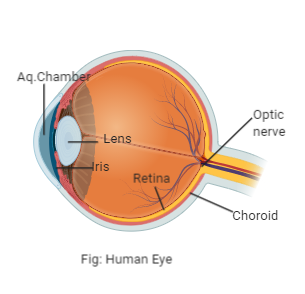
Hint: The human eye has three layers namely the sclera, choroid, and retina. The choroid is found inside the sclera which is a protective layer. The choroid is the middle layer which is dark and pigmented and has ample blood vessels.
Complete step by step answer: The choroid is a layer of the human eye. The choroid is the layer next to the sclera which is the outermost layer and can be distinguished by the appearance of blood vessels. It is highly pigmented, thin, and vascular. It is found between the sclera (outermost layer) and retina (inner layer). The ciliary body is also a part of the choroid which extends to form a pigmented and opaque structure called the iris which is a visible colored portion of the eye. The eyeball consists of a crystalline lens that is transparent and is held in place by ligaments that are connected with ciliary muscles. In front of the lens, in the human eye is an aperture that is surrounded by iris and is called the pupil, the diameter of the pupil is regulated by the muscle fibers. Choroid consists of loose connective tissue and several blood vessels. It seems to be bluish in color because pigment cells are present. The eyeball is thin over the posterior part and thick over the anterior part wherever it forms a membrane. It is responsible for providing oxygen and nutrients to the eye.
So, the correct answer is A-Loose connective tissue with pigment cells and vascular supply.
Note: Choroidal dystrophy is a condition where the choroid is infected. Choroidal dystrophy is caused because of gene abnormality and is passed down through families which means is inherited from parents. It mostly affects males in childhood.
Complete step by step answer: The choroid is a layer of the human eye. The choroid is the layer next to the sclera which is the outermost layer and can be distinguished by the appearance of blood vessels. It is highly pigmented, thin, and vascular. It is found between the sclera (outermost layer) and retina (inner layer). The ciliary body is also a part of the choroid which extends to form a pigmented and opaque structure called the iris which is a visible colored portion of the eye. The eyeball consists of a crystalline lens that is transparent and is held in place by ligaments that are connected with ciliary muscles. In front of the lens, in the human eye is an aperture that is surrounded by iris and is called the pupil, the diameter of the pupil is regulated by the muscle fibers. Choroid consists of loose connective tissue and several blood vessels. It seems to be bluish in color because pigment cells are present. The eyeball is thin over the posterior part and thick over the anterior part wherever it forms a membrane. It is responsible for providing oxygen and nutrients to the eye.
So, the correct answer is A-Loose connective tissue with pigment cells and vascular supply.
Note: Choroidal dystrophy is a condition where the choroid is infected. Choroidal dystrophy is caused because of gene abnormality and is passed down through families which means is inherited from parents. It mostly affects males in childhood.
Recently Updated Pages
Master Class 12 Economics: Engaging Questions & Answers for Success

Master Class 12 English: Engaging Questions & Answers for Success
Master Class 12 Social Science: Engaging Questions & Answers for Success
Master Class 12 Maths: Engaging Questions & Answers for Success
Master Class 12 Physics: Engaging Questions & Answers for Success
Master Class 11 Social Science: Engaging Questions & Answers for Success
Trending doubts
One Metric ton is equal to kg A 10000 B 1000 C 100 class 11 physics CBSE
Difference Between Prokaryotic Cells and Eukaryotic Cells
Two of the body parts which do not appear in MRI are class 11 biology CBSE
1 ton equals to A 100 kg B 1000 kg C 10 kg D 10000 class 11 physics CBSE
Draw a diagram of nephron and explain its structur class 11 biology CBSE
10 examples of friction in our daily life