




Choose the correct match of the two lists from the following –
List I (Example) List II (Example) A Earthworm 1 Pulmonary B Human 2 Branchial C Prawn 3 Tracheal D Insect 4 Cutaneous
(a) A-1, B-2, C-3, D-4
(b) A-4, B-2, C-1, D-3
(c) A-4, B-1, C-2, D-3
(d) A-3, B-2, C-4, D-1
| List I (Example) List II (Example) | |||
| A | Earthworm | 1 | Pulmonary |
| B | Human | 2 | Branchial |
| C | Prawn | 3 | Tracheal |
| D | Insect | 4 | Cutaneous |
Answer
 Verified
638.4k+ views
Hint: Cutaneous respiration is adapted by such organisms who live in a habitat where their outer skin is kept moist most of the time while the pulmonary respiration is the most advanced form of respiration and occurs in organisms with a well developed respiratory system.
Complete step-by-step answer:
In the given question, list I denote the organisms and list II denotes the modes of respiration.
The correct matching of the two lists will be as given below -
So, the correct answer is ‘A-4, B-1, C-2, D-3’.
Note: Pulmonary respiration occurs in some amphibians, mammals, and birds where the exchange of gas takes place in special respiratory organs, Lungs. Branchial respiration is common in aquatic animals like crabs and prawns where gills separate oxygen from water and make it then made available for the organism.
Complete step-by-step answer:
In the given question, list I denote the organisms and list II denotes the modes of respiration.
The correct matching of the two lists will be as given below -
| A | Earthworm | 4 | Cutaneous- As we know earthworm belongs to phylum Annelida and it does not have a well developed respiratory system, it uses its skin for gaseous exchange purposes, and this type of respiration is termed as cutaneous respiration. |
| B | Human | 1 | Pulmonary- Humans are chordates and have a well developed respiratory system where gaseous exchange takes place inside the lungs and the mode of respiration is pulmonary. 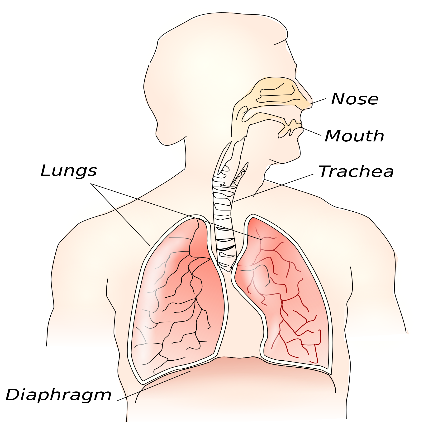
|
| C | Prawn | 2 | Branchial- Prawns are Crustacean Arthropods and respire in the aquatic medium so they have three sets of organs of respiration – branchiostegite, gills, and epipodites. Here, the mode of respiration is branchial which occurs through gills. 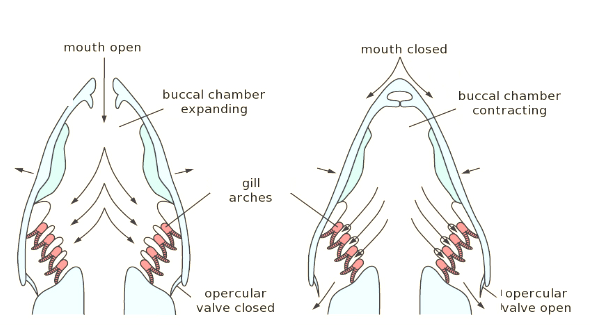
|
| D | Insect | 3 | Tracheal- Insects belong to the largest phylum of kingdom Animalia i.e. Arthropods, and in the case of insects, air enters the respiratory system through spiracles (external openings) that act as muscular valves and lead to a dense network of tubes named tracheae. As the respiration is taking place primarily with the help of tracheae, it is called tracheal respiration. |
So, the correct answer is ‘A-4, B-1, C-2, D-3’.
Note: Pulmonary respiration occurs in some amphibians, mammals, and birds where the exchange of gas takes place in special respiratory organs, Lungs. Branchial respiration is common in aquatic animals like crabs and prawns where gills separate oxygen from water and make it then made available for the organism.
Recently Updated Pages
Master Class 11 English: Engaging Questions & Answers for Success

Master Class 11 Social Science: Engaging Questions & Answers for Success
Master Class 11 Maths: Engaging Questions & Answers for Success
Master Class 11 Biology: Engaging Questions & Answers for Success
Master Class 11 Physics: Engaging Questions & Answers for Success
Master Class 11 Chemistry: Engaging Questions & Answers for Success
Trending doubts
One Metric ton is equal to kg A 10000 B 1000 C 100 class 11 physics CBSE
Difference Between Prokaryotic Cells and Eukaryotic Cells
Two of the body parts which do not appear in MRI are class 11 biology CBSE
Find the value of the expression given below sin 30circ class 11 maths CBSE
Draw a diagram of a plant cell and label at least eight class 11 biology CBSE
10 examples of friction in our daily life