




Choose the correct answer from the alternatives given:
An inducible operon system usually occurs in (i) pathways. Nutrient molecules serve as (ii) to stimulate the production of the enzymes necessary for their breakdown. Genes for inducible operon are usually switched (iii) and the repressor is synthesized in an (iv) form.
(a) (i) anabolic (ii) compressor (iii) on (iv) inactive
(b) (i) anabolic (ii) inducer (iii) off (iv) active
(c) (i) catabolic (ii) inducer (iii) off (iv) active
(d) (i) catabolic (ii) compressor (iii) on (iv) inactive
Answer
 Verified
615k+ views
Hint: An operon is a system consisting of genes that are involved in the breaking of complex substances with the help of enzymes that requires a special substance to turn on the mechanism system.
Complete answer:
An inducible operon is a catabolic pathway where the nutrients act as an inducer like in the case of the lac operon, allolactose serves as an inducer and switches on the operon system making the repressor to become active.
Additional Information:
-An operon is the set of genes present in the DNA that belongs to the same group and is controlled by the promoter.
-The genes will undergo transcription (forming of mRNA from DNA, translation (formation of proteins from the mRNA coding), or splicing of mRNA (removal of coding and non-coding regions of the mRNA).
-The operon system may result in the expression of all the genes together but sometimes the genes are not expressed.
-To make an operon it is necessary for the genes to transcribe together.
-The operons are of various types in the case of the prokaryotes and the eukaryotes.
-The prokaryotic operons will result in the formation of a polycistronic mRNA while the eukaryotic operons will result in the formation of the monocistronic mRNA.
-Polycistronic mRNA consists of a single cistron that encodes many proteins while monocistronic mRNA will encode for the formation of a single protein.
-The inducible operon is generally switched off but when the inducer is provided it is turned on.
-The repressor is the protein that binds to the DNA and RNA to prevent them from expressing several genes.
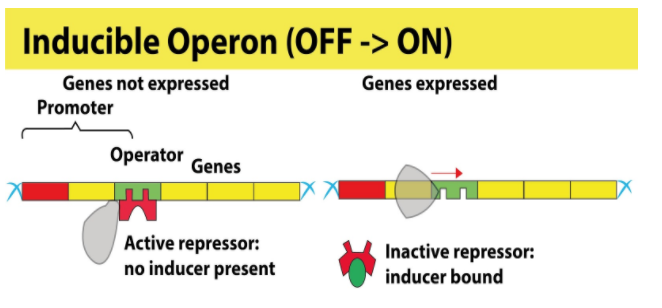
So, the correct answer is ‘(i) catabolic (ii) inducer (iii) off (iv) active'.
Note: The term operon was derived in 1960 from the French Academy of Science. The lac operon was the first operon to be discovered. It was discovered in E.coli and the scientists Francois Jacob, Andre Michel Lwoff, and Jacques Monod were awarded the Nobel Prize in Physiology and Medicine in 1965.
Complete answer:
An inducible operon is a catabolic pathway where the nutrients act as an inducer like in the case of the lac operon, allolactose serves as an inducer and switches on the operon system making the repressor to become active.
Additional Information:
-An operon is the set of genes present in the DNA that belongs to the same group and is controlled by the promoter.
-The genes will undergo transcription (forming of mRNA from DNA, translation (formation of proteins from the mRNA coding), or splicing of mRNA (removal of coding and non-coding regions of the mRNA).
-The operon system may result in the expression of all the genes together but sometimes the genes are not expressed.
-To make an operon it is necessary for the genes to transcribe together.
-The operons are of various types in the case of the prokaryotes and the eukaryotes.
-The prokaryotic operons will result in the formation of a polycistronic mRNA while the eukaryotic operons will result in the formation of the monocistronic mRNA.
-Polycistronic mRNA consists of a single cistron that encodes many proteins while monocistronic mRNA will encode for the formation of a single protein.
-The inducible operon is generally switched off but when the inducer is provided it is turned on.
-The repressor is the protein that binds to the DNA and RNA to prevent them from expressing several genes.
So, the correct answer is ‘(i) catabolic (ii) inducer (iii) off (iv) active'.
Note: The term operon was derived in 1960 from the French Academy of Science. The lac operon was the first operon to be discovered. It was discovered in E.coli and the scientists Francois Jacob, Andre Michel Lwoff, and Jacques Monod were awarded the Nobel Prize in Physiology and Medicine in 1965.
Recently Updated Pages
Master Class 11 Economics: Engaging Questions & Answers for Success

Master Class 11 English: Engaging Questions & Answers for Success
Master Class 11 Maths: Engaging Questions & Answers for Success
Class 11 Question and Answer - Your Ultimate Solutions Guide
Master Class 11 Social Science: Engaging Questions & Answers for Success
Master Class 11 Business Studies: Engaging Questions & Answers for Success
Trending doubts
One Metric ton is equal to kg A 10000 B 1000 C 100 class 11 physics CBSE
There are 720 permutations of the digits 1 2 3 4 5 class 11 maths CBSE
Differentiate between an exothermic and an endothermic class 11 chemistry CBSE
In what year Guru Nanak Dev ji was born A15 April 1469 class 11 social science CBSE
Difference Between Prokaryotic Cells and Eukaryotic Cells
State and prove Bernoullis theorem class 11 physics CBSE