




Choanocytes are seen in
(a)Coelenterata
(b)Porifera
(c)Mollusca
(d)Echinodermata
Answer
 Verified
628.5k+ views
Hint: Choanocytes are special types of cells that are also known as collar cells and resemble the choanoflagellates. They consist of the choanoderm. They contribute to the digestive, respiratory as well as excretory functions of the organism.
Complete answer:
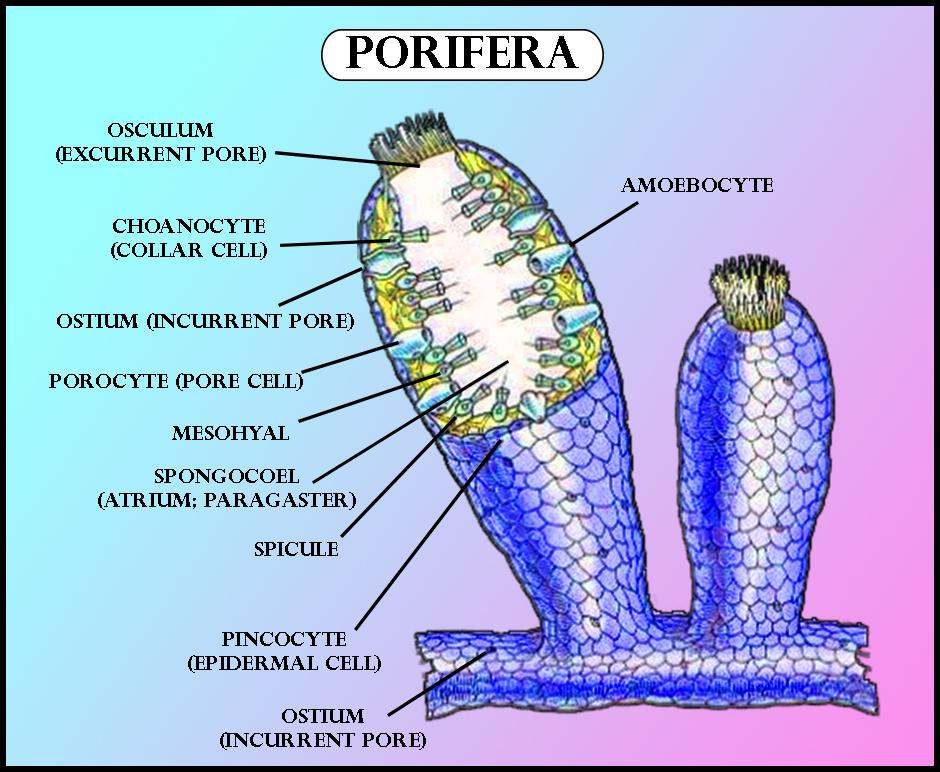
Choanocytes are cells that line the interior of asconoids, syconoid, and leuconoid bodies of sponges and are seen in members of Porifera. These contain a central flagellum or cilium which is surrounded by a collar of microvilli connected by a thin membrane. The choanoderm in Porifera is made of these Choanocytes.
Additional Information: Let us know more about these special cells:
-Choanocytes consist of the cell layer named choanoderm in sponges and has the closest resemblance to choanoflagellates related to single-celled protists.
-These are found on the surface of the spongocoel of asconoid sponges in a dotted manner and the radial canals in syconoid sponges.
-These make the chambers in leuconoid sponges.
-They have flagella or cilia that filter particles out of the water and throw them out through the osculum.
-These improve both respiratory and digestive functions for the organism.
-They pull in oxygen and nutrients and allow rapid expulsion of carbon dioxide and other wastes.
-They can turn into spermatocytes during sexual reproduction due to a lack of sexual organs in sponges.
-They show resemblance to the choanoflagellates which shows evolutionary significance as choanoflagellates and single-celled protists are closely related.
So, the correct answer is Porifera.
Note: Only members of Porifera have these special collar cells. Other phyla like Coelenterata, Mollusca, and Echinodermata don’t contain these cells. The maintenance of water flow in poriferans is done by these cells which carry out almost every important function of the body. Therefore, these cells are characteristic and a very important part of their life.
Complete answer:
Choanocytes are cells that line the interior of asconoids, syconoid, and leuconoid bodies of sponges and are seen in members of Porifera. These contain a central flagellum or cilium which is surrounded by a collar of microvilli connected by a thin membrane. The choanoderm in Porifera is made of these Choanocytes.
Additional Information: Let us know more about these special cells:
-Choanocytes consist of the cell layer named choanoderm in sponges and has the closest resemblance to choanoflagellates related to single-celled protists.
-These are found on the surface of the spongocoel of asconoid sponges in a dotted manner and the radial canals in syconoid sponges.
-These make the chambers in leuconoid sponges.
-They have flagella or cilia that filter particles out of the water and throw them out through the osculum.
-These improve both respiratory and digestive functions for the organism.
-They pull in oxygen and nutrients and allow rapid expulsion of carbon dioxide and other wastes.
-They can turn into spermatocytes during sexual reproduction due to a lack of sexual organs in sponges.
-They show resemblance to the choanoflagellates which shows evolutionary significance as choanoflagellates and single-celled protists are closely related.
So, the correct answer is Porifera.
Note: Only members of Porifera have these special collar cells. Other phyla like Coelenterata, Mollusca, and Echinodermata don’t contain these cells. The maintenance of water flow in poriferans is done by these cells which carry out almost every important function of the body. Therefore, these cells are characteristic and a very important part of their life.
Recently Updated Pages
Lysosomes are known as suicidal bags of cell why class 11 biology CBSE

Father s age is three times the sum of the ages of-class-11-maths-CBSE
Give a comparative account of the classes of kingdom class 11 biology CBSE
The ceiling of a long hall is 25m high What is the class 11 physics CBSE
Name the Largest and the Smallest Cell in the Human Body ?
Draw a welllabelled diagram of a plant cell class 11 biology CBSE
Trending doubts
Difference Between Prokaryotic Cells and Eukaryotic Cells
One Metric ton is equal to kg A 10000 B 1000 C 100 class 11 physics CBSE
Two of the body parts which do not appear in MRI are class 11 biology CBSE
10 examples of friction in our daily life
Draw a diagram of nephron and explain its structur class 11 biology CBSE
Proton was discovered by A Thomson B Rutherford C Chadwick class 11 chemistry CBSE