




Chlorenchyma found in leaves is also called as
a. Mesophyll
b. Sporophyll
c. Hypsophyll
d. Chlorophyll
Answer
 Verified
620.1k+ views
Hint: Chlorenchyma, as the name indicates, is a parenchymatous tissue that is known to possess chlorophyll (green colored pigment). It plays a role in the process of photosynthesis and is present in the ground tissue of the leaves of the plant.
Complete answer:
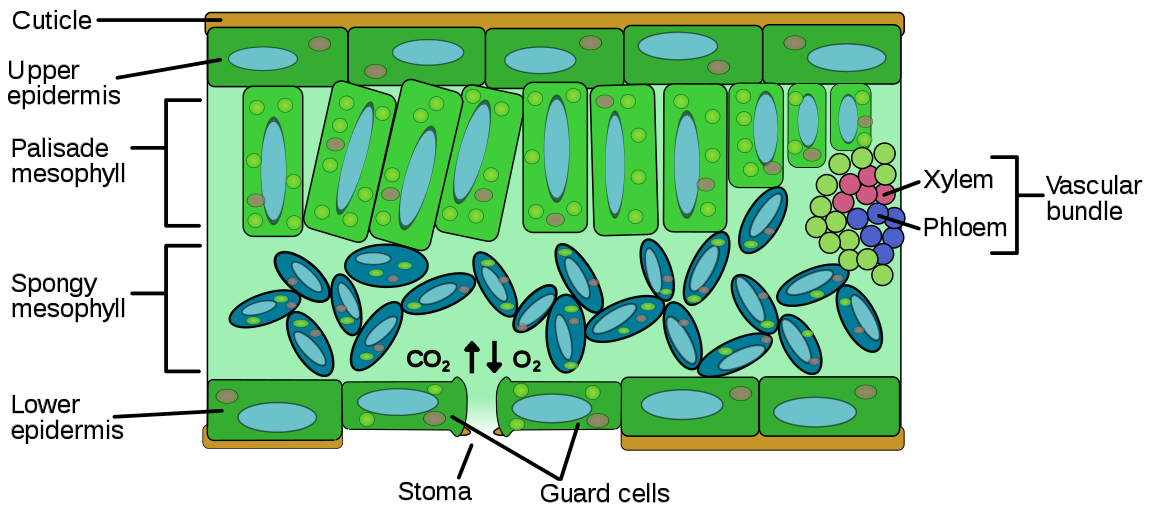
Leaves of a plant are composed of three types of tissues i.e., dermal tissues, vascular tissues, and internal ground tissues. Dermal tissues most probably make up the upper and lower epidermis of leaves. Vascular tissues such as xylem and phloem are present in the veins of leaves. The remaining ground tissue which is present in between the upper and lower epidermis of leaves, known as the mesophyll, is composed of 2 types of parenchymatous cells: palisade (making the upper layer, elongated cells) and spongy (making the lower layer, spherical or ovoid) parenchymatous cells. These parenchymatous cells are modified to possess chlorophyll, hence, termed as chlorenchyma parenchymatous cells.
- Sporophyll can be defined as a modified leaf that bears sporangia (structures that produce spores).
- Hypsophyll can be defined as any of the parts of a flower that is derived from leaves such as sepals, petals, bracts.
- Chlorophyll is a green-colored pigment present in plants, algae, and cyanobacteria that has its role in photosynthesis.
Hence, the correct answer is option (A).
Note: Mesophyll cells in leaves are responsible for photosynthesis as well as the exchange of gases from the surface of the leaf. They are composed of parenchymatous cells that are modified to possess chlorophyll in them which are known as chlorenchyma cells.
Complete answer:
Leaves of a plant are composed of three types of tissues i.e., dermal tissues, vascular tissues, and internal ground tissues. Dermal tissues most probably make up the upper and lower epidermis of leaves. Vascular tissues such as xylem and phloem are present in the veins of leaves. The remaining ground tissue which is present in between the upper and lower epidermis of leaves, known as the mesophyll, is composed of 2 types of parenchymatous cells: palisade (making the upper layer, elongated cells) and spongy (making the lower layer, spherical or ovoid) parenchymatous cells. These parenchymatous cells are modified to possess chlorophyll, hence, termed as chlorenchyma parenchymatous cells.
- Sporophyll can be defined as a modified leaf that bears sporangia (structures that produce spores).
- Hypsophyll can be defined as any of the parts of a flower that is derived from leaves such as sepals, petals, bracts.
- Chlorophyll is a green-colored pigment present in plants, algae, and cyanobacteria that has its role in photosynthesis.
Hence, the correct answer is option (A).
Note: Mesophyll cells in leaves are responsible for photosynthesis as well as the exchange of gases from the surface of the leaf. They are composed of parenchymatous cells that are modified to possess chlorophyll in them which are known as chlorenchyma cells.
Recently Updated Pages
Master Class 11 English: Engaging Questions & Answers for Success

Master Class 11 Social Science: Engaging Questions & Answers for Success
Master Class 11 Maths: Engaging Questions & Answers for Success
Master Class 11 Biology: Engaging Questions & Answers for Success
Master Class 11 Physics: Engaging Questions & Answers for Success
Master Class 11 Chemistry: Engaging Questions & Answers for Success
Trending doubts
One Metric ton is equal to kg A 10000 B 1000 C 100 class 11 physics CBSE
Difference Between Prokaryotic Cells and Eukaryotic Cells
Find the value of the expression given below sin 30circ class 11 maths CBSE
Two of the body parts which do not appear in MRI are class 11 biology CBSE
Draw a diagram of a plant cell and label at least eight class 11 biology CBSE
10 examples of friction in our daily life