




What changes can be observed in the length of the I band during muscle contraction?
Answer
 Verified
626.4k+ views
Hint: The I band contains the actin filaments which are twice in number compared to myosin filaments in a single sarcomere. Each I band is subdivided into two halves by a Z disc. During muscular contraction the region of overlap between actin and myosin filaments increases.
Complete answer:
The following changes are observed in the I band during muscle contraction:
-Progressive shortening of the I band occurs.
-Gradually the I band disappears, at this time the fibril has shortened to almost 65% of its initial resting length.
Additional Information: The Muscle contraction is usually related to the activation of the sites which generate tension within the muscle fibers. The contraction doesn't always mean muscle shortening because muscle tension is often produced without changes in muscle length, like when holding an important book or a dumbbell at an equivalent position. When the contraction will be terminating, it will be followed by muscle relaxation, which may be a return of the muscle fibers to their low tension-generating state. Muscle contractions will be described based on two variables: length and tension. A muscle contraction is described as isometric if the muscle tension changes but the muscle length remains equivalent. In contrast, a muscle contraction is isotonic if muscle tension remains equivalent throughout the contraction.
Note: If the muscle length gets shorter, the contraction is concentric; if the muscle length lengthens, the contraction is eccentric. In natural movements which include locomotor activity, muscle contractions are multifaceted as they're ready to produce changes in length and tension during a time-varying manner. Therefore, neither length nor tension is probably going to stay equivalent in muscles that contract during locomotor activity.
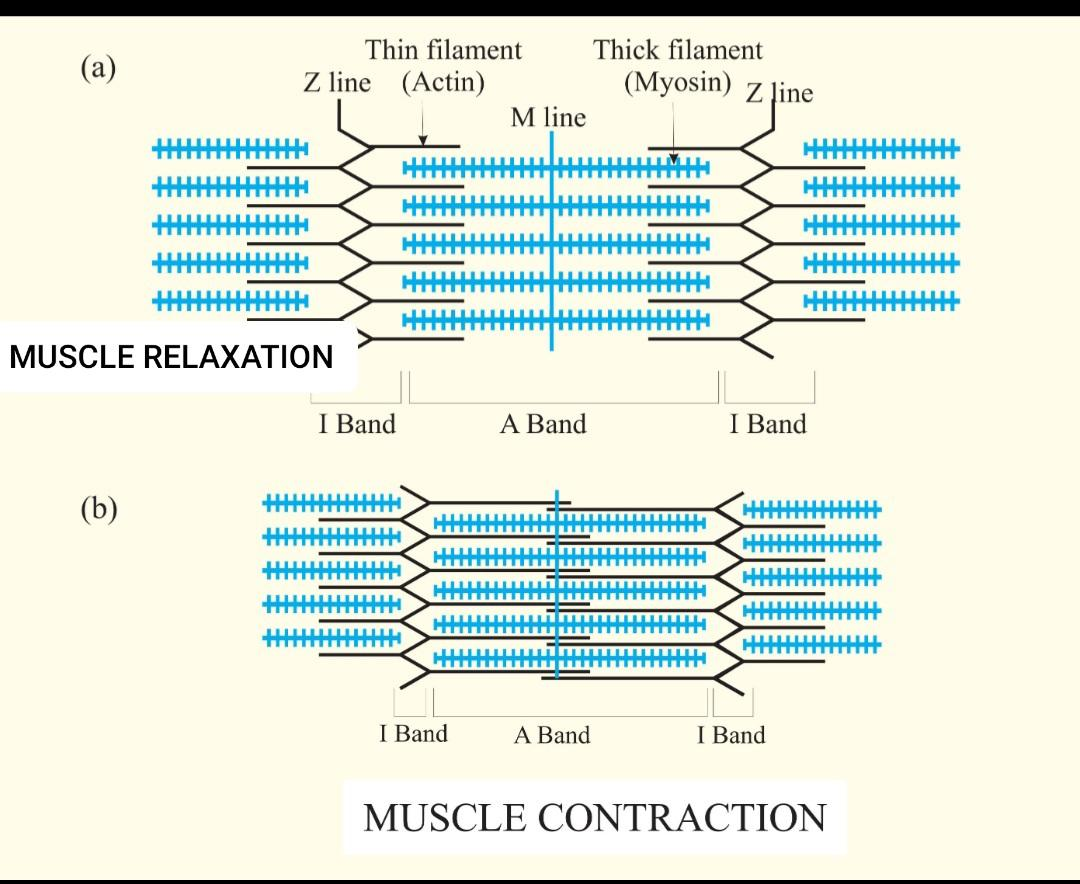
Complete answer:
The following changes are observed in the I band during muscle contraction:
-Progressive shortening of the I band occurs.
-Gradually the I band disappears, at this time the fibril has shortened to almost 65% of its initial resting length.
Additional Information: The Muscle contraction is usually related to the activation of the sites which generate tension within the muscle fibers. The contraction doesn't always mean muscle shortening because muscle tension is often produced without changes in muscle length, like when holding an important book or a dumbbell at an equivalent position. When the contraction will be terminating, it will be followed by muscle relaxation, which may be a return of the muscle fibers to their low tension-generating state. Muscle contractions will be described based on two variables: length and tension. A muscle contraction is described as isometric if the muscle tension changes but the muscle length remains equivalent. In contrast, a muscle contraction is isotonic if muscle tension remains equivalent throughout the contraction.
Note: If the muscle length gets shorter, the contraction is concentric; if the muscle length lengthens, the contraction is eccentric. In natural movements which include locomotor activity, muscle contractions are multifaceted as they're ready to produce changes in length and tension during a time-varying manner. Therefore, neither length nor tension is probably going to stay equivalent in muscles that contract during locomotor activity.
Recently Updated Pages
Which will be the least stable resonating structure class 11 chemistry CBSE

How many 5 digit telephone numbers can be construc-class-11-maths-CBSE
How do you find the angle of the resultant vector class 11 physics CBSE
Draw labelled diagram of the following i Gram seed class 11 biology CBSE
What is the need and importance of classification class 11 biology CBSE
The way in which the sparrows expressed their sorrow class 11 english CBSE
Trending doubts
One Metric ton is equal to kg A 10000 B 1000 C 100 class 11 physics CBSE
Find the value of the expression given below sin 30circ class 11 maths CBSE
1 Quintal is equal to a 110 kg b 10 kg c 100kg d 1000 class 11 physics CBSE
Draw a diagram of nephron and explain its structur class 11 biology CBSE
10 examples of friction in our daily life
Proton was discovered by A Thomson B Rutherford C Chadwick class 11 chemistry CBSE