



Chambers in human heart
A) 1 auricle, 1 ventricle
B) 2 auricles, 1 ventricle
C) 1 auricle, 3 ventricles
D) 2 auricles, 2 ventricles
Answer
 Verified
598.8k+ views
Hint: The heart in birds and mammals has four chambers (the crocodile is the only reptile with a four chamber heart). The complete segregation of deoxygenated and oxygenated blood makes the process of oxygen carrying much more efficient.
Complete answer:
The heart of a human has four chambers. There are two upper chambers called the auricles, also referred to as the atrium, and the ventricles are called the two lower chambers. Compared to the upper chambers, auricles are called ventricles in the larger chambers. The blood passes through the right ventricle and enters the right atrium.
The blood is pumped by the proper ventricle into the lungs where it is oxygenated. The oxygenated blood is carried back to the heart by the pulmonary veins which join the left atrium. The distribution of the blood is double, i.e., pulmonary and systemic circulation. For the purposes of blood oxygenation, heart to lungs and back to heart is pulmonary circulation. Systemic circulation is the transport of blood from heart to organs and back to heart.
The auricles and ventricles are separated by septum with valves in between. Tricuspid valve in between right atrium and ventricle and bicuspid valve in between left atrium and ventricle.
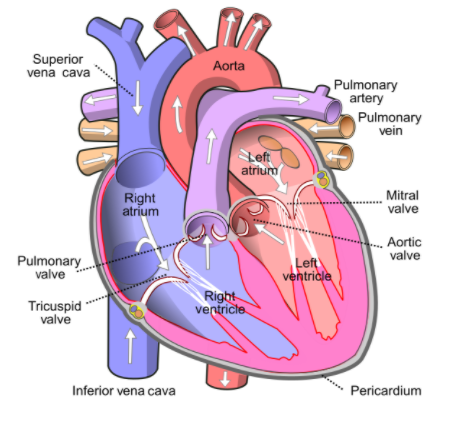
Hence the correct answer is option ‘D’.
Note: Our heart's largest and strongest chamber is the left ventricle. The walls of the chamber of the left ventricle are just around half an inch thick, but they have enough strength through the aortic valve to drive blood through your body.
Complete answer:
The heart of a human has four chambers. There are two upper chambers called the auricles, also referred to as the atrium, and the ventricles are called the two lower chambers. Compared to the upper chambers, auricles are called ventricles in the larger chambers. The blood passes through the right ventricle and enters the right atrium.
The blood is pumped by the proper ventricle into the lungs where it is oxygenated. The oxygenated blood is carried back to the heart by the pulmonary veins which join the left atrium. The distribution of the blood is double, i.e., pulmonary and systemic circulation. For the purposes of blood oxygenation, heart to lungs and back to heart is pulmonary circulation. Systemic circulation is the transport of blood from heart to organs and back to heart.
The auricles and ventricles are separated by septum with valves in between. Tricuspid valve in between right atrium and ventricle and bicuspid valve in between left atrium and ventricle.
Hence the correct answer is option ‘D’.
Note: Our heart's largest and strongest chamber is the left ventricle. The walls of the chamber of the left ventricle are just around half an inch thick, but they have enough strength through the aortic valve to drive blood through your body.
Recently Updated Pages
Which will be the least stable resonating structure class 11 chemistry CBSE

Explain the structure of megasporangium class 12 biology CBSE
Differentiate between voluntary action and reflex class 10 biology CBSE
How many 5 digit telephone numbers can be construc-class-11-maths-CBSE
How do you find the angle of the resultant vector class 11 physics CBSE
Why is chloroform kept in dark coloured bottles class 12 chemistry CBSE
Trending doubts
The common name of Rheo leaf is A Oyster plant B Boat class 9 biology CBSE
Difference Between Plant Cell and Animal Cell
Fill the blanks with the suitable prepositions 1 The class 9 english CBSE
What is the full form of pH?
Any five important events between the years 1930 to class 9 social science CBSE
On an outline map of India show its neighbouring c class 9 social science CBSE