




$C{{H}_{4}}$ has:
a.) Linear Geometry
b.) Bent geometry
c.) Tetrahedral geometry
d.) Pyramidal geometry
Answer
 Verified
619.8k+ views
Hint: Geometry of the molecule depends on two factors. One is hybridization and second is number of lone present in central atom. As in Carbon there will not be a lone pair for the given molecule, that’s why it's geometry will purely be decided on the basis of hybridization alone. In case of $sp$ hybridization, a molecule will have linear geometry and in case of $s{{p}^{3}}$ hybridization molecule will have tetrahedral geometry. Since Carbon doesn’t have any lone pair, therefore it can’t have bent or pyramidal geometry.
Complete Solution :
Electronic configuration for of Carbon:
$1{{s}^{2}}2{{s}^{2}}2{{p}^{2}}$
- As carbon has to accommodate 4 hydrogen atoms, therefore it needs 4 half filled orbitals, so one 2s electron will be transferred into 2p orbital. Now new electronic configuration is:
$1{{s}^{2}}2{{s}^{1}}2{{p}^{3}}$
Now it has one s orbital and 3 p orbitals as half filled orbitals and no lone pair in valence shell, therefore these 4 orbitals will take part in hybridization, so there will be clearly $s{{p}^{3}}$ hybridization.
We know that molecule that has $s{{p}^{3}}$ hybridization without any lone pair, always has tetrahedral geometry.
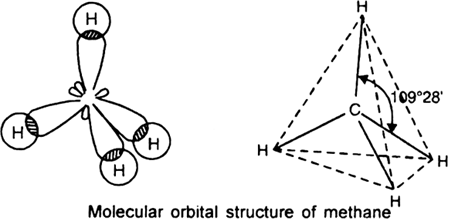
So $C{{H}_{4}}$ has tetrahedral geometry.
So, the correct answer is “Option C”.
Additional Information:
In a tetrahedral molecular geometry, a central atom is located at the center with four substituents that are located at the corners of a tetrahedron. It has the bond angle of ${{109}^{0}}{{28}^{'}}$. It is a symmetrical shape.
Note: Methane is gas that is found in small quantities in Earth's atmosphere. Methane is a powerful greenhouse gas. Methane is flammable, and is used as a fuel worldwide. It can explode at concentrations between 5% (lower explosive limit) and 15% (upper explosive limit). It is relatively non-toxic gas. Its health effects are associated with being simple asphyxiate displacing oxygen in the lungs.
Complete Solution :
Electronic configuration for of Carbon:
$1{{s}^{2}}2{{s}^{2}}2{{p}^{2}}$
- As carbon has to accommodate 4 hydrogen atoms, therefore it needs 4 half filled orbitals, so one 2s electron will be transferred into 2p orbital. Now new electronic configuration is:
$1{{s}^{2}}2{{s}^{1}}2{{p}^{3}}$
Now it has one s orbital and 3 p orbitals as half filled orbitals and no lone pair in valence shell, therefore these 4 orbitals will take part in hybridization, so there will be clearly $s{{p}^{3}}$ hybridization.
We know that molecule that has $s{{p}^{3}}$ hybridization without any lone pair, always has tetrahedral geometry.
So $C{{H}_{4}}$ has tetrahedral geometry.
So, the correct answer is “Option C”.
Additional Information:
In a tetrahedral molecular geometry, a central atom is located at the center with four substituents that are located at the corners of a tetrahedron. It has the bond angle of ${{109}^{0}}{{28}^{'}}$. It is a symmetrical shape.
Note: Methane is gas that is found in small quantities in Earth's atmosphere. Methane is a powerful greenhouse gas. Methane is flammable, and is used as a fuel worldwide. It can explode at concentrations between 5% (lower explosive limit) and 15% (upper explosive limit). It is relatively non-toxic gas. Its health effects are associated with being simple asphyxiate displacing oxygen in the lungs.
Recently Updated Pages
Master Class 11 English: Engaging Questions & Answers for Success

Master Class 11 Physics: Engaging Questions & Answers for Success
Master Class 11 Computer Science: Engaging Questions & Answers for Success
Master Class 11 Chemistry: Engaging Questions & Answers for Success
Master Class 11 Social Science: Engaging Questions & Answers for Success
Master Class 11 Accountancy: Engaging Questions & Answers for Success
Trending doubts
Difference Between Prokaryotic Cells and Eukaryotic Cells
Two of the body parts which do not appear in MRI are class 11 biology CBSE
One Metric ton is equal to kg A 10000 B 1000 C 100 class 11 physics CBSE
10 examples of friction in our daily life
Draw a diagram of nephron and explain its structur class 11 biology CBSE
Draw a diagram of a plant cell and label at least eight class 11 biology CBSE