




$C{{H}_{3}}C\equiv CC{{H}_{3}}\xrightarrow{{{H}_{2}}/Pt}A\xrightarrow{{{D}_{2}}/Pt}B$
The compounds A and B respectively are-
[A] cis-butene-2 and rac-2,3-dideuterobutane
[B] trans-butene-2 and rac-2,3-dideuterio butane
[C] cis-butene-2 and meso-2,3-dideuterobutane
[D] trans-butene-2 and meso-2,3-dideuterio butane
Answer
 Verified
648k+ views
Hint: Alkynes are converted into alkenes and alkanes in presence of a catalyst like platinum or palladium. Hydrogenation of alkenes is a reduction reaction. The product A will be an alkene and B will be an optically active alkane.
Complete step by step solution:
The starting product given to us is an alkyne. An alkyne is an organic compound which contains a triple bond between two carbon atoms.
Alkynes can be hydrogenated into alkenes in presence of platinum catalyst and hydrogen.
They can also be fully hydrogenated into alkanes if two catalysts and 2 hydrogen atoms are present.
So we can say that the product A will be an alkene and B will be an alkane.
Hydrogenation of alkynes simply means addition of hydrogen atoms across the triple bonds. If the product formed has a carbon-carbon double bond, it is an alkene and if the product formed has a carbon-carbon single bond, the product is alkane.
Addition of hydrogen atoms across the double bond will cause loss of a bond.
On hydrogenating the alkyne given, the product obtained is-
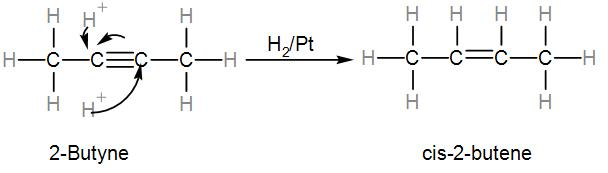
Further, when cis-2-butene is treated with deuterium in presence of a platinum catalyst, the double bond is converted into a single bond and an alkane is obtained.
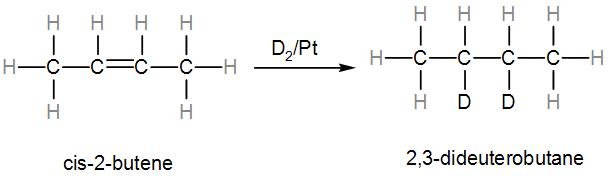 Meso compounds are compounds which are optically active i.e. have a non-superimposable mirror image but also have a centre of symmetry.
Racemic mixture is a mixture of compounds which contain both (R) and (S) configuration.
As the product obtained exhibits optical activity, therefore it cannot be a racemic mixture.
Here, the obtained product is a meso compound as it has a non-superimposable mirror image, making it optically active and also a plane of symmetry.
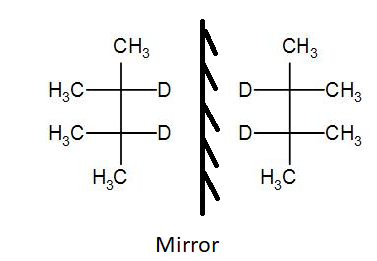 Therefore, the correct answer is option [C] cis-butene-2 and meso-2,3-dideuterobutane
Note: Racemic mixtures exhibit no optical activity, hence the product obtained is a meso compound.
Hydrogenation of alkyne to alkene gives a cis-alkene in presence of hydrogen and platinum catalyst. If we want a trans-alkene, Lindlar’s Reagent is used which is sodium in ammonia.
Complete step by step solution:
The starting product given to us is an alkyne. An alkyne is an organic compound which contains a triple bond between two carbon atoms.
Alkynes can be hydrogenated into alkenes in presence of platinum catalyst and hydrogen.
They can also be fully hydrogenated into alkanes if two catalysts and 2 hydrogen atoms are present.
So we can say that the product A will be an alkene and B will be an alkane.
Hydrogenation of alkynes simply means addition of hydrogen atoms across the triple bonds. If the product formed has a carbon-carbon double bond, it is an alkene and if the product formed has a carbon-carbon single bond, the product is alkane.
Addition of hydrogen atoms across the double bond will cause loss of a bond.
On hydrogenating the alkyne given, the product obtained is-
Further, when cis-2-butene is treated with deuterium in presence of a platinum catalyst, the double bond is converted into a single bond and an alkane is obtained.
Racemic mixture is a mixture of compounds which contain both (R) and (S) configuration.
As the product obtained exhibits optical activity, therefore it cannot be a racemic mixture.
Here, the obtained product is a meso compound as it has a non-superimposable mirror image, making it optically active and also a plane of symmetry.
Note: Racemic mixtures exhibit no optical activity, hence the product obtained is a meso compound.
Hydrogenation of alkyne to alkene gives a cis-alkene in presence of hydrogen and platinum catalyst. If we want a trans-alkene, Lindlar’s Reagent is used which is sodium in ammonia.
Recently Updated Pages
Basicity of sulphurous acid and sulphuric acid are

Master Class 12 Economics: Engaging Questions & Answers for Success
Master Class 12 Biology: Engaging Questions & Answers for Success
Master Class 11 English: Engaging Questions & Answers for Success
Master Class 11 Physics: Engaging Questions & Answers for Success
Master Class 11 Computer Science: Engaging Questions & Answers for Success
Trending doubts
Draw a labelled sketch of the human eye class 12 physics CBSE
The chemical formula of tear gas is A CO Cl 2 B C 10 class 12 chemistry CBSE
Draw ray diagrams each showing i myopic eye and ii class 12 physics CBSE
Which are the Top 10 Largest Countries of the World?
Differentiate between homogeneous and heterogeneous class 12 chemistry CBSE
Which is the correct genotypic ratio of mendel dihybrid class 12 biology CBSE