




$CH_3 - CH = CH_2\xrightarrow{Cl_2/H_2O}$
The correct product is:
A)
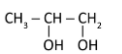
B)
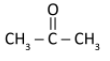
C)
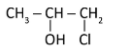
D)
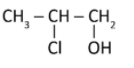
Answer
 Verified
651k+ views
Hint: The given reactant reacts with chlorine in the presence of water, the pi bond will break and the addition of chlorine and hydroxide will take place. The double bond present here is important for the reaction to occur, after reaction of acid and water hypochlorous acid will be formed in which Cl acts as electrophile. To decide the correct answer, we should know the proper mechanism.
Complete answer:
Alkenes react with HOCl the intermediate containing carbocation will be formed, as shown.
Hydroxyl will form the bond with secondary carbocation of the intermediate. As per Markovnikov’s rule the halogen (nucleophile) will go to the carbon with a greater number of alkyl atoms but here hydroxyl will get the preference, because it acts as nucleophile and Cl act as electrophile. So the major product is option (C) and not option (D). Other options are wrong as the mechanism suggests.
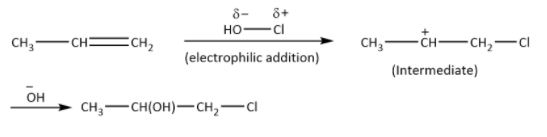
Hence, the correct answer is option (C).
Note: This type of reaction in organic chemistry is called electrophilic addition reaction. Electrophilic addition reactions are characteristic of those compounds that contain multiple bonds such as alkenes and alkynes. The attack of electrophile occurs at the carbon-carbon double or triple bond that results in the formation of a carbocation in the initial step. The carbocation is further attacked by a nucleophile.
Complete answer:
Alkenes react with HOCl the intermediate containing carbocation will be formed, as shown.
Hydroxyl will form the bond with secondary carbocation of the intermediate. As per Markovnikov’s rule the halogen (nucleophile) will go to the carbon with a greater number of alkyl atoms but here hydroxyl will get the preference, because it acts as nucleophile and Cl act as electrophile. So the major product is option (C) and not option (D). Other options are wrong as the mechanism suggests.
Hence, the correct answer is option (C).
Note: This type of reaction in organic chemistry is called electrophilic addition reaction. Electrophilic addition reactions are characteristic of those compounds that contain multiple bonds such as alkenes and alkynes. The attack of electrophile occurs at the carbon-carbon double or triple bond that results in the formation of a carbocation in the initial step. The carbocation is further attacked by a nucleophile.
Recently Updated Pages
If x a + bt + ct2 where x is in meters and t is in class 11 physics CBSE

A car covers the first half distance between two places class 11 physics CBSE
The resultant of two vectors overrightarrow P and overrightarrow class 11 physics CBSE
Find the value of cos 135 class 11 maths CBSE
A mass M is held in place by an applied force F and class 11 physics CBSE
A solution of glucose in water is labelled as 10 dfracwv class 11 chemistry CBSE
Trending doubts
One Metric ton is equal to kg A 10000 B 1000 C 100 class 11 physics CBSE
Find the value of the expression given below sin 30circ class 11 maths CBSE
Draw a diagram of nephron and explain its structur class 11 biology CBSE
10 examples of friction in our daily life
Proton was discovered by A Thomson B Rutherford C Chadwick class 11 chemistry CBSE
Bond order ofO2 O2+ O2 and O22 is in order A O2 langle class 11 chemistry CBSE