




Where do certain symbiotic microorganisms normally occur in the human body?
A. Caecum
B. Oral lining and tongue surface
C. Vermiform appendix and rectum
D. Duodenum
Answer
 Verified
617.7k+ views
Hint: Symbiotic bacteria are those that live in beneficial associations with other organisms like other bacteria, plants, fungi, etc. The bacteria that occur in symbiosis with the human body majorly help in digestion. A finger-like tubular sac that lies on the upper section of the colon is where these symbiotic organisms are found mostly.
Complete step by step answer: Symbiotic microorganisms are those that live in relation with some other living being. In this kind of relationship, the host as well as the bacteria are benefitted from each other. The human body serves as a suitable host to many microorganisms. The gut is home to thousands of microorganisms that live in symbiosis with the cells of the gut lining. These microbes help in digestion and also produce vitamin K and B complexes. The bacteria in turn get suitable habitat and nutrition from incoming food inside our guts.
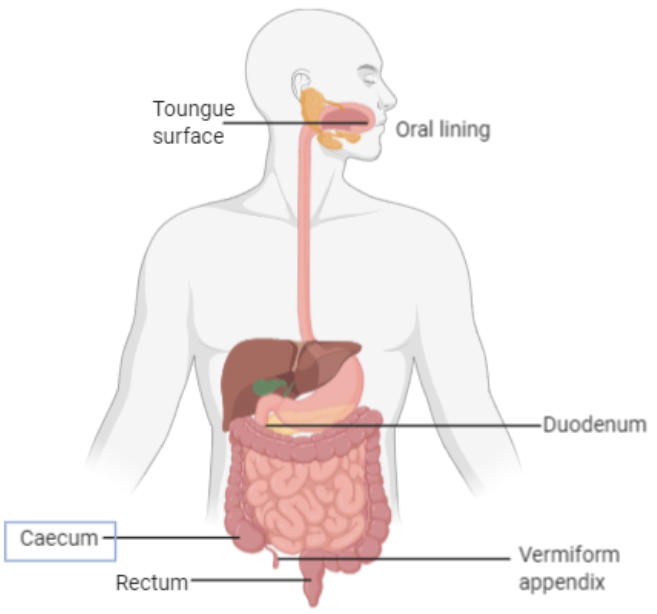
Now let us see that which of the given options acts as a hotspot for these symbiotic bacteria in the human body.
-Option A is Caecum. It is the upper or proximal part of the large intestine. It is a tube-like structure or a finger-like tubular sac that is present in the left lower abdominal cavity. It is considered as the beginning of the large intestine and lies above the colon. It receives undigested food waste and absorbs fluids and salts from it. It is home to $99%$ aerobic bacteria in the gut. The bacteria help in further digestion of food.
-Option B is Oral lining and tongue surface. The bacteria that are found over these surfaces are not symbiotic and are not good for oral hygiene or overall health. Thus if there are any bacteria on these surfaces it should be removed.
-Option C is a Vermiform appendix and rectum. The vermiform appendix is a worm-shaped tubular structure attached to the caecum and is thought to play an important role in the maintenance of gut flora. But this role is not confirmed. The rectum is a temporary storage site for human excreta and when filled it passes out feces from the body.
-Option D is Duodenum. It is the proximal portion of the small intestine that lies immediately below the stomach. The partially digested food passes from it to the small intestine. It has no gut flora in it.
Hence, the correct answer is Option A
Note: The gut microbes help in maintaining good gut conditions. They help in digestion and release nutritious compounds that are absorbed by the gut lining. Many good microbes are now being studied from the gut and are included in a healthy diet. Probiotics are a good example of using these gut microbes in providing immunity and a healthy gut.
Complete step by step answer: Symbiotic microorganisms are those that live in relation with some other living being. In this kind of relationship, the host as well as the bacteria are benefitted from each other. The human body serves as a suitable host to many microorganisms. The gut is home to thousands of microorganisms that live in symbiosis with the cells of the gut lining. These microbes help in digestion and also produce vitamin K and B complexes. The bacteria in turn get suitable habitat and nutrition from incoming food inside our guts.
Now let us see that which of the given options acts as a hotspot for these symbiotic bacteria in the human body.
-Option A is Caecum. It is the upper or proximal part of the large intestine. It is a tube-like structure or a finger-like tubular sac that is present in the left lower abdominal cavity. It is considered as the beginning of the large intestine and lies above the colon. It receives undigested food waste and absorbs fluids and salts from it. It is home to $99%$ aerobic bacteria in the gut. The bacteria help in further digestion of food.
-Option B is Oral lining and tongue surface. The bacteria that are found over these surfaces are not symbiotic and are not good for oral hygiene or overall health. Thus if there are any bacteria on these surfaces it should be removed.
-Option C is a Vermiform appendix and rectum. The vermiform appendix is a worm-shaped tubular structure attached to the caecum and is thought to play an important role in the maintenance of gut flora. But this role is not confirmed. The rectum is a temporary storage site for human excreta and when filled it passes out feces from the body.
-Option D is Duodenum. It is the proximal portion of the small intestine that lies immediately below the stomach. The partially digested food passes from it to the small intestine. It has no gut flora in it.
Hence, the correct answer is Option A
Note: The gut microbes help in maintaining good gut conditions. They help in digestion and release nutritious compounds that are absorbed by the gut lining. Many good microbes are now being studied from the gut and are included in a healthy diet. Probiotics are a good example of using these gut microbes in providing immunity and a healthy gut.
Recently Updated Pages
Master Class 11 English: Engaging Questions & Answers for Success

Master Class 11 Social Science: Engaging Questions & Answers for Success
Master Class 11 Maths: Engaging Questions & Answers for Success
Master Class 11 Biology: Engaging Questions & Answers for Success
Master Class 11 Physics: Engaging Questions & Answers for Success
Master Class 11 Chemistry: Engaging Questions & Answers for Success
Trending doubts
One Metric ton is equal to kg A 10000 B 1000 C 100 class 11 physics CBSE
Difference Between Prokaryotic Cells and Eukaryotic Cells
Find the value of the expression given below sin 30circ class 11 maths CBSE
Difference between physical and chemical change class 11 chemistry CBSE
Two of the body parts which do not appear in MRI are class 11 biology CBSE
Draw a diagram of a plant cell and label at least eight class 11 biology CBSE