



Cell plate grows from
A. Wall to centre
B. Centre to walls
C. One wall to another
D. Simultaneously
Answer
 Verified
518.1k+ views
Hint: The cell is surrounded by a cleavage furrow that tightens as the division process progresses. Cleavage furrows are exclusively seen in animal cells, while cell plates are only found in plant cells. Plants generate a cell plate when dividing, which is the most visible distinction between plant and animal cytokinesis.
Complete answer:
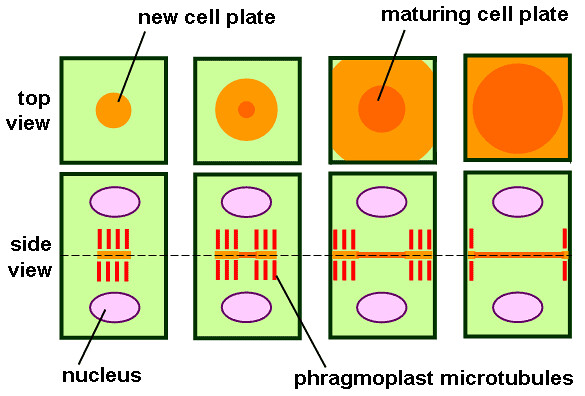
In a dividing cell, a plate forms halfway between the two groups of chromosomes and is involved in building the wall between the two new daughter cells. The phragmoplast, a bundle of two sets of microtubules of opposite polarity that appears at the central zone of the anaphase spindle, provides the structural scaffold for cell plate expansion and positional coordination. The cell plate is completed interphase, and DNA is replicated.
Correct option is B. Centre to walls
Small Golgi-derived vesicles combine in a plane across the equator of the late telophase spindle to create a disk-shaped structure, forming the cell plate. The phragmoplast, a bundle of two sets of microtubules of opposite polarity that appears at the central zone of the anaphase spindle, provides the structural scaffold for cell plate expansion and positional coordination.
Note:
Both plants and animals go through two processes that are referred to as cell division. The first is mitosis, in which the cell replicates and splits, resulting in the formation of two identical cells. The second stage is meiosis, during which gametes (sex cells) are produced. Meiosis I and II are two types of meiosis. Identical cells are created in meiosis I, and haploid cells are formed in meiosis II, allowing for conception.
Complete answer:
In a dividing cell, a plate forms halfway between the two groups of chromosomes and is involved in building the wall between the two new daughter cells. The phragmoplast, a bundle of two sets of microtubules of opposite polarity that appears at the central zone of the anaphase spindle, provides the structural scaffold for cell plate expansion and positional coordination. The cell plate is completed interphase, and DNA is replicated.
Correct option is B. Centre to walls
Small Golgi-derived vesicles combine in a plane across the equator of the late telophase spindle to create a disk-shaped structure, forming the cell plate. The phragmoplast, a bundle of two sets of microtubules of opposite polarity that appears at the central zone of the anaphase spindle, provides the structural scaffold for cell plate expansion and positional coordination.
Note:
Both plants and animals go through two processes that are referred to as cell division. The first is mitosis, in which the cell replicates and splits, resulting in the formation of two identical cells. The second stage is meiosis, during which gametes (sex cells) are produced. Meiosis I and II are two types of meiosis. Identical cells are created in meiosis I, and haploid cells are formed in meiosis II, allowing for conception.
Recently Updated Pages
Master Class 11 Social Science: Engaging Questions & Answers for Success

Master Class 11 English: Engaging Questions & Answers for Success
Master Class 11 Maths: Engaging Questions & Answers for Success
Master Class 11 Chemistry: Engaging Questions & Answers for Success
Master Class 11 Biology: Engaging Questions & Answers for Success
Master Class 11 Physics: Engaging Questions & Answers for Success
Trending doubts
One Metric ton is equal to kg A 10000 B 1000 C 100 class 11 physics CBSE
Difference Between Prokaryotic Cells and Eukaryotic Cells
How many of the following diseases can be studied with class 11 biology CBSE
Draw a diagram of a plant cell and label at least eight class 11 biology CBSE
Two of the body parts which do not appear in MRI are class 11 biology CBSE
Which gas is abundant in air class 11 chemistry CBSE