




Cell organelles are the parts of a living cell. Answer the following 3 questions using the choices provided. A choice may be used once, more than once, or not at all.
Which organelle is not bound by a membrane and is the site of protein synthesis.
(a) Ribosomes
(b) Smooth endoplasmic reticulum
(c) Chloroplasts
(d) Golgi apparatus
(e) Nucleolus
Answer
 Verified
570.9k+ views
Hint: Ribosomal rRNA is involved in the synthesis of proteins present in ribosomes in the cytoplasm, endoplasmic reticulum, and nucleus. Ribosome biogenesis takes place in the nucleolus.
Complete answer:
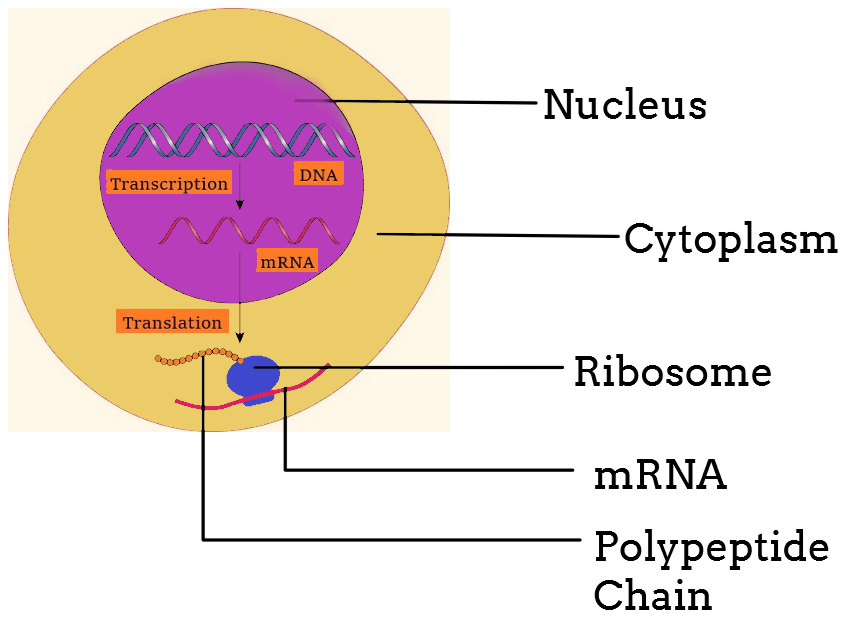
The structural and functional unit of any living organism is the cell. A eukaryotic cell is a highly developed cell contains various cell organelles like mitochondria, endoplasmic reticulum, Golgi complex, ribosomes, nucleus, vacuoles, peroxisomes, etc. almost all of the organelles are membrane-bound except ribosomes. The nucleus of a eukaryotic cell and the prokaryotic cell contains genetic material in the form of chromatin and a dark stained structure called the nucleolus. It is also a non-membrane bound structure in the cell. mRNA is used in the synthesis of proteins which is present in nucleolus and ribosomes.
Additional information:
- Primary function of nucleoli in the nucleus is rRNA formation and production of ribosomes. These are the non-membrane bound organelles inside the cell that are involved in the synthesis of proteins.
- Ribosomes are of two types namely 70s ribosomes and 80s ribosomes. The 70s ribosomes are present in the prokaryotic cell whereas in the eukaryotic cell 80s ribosomes are seen.
- Ribosomes are also present in the mitochondria and on the surface of the endoplasmic reticulum called the rough endoplasmic reticulum.
So, the correct answer is ‘Ribosomes and nucleolus’.
Note: - 80s ribosomes contain 60s and 40s subunits whereas in 70s ribosomes contain 50s and 30s subunits.
- Ribosomes present in the mitochondria are 70s types are the components required for protein synthesis.
Complete answer:
The structural and functional unit of any living organism is the cell. A eukaryotic cell is a highly developed cell contains various cell organelles like mitochondria, endoplasmic reticulum, Golgi complex, ribosomes, nucleus, vacuoles, peroxisomes, etc. almost all of the organelles are membrane-bound except ribosomes. The nucleus of a eukaryotic cell and the prokaryotic cell contains genetic material in the form of chromatin and a dark stained structure called the nucleolus. It is also a non-membrane bound structure in the cell. mRNA is used in the synthesis of proteins which is present in nucleolus and ribosomes.
Additional information:
- Primary function of nucleoli in the nucleus is rRNA formation and production of ribosomes. These are the non-membrane bound organelles inside the cell that are involved in the synthesis of proteins.
- Ribosomes are of two types namely 70s ribosomes and 80s ribosomes. The 70s ribosomes are present in the prokaryotic cell whereas in the eukaryotic cell 80s ribosomes are seen.
- Ribosomes are also present in the mitochondria and on the surface of the endoplasmic reticulum called the rough endoplasmic reticulum.
So, the correct answer is ‘Ribosomes and nucleolus’.
Note: - 80s ribosomes contain 60s and 40s subunits whereas in 70s ribosomes contain 50s and 30s subunits.
- Ribosomes present in the mitochondria are 70s types are the components required for protein synthesis.
Recently Updated Pages
Master Class 11 Computer Science: Engaging Questions & Answers for Success

Master Class 11 Business Studies: Engaging Questions & Answers for Success
Master Class 11 Economics: Engaging Questions & Answers for Success
Master Class 11 English: Engaging Questions & Answers for Success
Master Class 11 Maths: Engaging Questions & Answers for Success
Master Class 11 Biology: Engaging Questions & Answers for Success
Trending doubts
One Metric ton is equal to kg A 10000 B 1000 C 100 class 11 physics CBSE
There are 720 permutations of the digits 1 2 3 4 5 class 11 maths CBSE
Discuss the various forms of bacteria class 11 biology CBSE
Draw a diagram of a plant cell and label at least eight class 11 biology CBSE
State the laws of reflection of light
10 examples of friction in our daily life