




What cell organelle is responsible for protein synthesis?
Answer
 Verified
570.6k+ views
Hint: They are the cell organelles that are not enclosed by an outer covering called a membrane. They do not control the substances that enter or leave the cell. They do not need a membrane to control their internal structure.
Complete answer
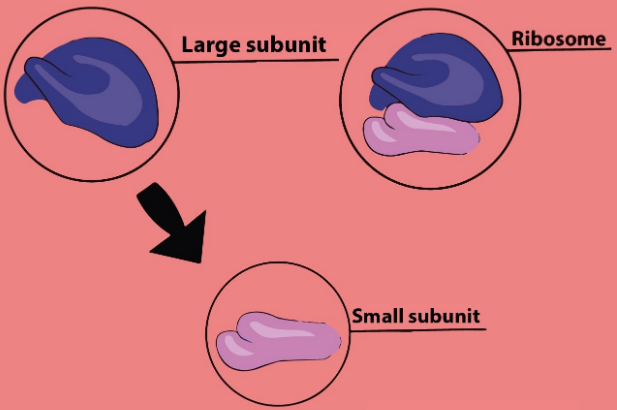
Ribosomes are tiny particles of ribonucleoprotein, which serve as the factories of protein production. Ribosomes are divided into two categories prokaryotic and eukaryotic. They are the main site for the protein synthesis and undergo the process of transcription to produce proteins. They act as an enzyme complex. They are smaller in the case of prokaryotic cells as compared to the eukaryotic cells. For the synthesis of hemoglobin in the Red Blood cells they are present in large numbers and help in transporting the oxygen throughout the body. They bring together the amino acid to form a particular protein which is important for completing the activities of the cell. By taking into consideration the main functions of the proteins it is clear that cells cannot function in the absence of ribosomes.
In 1983 A.D. The ribosomes were first isolated by Claude. The ribosomes were first reported in the root cells of broad beans. The ribosomes are also known as the cell organelle having the smallest electron microscopic structure. The ribosomes are classified into two types depending upon their sedimentation coefficient (S), 70s ribosomes, and 80s ribosomes.
Ribosomes are the tiny particles that are composed of ribonucleoprotein and help in the synthesis of proteins. The ribosomes of the prokaryotic and eukaryotic cells are different, in the case of the prokaryotic cells they constitute 54 kinds of proteins and rRNAs of 3 types. The 3 types of rRNAs are, namely, 5S,16S, and 23S rRNAs. While the ribosomes in the case of the eukaryotic cells are of two types, the 70S, and 80S that are freely located and or even attached. The 80S eukaryotic cyto ribosome has two unequal subunits. Their larger subunit is formed of 40 kinds of proteins and 28S, 5S, and 5. 8S rRNAs. The Smaller subunit is formed of 30- 40 proteins and 18S rRNAs.
Note:
'S' values are not additive. 'S' represents the Svedberg unit- the unit of measurement of sedimentation coefficient in ultracentrifugation. Ribosomes are present in all prokaryotic and eukaryotic cells except in mature mammalian erythrocytes. Without any organelles or complex chromosomes to breed, most prokaryotic cells can divide every 24 hours, or maybe faster with an adequate supply of food.
Complete answer
Ribosomes are tiny particles of ribonucleoprotein, which serve as the factories of protein production. Ribosomes are divided into two categories prokaryotic and eukaryotic. They are the main site for the protein synthesis and undergo the process of transcription to produce proteins. They act as an enzyme complex. They are smaller in the case of prokaryotic cells as compared to the eukaryotic cells. For the synthesis of hemoglobin in the Red Blood cells they are present in large numbers and help in transporting the oxygen throughout the body. They bring together the amino acid to form a particular protein which is important for completing the activities of the cell. By taking into consideration the main functions of the proteins it is clear that cells cannot function in the absence of ribosomes.
In 1983 A.D. The ribosomes were first isolated by Claude. The ribosomes were first reported in the root cells of broad beans. The ribosomes are also known as the cell organelle having the smallest electron microscopic structure. The ribosomes are classified into two types depending upon their sedimentation coefficient (S), 70s ribosomes, and 80s ribosomes.
Ribosomes are the tiny particles that are composed of ribonucleoprotein and help in the synthesis of proteins. The ribosomes of the prokaryotic and eukaryotic cells are different, in the case of the prokaryotic cells they constitute 54 kinds of proteins and rRNAs of 3 types. The 3 types of rRNAs are, namely, 5S,16S, and 23S rRNAs. While the ribosomes in the case of the eukaryotic cells are of two types, the 70S, and 80S that are freely located and or even attached. The 80S eukaryotic cyto ribosome has two unequal subunits. Their larger subunit is formed of 40 kinds of proteins and 28S, 5S, and 5. 8S rRNAs. The Smaller subunit is formed of 30- 40 proteins and 18S rRNAs.
Note:
'S' values are not additive. 'S' represents the Svedberg unit- the unit of measurement of sedimentation coefficient in ultracentrifugation. Ribosomes are present in all prokaryotic and eukaryotic cells except in mature mammalian erythrocytes. Without any organelles or complex chromosomes to breed, most prokaryotic cells can divide every 24 hours, or maybe faster with an adequate supply of food.
Recently Updated Pages
Master Class 11 English: Engaging Questions & Answers for Success

Master Class 11 Social Science: Engaging Questions & Answers for Success
Master Class 11 Maths: Engaging Questions & Answers for Success
Master Class 11 Biology: Engaging Questions & Answers for Success
Master Class 11 Physics: Engaging Questions & Answers for Success
Master Class 11 Chemistry: Engaging Questions & Answers for Success
Trending doubts
One Metric ton is equal to kg A 10000 B 1000 C 100 class 11 physics CBSE
Difference Between Prokaryotic Cells and Eukaryotic Cells
Two of the body parts which do not appear in MRI are class 11 biology CBSE
Find the value of the expression given below sin 30circ class 11 maths CBSE
Draw a diagram of a plant cell and label at least eight class 11 biology CBSE
10 examples of friction in our daily life