




Cell in latin means______
Answer
 Verified
543k+ views
Hint: All known species have a cell as their basic structural, functional, and biological unit. Because cells are the tiniest units of life, they are frequently referred to as "building blocks of life". Cell biology, cellular biology, or cytology are various terms for the study of cells.
There are two sorts of cells: eukaryotic cells with a nucleus and prokaryotic cells without one. Eukaryotes can be single-celled or multicellular, whereas prokaryotes are single-celled organism
Complete explanation:
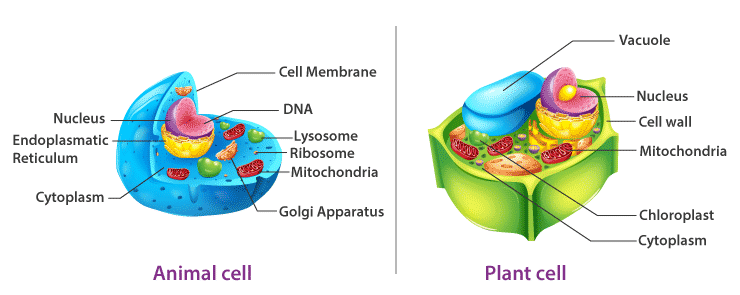
Every living creature is made up of cells, which are referred to as life's fundamental unit.
Cell is derived from the Latin word cellus, which means "little space".
It was first discovered by Robert Hooke, an English philosopher and architect.
Matthias Schleiden and Theodor Schwann, two German scientists, proposed the cell hypothesis.
Additional information:
Functions of cell:
The cell provides support and structure to the body.
Facilitates growth by mitosis.
Helps in reproduction.
Provides energy and allows the transport of substances.
Note:
Bacteria and archaea, two of the three kingdoms of life, are prokaryotes. Prokaryotic cells were the first form of life on Earth, and they were distinguished by the presence of important biological processes such as cell signalling. They lack a nucleus and other membrane-bound organelles, making them simpler and smaller than eukaryotic cells.
Eukaryotes include plants, mammals, fungi, slime moulds, protozoa, and algae. These cells are around fifteen times broader than a typical prokaryote and can have a thousand times the volume of a prokaryote. Compartmentalization is the presence of membrane-bound organelles (compartments) in which distinct processes take place, which distinguishes eukaryotes from prokaryotes.
There are two sorts of cells: eukaryotic cells with a nucleus and prokaryotic cells without one. Eukaryotes can be single-celled or multicellular, whereas prokaryotes are single-celled organism
Complete explanation:
Every living creature is made up of cells, which are referred to as life's fundamental unit.
Cell is derived from the Latin word cellus, which means "little space".
It was first discovered by Robert Hooke, an English philosopher and architect.
Matthias Schleiden and Theodor Schwann, two German scientists, proposed the cell hypothesis.
Additional information:
Functions of cell:
The cell provides support and structure to the body.
Facilitates growth by mitosis.
Helps in reproduction.
Provides energy and allows the transport of substances.
Note:
Bacteria and archaea, two of the three kingdoms of life, are prokaryotes. Prokaryotic cells were the first form of life on Earth, and they were distinguished by the presence of important biological processes such as cell signalling. They lack a nucleus and other membrane-bound organelles, making them simpler and smaller than eukaryotic cells.
Eukaryotes include plants, mammals, fungi, slime moulds, protozoa, and algae. These cells are around fifteen times broader than a typical prokaryote and can have a thousand times the volume of a prokaryote. Compartmentalization is the presence of membrane-bound organelles (compartments) in which distinct processes take place, which distinguishes eukaryotes from prokaryotes.
Recently Updated Pages
Master Class 11 English: Engaging Questions & Answers for Success

Master Class 11 Social Science: Engaging Questions & Answers for Success
Master Class 11 Maths: Engaging Questions & Answers for Success
Master Class 11 Biology: Engaging Questions & Answers for Success
Master Class 11 Physics: Engaging Questions & Answers for Success
Master Class 11 Chemistry: Engaging Questions & Answers for Success
Trending doubts
One Metric ton is equal to kg A 10000 B 1000 C 100 class 11 physics CBSE
Difference Between Prokaryotic Cells and Eukaryotic Cells
Two of the body parts which do not appear in MRI are class 11 biology CBSE
Find the value of the expression given below sin 30circ class 11 maths CBSE
Draw a diagram of a plant cell and label at least eight class 11 biology CBSE
10 examples of friction in our daily life