




Cell furrow is formed in
(a) Animal cell
(b) Plant cell
(c) Bacteria
(d) Virus
Answer
 Verified
547.5k+ views
Hint:At the end of cell division, cytokinesis ensures the proper partitioning of the nuclear and cytoplasmic contents into separate daughter cells. The final act of cell division is cytokinesis.
Complete answer:
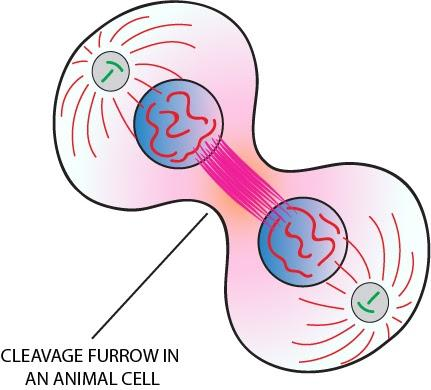
-After anaphase, a cleavage furrow forms in the equatorial cortex in typical animal mitosis. To divide the two daughter cells, this furrow then advances inward. Spindle microtubules play a key role in the creation of furrows.
-The cleavage furrow is the indentation of the surface of the cell that starts the cleavage development through which cytokinesis is undergone through animals and certain algal cells.
-The same proteins responsible for muscle contraction, actin, and myosin, begin the process of forming the furrow of cleavage, producing an actomyosin ring.
-The technique includes other cytoskeletal proteins and actin-binding proteins.
-Complex structures composed of microtubules and microfilaments that assist in the final separation of the cells into two identical daughter cells are the cleavage furrow in animal cells and the phragmoplast in plant cells.
-Through this particular technique, plant cells do not perform cytokinesis, but the two procedures are not entirely different.
-Within the equatorial region of the cell membrane, animal cells form an actin-myosin contractile ring that constricts the cleavage furrow to form.
-Golgi vesicle secretions form a cell plate or septum in plant cells on the equatorial plane of the cell wall through the action of phragmoplast microtubules.
So, the correct answer is ‘Animal cells’
Note:
The septum of the plant cell and the mid-zone of the animal cell are analogous in contrast. Apart from microtubules and microfilaments for division and movement, all involve vesicular secretions by the Golgi apparatus for resealing and development of the cytoskeletal network.
Complete answer:
-After anaphase, a cleavage furrow forms in the equatorial cortex in typical animal mitosis. To divide the two daughter cells, this furrow then advances inward. Spindle microtubules play a key role in the creation of furrows.
-The cleavage furrow is the indentation of the surface of the cell that starts the cleavage development through which cytokinesis is undergone through animals and certain algal cells.
-The same proteins responsible for muscle contraction, actin, and myosin, begin the process of forming the furrow of cleavage, producing an actomyosin ring.
-The technique includes other cytoskeletal proteins and actin-binding proteins.
-Complex structures composed of microtubules and microfilaments that assist in the final separation of the cells into two identical daughter cells are the cleavage furrow in animal cells and the phragmoplast in plant cells.
-Through this particular technique, plant cells do not perform cytokinesis, but the two procedures are not entirely different.
-Within the equatorial region of the cell membrane, animal cells form an actin-myosin contractile ring that constricts the cleavage furrow to form.
-Golgi vesicle secretions form a cell plate or septum in plant cells on the equatorial plane of the cell wall through the action of phragmoplast microtubules.
So, the correct answer is ‘Animal cells’
Note:
The septum of the plant cell and the mid-zone of the animal cell are analogous in contrast. Apart from microtubules and microfilaments for division and movement, all involve vesicular secretions by the Golgi apparatus for resealing and development of the cytoskeletal network.
Recently Updated Pages
Master Class 11 Social Science: Engaging Questions & Answers for Success

Master Class 11 English: Engaging Questions & Answers for Success
Master Class 11 Maths: Engaging Questions & Answers for Success
Master Class 11 Chemistry: Engaging Questions & Answers for Success
Master Class 11 Biology: Engaging Questions & Answers for Success
Master Class 11 Physics: Engaging Questions & Answers for Success
Trending doubts
One Metric ton is equal to kg A 10000 B 1000 C 100 class 11 physics CBSE
Difference Between Prokaryotic Cells and Eukaryotic Cells
How many of the following diseases can be studied with class 11 biology CBSE
Draw a diagram of a plant cell and label at least eight class 11 biology CBSE
Two of the body parts which do not appear in MRI are class 11 biology CBSE
Which gas is abundant in air class 11 chemistry CBSE