




Caudal vertebrae of Frog fuse to form
(a)Coccyx
(b)Pogostyle
(c)Urostyle
(d)Prehensile tail
Answer
 Verified
619.8k+ views
Hint: A long unsegmented bone that represents several fused vertebrae and forms the posterior part of the vertebral column of frogs and toads which help in shock absorption during a jump. The short, stiff vertebral column (9 or fewer vertebrae proper) and no ribs.
Complete answer:
The last thoracic, all the lumbar, the 2 sacral, and several caudal vertebrae all fuse to form one bone, the Synsacrum which in turn is fused to the pelvic girdle. Several free caudal vertebrae can be found and then the tail ends in an enlarged Pogostyle, which represents several fused vertebrae. The bones of the tail i.e Caudal vertebrae, that articulate with the sacral vertebrae and the number of caudal vertebrae vary with the species. We can take rabbits, for example, they have 15 caudal vertebrae, while in humans these vertebrae are fused to form a single bone which is known as the coccyx.
A rod-like fusion of the sacral vertebrae that is running in parallel with the extended iliac blades of the pelvis which results in a strong, shock-absorbing pelvic basket and that is known as a urostyle. The small upturned posterior tip of the vertebral column, generally formed of fused vertebrae and associated elements (in homocercal caudal fins of Teleostomi), the fan-like series of bones articulating with the last true vertebra, including preural centra, neural centra, epidurals, and hypural counted as one vertebra in some vertebral counts, not counted in others.
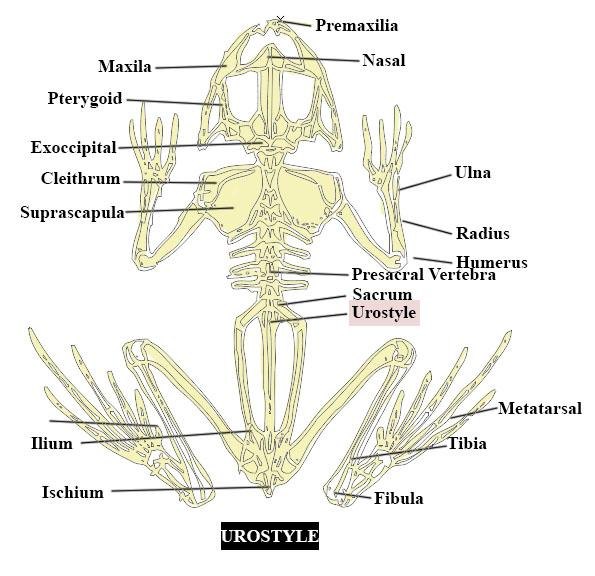
So, the correct answer is 'Urostyle’.
Note: The urostyle is first observed in the fossil record in the Early Jurassic and has remained a conserved feature for over 200 million years. The urostyle that is found in anuran is a unique component of the vertebrate axial skeleton, as it is formed from an ossifying hypochord, which contributes and fuses to the coccyx at the end of metamorphosis. In the case of a fish larvae a backwardly projecting process on the most posterior vertebra. The urostyle is usually included when counting vertebrae.
Complete answer:
The last thoracic, all the lumbar, the 2 sacral, and several caudal vertebrae all fuse to form one bone, the Synsacrum which in turn is fused to the pelvic girdle. Several free caudal vertebrae can be found and then the tail ends in an enlarged Pogostyle, which represents several fused vertebrae. The bones of the tail i.e Caudal vertebrae, that articulate with the sacral vertebrae and the number of caudal vertebrae vary with the species. We can take rabbits, for example, they have 15 caudal vertebrae, while in humans these vertebrae are fused to form a single bone which is known as the coccyx.
A rod-like fusion of the sacral vertebrae that is running in parallel with the extended iliac blades of the pelvis which results in a strong, shock-absorbing pelvic basket and that is known as a urostyle. The small upturned posterior tip of the vertebral column, generally formed of fused vertebrae and associated elements (in homocercal caudal fins of Teleostomi), the fan-like series of bones articulating with the last true vertebra, including preural centra, neural centra, epidurals, and hypural counted as one vertebra in some vertebral counts, not counted in others.
So, the correct answer is 'Urostyle’.
Note: The urostyle is first observed in the fossil record in the Early Jurassic and has remained a conserved feature for over 200 million years. The urostyle that is found in anuran is a unique component of the vertebrate axial skeleton, as it is formed from an ossifying hypochord, which contributes and fuses to the coccyx at the end of metamorphosis. In the case of a fish larvae a backwardly projecting process on the most posterior vertebra. The urostyle is usually included when counting vertebrae.
Recently Updated Pages
Master Class 11 English: Engaging Questions & Answers for Success

Master Class 11 Social Science: Engaging Questions & Answers for Success
Master Class 11 Maths: Engaging Questions & Answers for Success
Master Class 11 Biology: Engaging Questions & Answers for Success
Master Class 11 Physics: Engaging Questions & Answers for Success
Master Class 11 Chemistry: Engaging Questions & Answers for Success
Trending doubts
One Metric ton is equal to kg A 10000 B 1000 C 100 class 11 physics CBSE
Difference Between Prokaryotic Cells and Eukaryotic Cells
Difference between physical and chemical change class 11 chemistry CBSE
Find the value of the expression given below sin 30circ class 11 maths CBSE
Two of the body parts which do not appear in MRI are class 11 biology CBSE
Draw a diagram of a plant cell and label at least eight class 11 biology CBSE