




Cathode rays are streams of fast moving negatively charged particles. Their speed range is (Consider $c = 3x10_{}^8ms_{}^{ - 1}$)
a.$0.1c$ to $0.2c$
b.$c$
c.greater than $c$
d.Around $10_{}^{ - 5}c$ to $10_{}^{ - 3}c$
Answer
 Verified
500.7k+ views
Hint: By using cathode rays, J.J. Thomson studied the properties of negatively charged particles, electrons. He discovered a specific charge of the electron which is the ratio of charge by mass $(\dfrac{e}{m})$.
We will use a formula from the experiment which J.J. Thomson performed to study electrons.
Formula used:
\[v_{}^{} = \sqrt {\dfrac{{2eV}}{m}} \]
Where $v$ is the speed of an electron, $e$ is electric charge $(1.6x10_{}^{ - 19}C)$, $V$is the potential difference, and $m$is the mass of an electron $(9.1x10_{}^{ - 31}Kg)$.
Complete step by step answer:
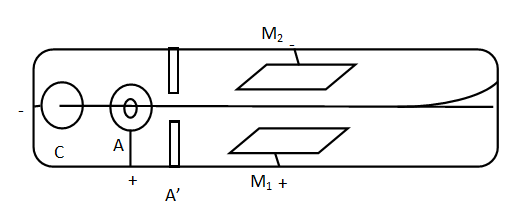
$C - $ cathode, $A - $ anode, $A' - $ metal electrode, $M_1^{},M_2^{} - $ metal plates
A very large potential difference $V$ is applied between cathode $C$ and anode $A$. A beam of electrons passes through anode and metal electrodes $A'$. The electron beam then passes through metal plates $M_1^{}$ and $M_2^{}$.\[M_1^{}\] is connected to the positive terminal of supply and \[M_2^{}\], a negative power supply maintaining constant potential difference $V$. Beams of electron travels through these plates and hits the end of a tube which is coated by fluorescent material, which glows when an electron strikes it. The potential difference $V$ between C and A then the speed of the electron coming out of the anode is given by
\[\dfrac{1}{2}mv_{}^2 = eV\]
\[v_{}^{} = \sqrt {\dfrac{{2eV}}{m}} \]
If we take $V = 3000$
\[v = \sqrt {\dfrac{{2 \times 1.6 \times 3000 \times 10_{}^{ - 19}}}{{9.1 \times 10_{}^{ - 31}}}} \]
\[v = \sqrt {\dfrac{{9600}}{{9.1}}} \times \sqrt {10_{}^{ - 19 + 31}} \]
\[v = \sqrt {1054.94} \times \sqrt {10_{}^{12}} \]
\[v = 32.47 \times 10_{}^6\]
\[\dfrac{v}{c} = \dfrac{{32.47}}{3} \times \dfrac{{10_{}^6}}{{10_{}^8}}\]
\[\dfrac{v}{c} = 108 \times 10_{}^{ - 2}\]
\[v = 0.1c\]
Similarly, if we increase the potential difference $V$, the speed of an electron can be increased.
Looking at options b) and c) is not possible and from the above calculation, option d) is also incorrect.
Hence if we look at the options a) $0.1c$ to $0.2c$ is correct.
Additional Information:
This theory contributed to a better understanding of the structure of an atom. And the most important discovery Thomson made was that the characteristics of cathode rays or electrons were unaffected by the material of the electrodes or the nature of the gas present in the cathode ray tube. Overall, we can conclude that electrons are the fundamental constituents of all atoms.
Note:
In the cathode ray, if both magnetic field and electric field are applied then both the field will cancel each other out and electrons would pass through the tube undeflected.
While calculating 10 to powers try to solve them separately as calculation becomes easier.
We will use a formula from the experiment which J.J. Thomson performed to study electrons.
Formula used:
\[v_{}^{} = \sqrt {\dfrac{{2eV}}{m}} \]
Where $v$ is the speed of an electron, $e$ is electric charge $(1.6x10_{}^{ - 19}C)$, $V$is the potential difference, and $m$is the mass of an electron $(9.1x10_{}^{ - 31}Kg)$.
Complete step by step answer:
$C - $ cathode, $A - $ anode, $A' - $ metal electrode, $M_1^{},M_2^{} - $ metal plates
A very large potential difference $V$ is applied between cathode $C$ and anode $A$. A beam of electrons passes through anode and metal electrodes $A'$. The electron beam then passes through metal plates $M_1^{}$ and $M_2^{}$.\[M_1^{}\] is connected to the positive terminal of supply and \[M_2^{}\], a negative power supply maintaining constant potential difference $V$. Beams of electron travels through these plates and hits the end of a tube which is coated by fluorescent material, which glows when an electron strikes it. The potential difference $V$ between C and A then the speed of the electron coming out of the anode is given by
\[\dfrac{1}{2}mv_{}^2 = eV\]
\[v_{}^{} = \sqrt {\dfrac{{2eV}}{m}} \]
If we take $V = 3000$
\[v = \sqrt {\dfrac{{2 \times 1.6 \times 3000 \times 10_{}^{ - 19}}}{{9.1 \times 10_{}^{ - 31}}}} \]
\[v = \sqrt {\dfrac{{9600}}{{9.1}}} \times \sqrt {10_{}^{ - 19 + 31}} \]
\[v = \sqrt {1054.94} \times \sqrt {10_{}^{12}} \]
\[v = 32.47 \times 10_{}^6\]
\[\dfrac{v}{c} = \dfrac{{32.47}}{3} \times \dfrac{{10_{}^6}}{{10_{}^8}}\]
\[\dfrac{v}{c} = 108 \times 10_{}^{ - 2}\]
\[v = 0.1c\]
Similarly, if we increase the potential difference $V$, the speed of an electron can be increased.
Looking at options b) and c) is not possible and from the above calculation, option d) is also incorrect.
Hence if we look at the options a) $0.1c$ to $0.2c$ is correct.
Additional Information:
This theory contributed to a better understanding of the structure of an atom. And the most important discovery Thomson made was that the characteristics of cathode rays or electrons were unaffected by the material of the electrodes or the nature of the gas present in the cathode ray tube. Overall, we can conclude that electrons are the fundamental constituents of all atoms.
Note:
In the cathode ray, if both magnetic field and electric field are applied then both the field will cancel each other out and electrons would pass through the tube undeflected.
While calculating 10 to powers try to solve them separately as calculation becomes easier.
Recently Updated Pages
Master Class 11 Social Science: Engaging Questions & Answers for Success

Master Class 11 English: Engaging Questions & Answers for Success
Master Class 11 Maths: Engaging Questions & Answers for Success
Master Class 11 Chemistry: Engaging Questions & Answers for Success
Master Class 11 Biology: Engaging Questions & Answers for Success
Master Class 11 Physics: Engaging Questions & Answers for Success
Trending doubts
One Metric ton is equal to kg A 10000 B 1000 C 100 class 11 physics CBSE
Difference Between Prokaryotic Cells and Eukaryotic Cells
How many of the following diseases can be studied with class 11 biology CBSE
Draw a diagram of a plant cell and label at least eight class 11 biology CBSE
Two of the body parts which do not appear in MRI are class 11 biology CBSE
Which gas is abundant in air class 11 chemistry CBSE